
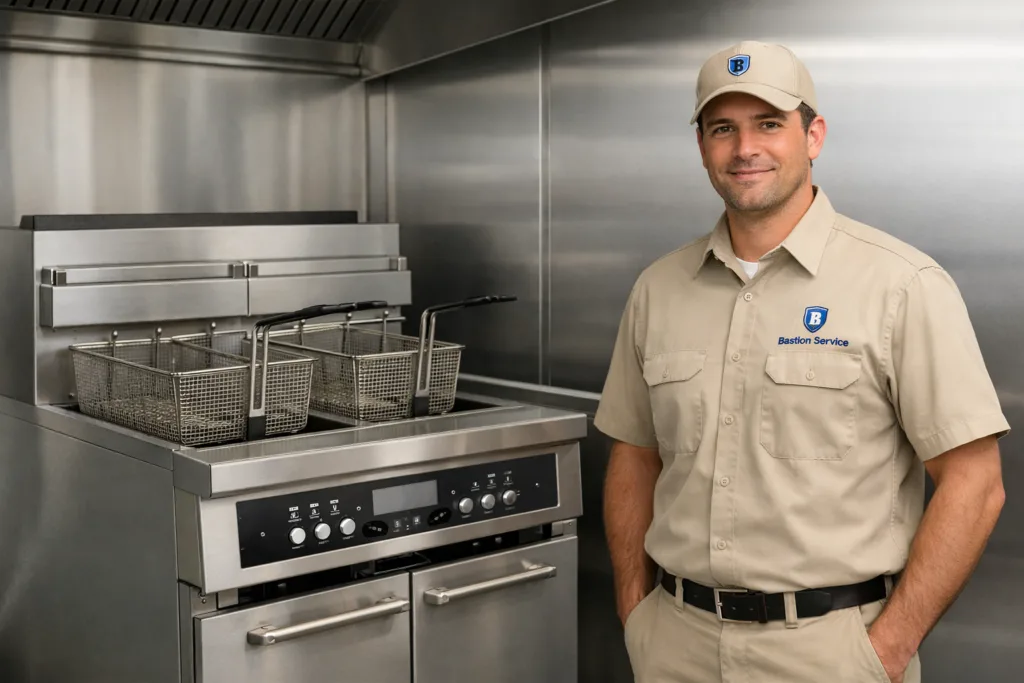




Fryer trouble can disrupt batch timing, strain staffing, and create avoidable product loss, so service needs to focus on the exact failure pattern rather than assumptions. For businesses in Century City, the most useful repair visit is one that identifies whether the problem is tied to ignition, heat production, sensing, controls, filtration, or a developing wear issue that is affecting daily output. Bastion Service handles Frymaster fryer repairs with that service-first approach so managers can make informed scheduling and repair decisions instead of chasing recurring symptoms.
Related commercial service paths in Century City include Frymaster Commercial Repair in Century City, Commercial Fryer Repair in Century City, and Pitco Fryer Repair in Century City.
How Frymaster fryer problems usually show up in daily operation
Many fryer issues do not begin as a complete shutdown. They often start with slower recovery between baskets, drifting oil temperature, inconsistent browning, delayed ignition, nuisance lockouts, or staff noticing that one vat no longer behaves like the others. Those symptoms matter because they affect ticket times, oil life, and cooking consistency long before the unit stops running entirely.
On a Frymaster fryer, similar complaints can come from very different causes. A fryer that seems slow to heat may have an ignition problem, a weak heating cycle, a sensing error, a control issue, or a limit condition interrupting normal operation. That is why symptom-based diagnosis is more useful than replacing parts based only on the first visible fault.
Why a fryer may stop heating or recover too slowly
If the fryer is not reaching set temperature or takes too long to recover after a batch, the issue may involve the heating system, ignition sequence, temperature probe feedback, control response, safety limits, or incoming power. In a high-use kitchen, slow recovery usually appears as delayed cook times, uneven product finish, and staff having to wait longer between loads.
Recovery problems are especially important when the fryer still appears to work but cannot keep up with normal production. In that situation, the unit may be cycling incorrectly, struggling to sustain heat, or reading oil temperature inaccurately. A proper repair decision depends on confirming whether the fryer is failing to generate heat, failing to hold heat, or failing to recognize actual oil conditions correctly.
Common causes behind no-heat or slow-recovery complaints
- Ignition components not establishing or sustaining flame correctly
- Temperature sensing errors causing incorrect control decisions
- High-limit or safety-related interruption of normal heating
- Control faults affecting burner or heating response
- Electrical supply or wiring issues creating intermittent operation
- Restricted performance that becomes more obvious under load
Oil temperature swings and inconsistent cooking results
When oil runs hotter or cooler than expected, food quality usually shows it first. Product may come out darker than normal, absorb more oil, or require longer cook times even when staff are using the usual settings. Temperature instability can also shorten oil life and make production less predictable during busy periods.
On a Frymaster fryer, this kind of complaint often leads to inspection of the probe, control calibration, control board behavior, and overall heat response. The important distinction is whether the fryer is actually overheating, actually underheating, or only displaying inaccurate information. Those are different repair paths, and each affects whether the fryer can remain in active use while parts or follow-up work are being planned.
Ignition failure, burner trouble, and repeated lockouts
Gas fryer problems often show up as delayed ignition, failure to light, short cycling, weak burner performance, or repeated lockout conditions. These symptoms can reduce capacity quickly because the fryer may appear ready one moment and then drop out of service during production. Unstable ignition also creates a situation that should be checked promptly rather than worked around by staff.
Diagnosis typically focuses on whether the fryer is completing the ignition sequence properly, sensing flame consistently, and receiving the response the control system expects. Burner-related complaints may also involve uneven heating behavior, poor recovery, or shutdowns that occur only after the unit has been running for a period of time.
Signs the issue may be ignition or burner related
- The fryer attempts to start but does not establish heat
- Heat comes on briefly and then drops out
- The unit locks out or must be reset repeatedly
- Recovery is weak even when the fryer does light
- Performance becomes worse after the fryer has been operating for a while
Control faults, error codes, and intermittent shutdowns
Intermittent fryer problems are some of the most frustrating because the unit may behave normally during part of the day and fail during peak use. A Frymaster fryer may display fault codes, stop heating without warning, reset unexpectedly, or fall out of temperature control after operating for a period of time. These issues can point to sensor faults, control instability, wiring degradation, overheating protection, or failures that appear only under heat stress.
When a unit is shutting down unpredictably, repair should focus on reproducing the condition as accurately as possible and narrowing down what changes once the fryer is hot and under load. That is often the difference between a durable repair and a short-lived one.
Leaks, drain valve issues, and filtration-related problems
Oil leaks and filtration problems should be addressed early, even if the fryer still heats. What begins as a valve, seal, pan, or connection problem can turn into a larger cleanup issue, a safety concern, or added wear on nearby components. Filtration faults also affect oil management, labor time, and the consistency of routine kitchen procedures.
If the fryer is leaking, the service question is not only where the oil is coming from, but whether the surrounding parts remain in good enough condition for a straightforward repair. The same applies to drain-related issues. A repairable valve or seal problem is different from a situation where multiple high-use components have deteriorated together.
When to take a Frymaster fryer out of rotation and schedule repair
Service should be scheduled as soon as the fryer is no longer maintaining set temperature, recovery time has clearly slowed, the burner is not operating reliably, error conditions are recurring, filtration is not functioning as expected, or oil leakage is present. A fryer does not have to be fully down to be costly. Reduced output, inconsistent cooking, excess oil waste, and workarounds by staff all add up quickly.
It is also wise to stop using the fryer if it is overheating, shutting off without warning, failing ignition repeatedly, or leaking oil. Continuing to push the equipment under those conditions can increase repair scope and create more downtime than an earlier service call would have required.
Repair versus replacement for a Frymaster fryer
Many Frymaster fryer issues are worth repairing when the problem is isolated and the rest of the unit remains structurally sound. If diagnosis points to a defined fault and the fryer tank, controls, cabinet condition, and service history support continued use, repair is often the better operational decision.
Replacement becomes more likely when there are repeated failures across multiple systems, ongoing temperature inconsistency after prior work, serious wear, or repair costs that no longer fit the fryer’s remaining value in the kitchen. For businesses in Century City running tight production schedules, the key question is not just whether the fryer can be repaired, but whether it can return to reliable service without repeated interruptions.
What to have ready before a service visit
Helpful details can shorten diagnosis time and make the visit more productive. If possible, note whether the fryer fails on startup, during heat-up, after a batch, or only later in the day. It also helps to record any displayed error messages, unusual noises, repeated resets, visible leaks, or changes in recovery performance.
- When the issue started and whether it is constant or intermittent
- Whether the fryer affects all vats or only one section
- If the unit will ignite, partially heat, or not heat at all
- Any fault code or shutdown pattern staff have observed
- Whether oil temperature seems inaccurate or unstable
- If leaks, drain problems, or filtration issues are also present
Service-focused next steps for Century City businesses
When a Frymaster fryer begins slowing production, drifting out of temperature, or dropping into repeated faults, the best next step is to schedule repair based on the actual symptoms the unit is showing. For Century City businesses, that means treating the fryer as an equipment reliability issue, not just a nuisance that staff have to work around. The goal of service is to identify the fault, determine whether repair is the sensible path, and get the unit back into dependable operation with as little disruption as possible.


