
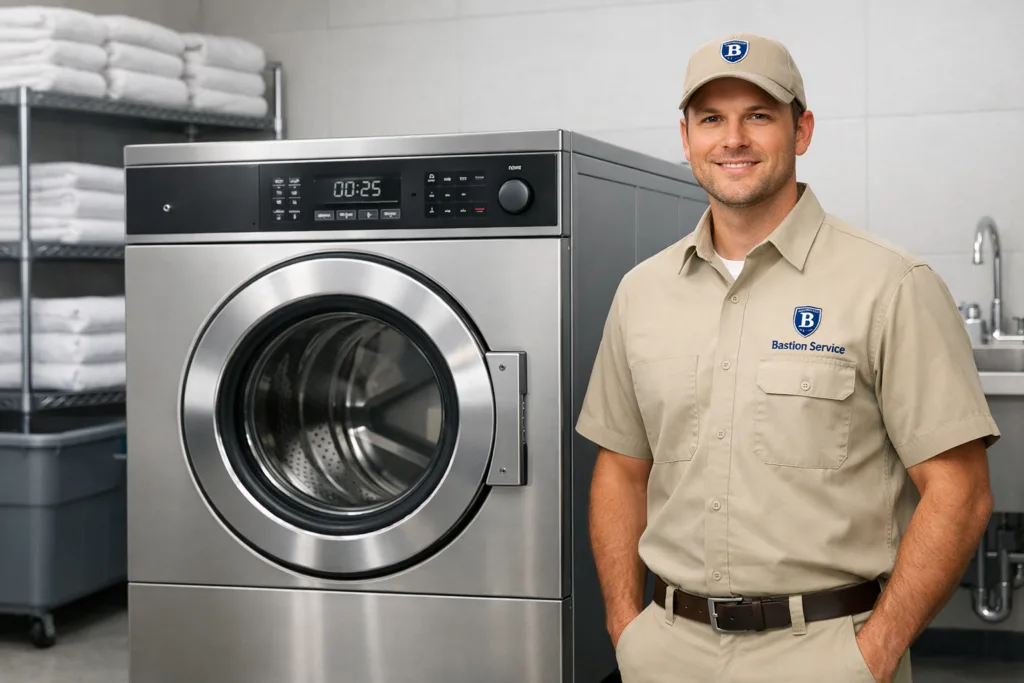




Commercial washers rarely fail in a way that is completely random. More often, the first sign is a change in cycle behavior, extraction quality, water handling, or noise level. In a business environment, those changes can slow linen turnover, create workarounds for staff, and put added strain on the rest of the laundry process if the machine stays in use without diagnosis.
Related commercial equipment paths in El Segundo include Speed Queen Washer Repair in El Segundo and Wascomat Washer Repair in El Segundo.
Commercial washer issues that usually need prompt attention
Drain failures, weak spin performance, fill problems, and intermittent cycle stoppages are among the most common complaints because they directly affect throughput. A washer that leaves loads overly wet may have a drain restriction, pump problem, balance-related interruption, drive issue, or a control fault preventing full extraction. Similar symptoms can come from different systems, which is why the repair path should start with testing rather than assumption.
Leaks are another issue that should be addressed early. Water on the floor may be coming from a hose connection, pump housing, door seal, internal tub component, or an oversudsing condition that looks like a hardware failure. In commercial settings, even a small leak can become a safety issue and can also lead to damage around the machine base, adjacent equipment, or utility connections.
Noise and vibration matter as much as outright failure. Banging, scraping, grinding, or aggressive machine movement may point to worn suspension parts, bearing wear, mounting problems, or load-balance faults. If a washer starts walking, shifting, or striking the cabinet during spin, the problem should be checked before continued operation turns a serviceable repair into broader mechanical damage.
What common symptoms can mean
Washer not draining or finishing the cycle
When a unit stalls with water still in the basket, the problem may involve the drain pump, drain path, lid or door lock system, or the control sequence that should advance the machine into spin. In some cases, staff may notice repeated attempts to drain, unusually long cycle times, or error codes that appear only under full-load conditions. Those patterns usually indicate a fault that is already affecting normal operation, not just a one-time interruption.
Loads coming out too wet
Poor extraction often gets blamed on a spin problem alone, but the cause may be upstream. If the washer cannot drain fast enough, cannot verify safe lock conditions, or senses imbalance repeatedly, it may reduce or skip final spin speed. The result is slower drying, more labor handling damp goods, and unnecessary bottlenecks across the laundry line. If the slowdown shows up mainly after washing and during dry time, Commercial Dryer Repair in El Segundo may also be relevant for the other half of the workflow.
Slow fill, overfill, or inconsistent water levels
Washers that fill too slowly can be affected by inlet valve restrictions, water supply issues, clogged screens, or control-related faults. Overfilling or inconsistent levels may point to valve failures, pressure sensing issues, or a problem in the machine logic that regulates the cycle. In a commercial operation, those water-related issues can lead to poor wash quality, wasted utilities, and repeated rewash loads.
Machine stops mid-cycle
A washer that starts normally but pauses before rinse or spin may be reacting to a safety interlock problem, communication fault, drain issue, or motor/control problem that only appears under load. Intermittent stoppages are especially disruptive because they create uncertainty for staff and make scheduling harder. If employees are restarting cycles manually or redistributing loads to get through the day, the machine is already costing time beyond the repair itself.
Leaks, odors, and breaker trips
Leaks should be evaluated alongside any unusual smell, visible residue, or electrical interruption. A burning odor can suggest a stressed motor, belt issue, wiring problem, or overheated component. A breaker trip may involve the washer, but it can also reflect a larger electrical condition that needs coordinated review. These symptoms call for caution because they may affect both equipment reliability and workplace safety.
How washer problems affect business operations
Commercial laundry equipment is part of a system, not a standalone convenience appliance. When one washer underperforms, the impact spreads into delayed transfers, overloaded companion machines, staff workarounds, and longer turnaround times for linens, uniforms, towels, or other washable inventory. A machine that still runs but no longer completes cycles correctly can be more disruptive than one that is fully offline because it creates uncertainty and rework throughout the shift.
That is why symptom tracking is useful before service begins. Noting whether the issue appears at fill, wash, drain, rinse, or final spin can help narrow the likely fault. It also helps to record whether the problem occurs on every load, only on heavier loads, or only during certain program selections. Those details can shorten diagnostic time and help distinguish between control problems, mechanical wear, and installation or utility-related issues.
When to schedule commercial washer repair in El Segundo
Service is usually worth scheduling promptly when the washer leaks, fails to drain, leaves repeated loads wet, stops mid-cycle, trips protection devices, produces new mechanical noise, or shows fault codes that return after reset. Continued operation under those conditions can increase wear on pumps, motors, bearings, door systems, and controls. It can also create avoidable strain on the rest of the laundry lineup.
Businesses in El Segundo should also pay attention to subtle changes, not only full stoppages. Longer cycle times, uneven extraction, inconsistent water temperature, and rising vibration are often early indicators that the machine is moving out of normal operating range. Catching those issues earlier can reduce downtime and help avoid secondary damage.
Repair versus replacement considerations
The repair-versus-replacement decision usually depends on the machine’s overall condition, service history, age, parts availability, and whether the current failure is isolated or part of a larger pattern. A targeted repair often makes sense when the main fault is limited to one system and the rest of the washer remains structurally sound. Replacement becomes a stronger consideration when there is major tub or bearing wear, repeated failures across multiple systems, or costs that no longer match the remaining useful life of the unit.
A proper diagnosis helps separate those situations. Instead of treating every leak, drain problem, or spin complaint as the same issue, the goal is to identify the failed components, check for secondary wear, and determine whether the machine can return to stable commercial use without recurring interruption. For businesses managing uptime closely, that kind of evaluation supports better planning and fewer surprises.


