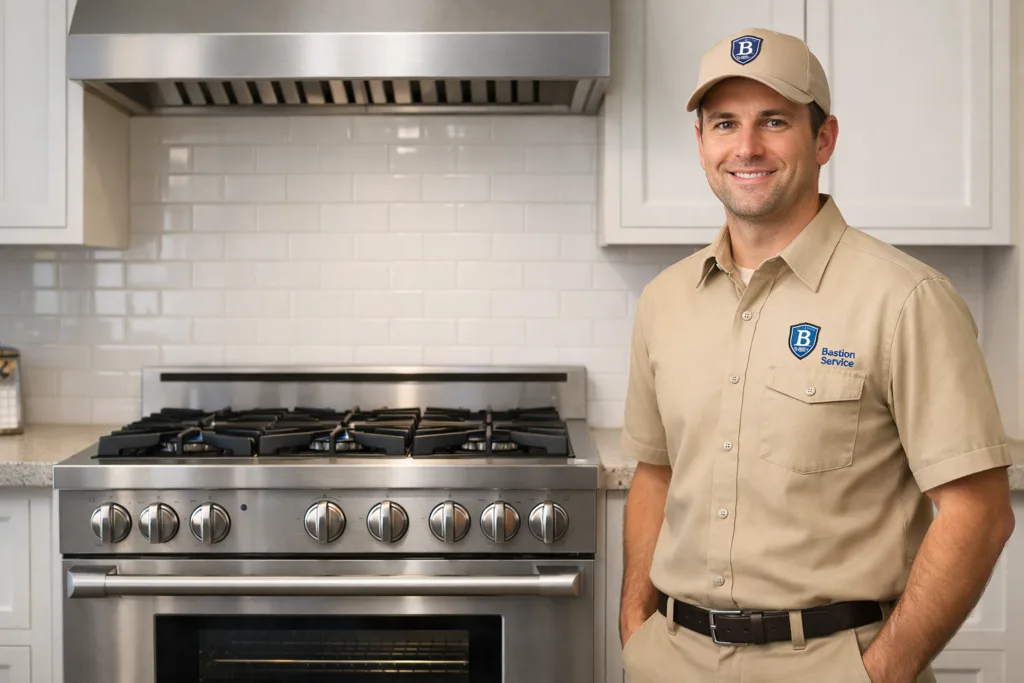
Cooking problems with a Wolf range often start as small annoyances and then become daily disruptions. A front burner may click several times before lighting, the oven may take longer to preheat, or temperatures may feel less predictable from one meal to the next. Because these symptoms can come from more than one failing part, the most useful first step is to match the behavior of the appliance to the most likely repair path.
Common Wolf range symptoms and what they can mean
Wolf ranges are built for precise cooking, so changes in ignition, flame quality, or oven performance usually show up quickly in regular household use. One symptom does not always point to one part, but the pattern of the problem often narrows the diagnosis.
Burner clicking but not lighting
If a burner clicks repeatedly and does not ignite, the issue may be related to the igniter, burner cap placement, moisture around the burner head, a spark module problem, or a fuel delivery issue. Sometimes the burner will light after several attempts, which can make the problem seem minor, but inconsistent ignition usually gets worse rather than better.
Homeowners in Marina del Rey often notice this problem after cleaning, after a spill, or after a period of normal use with no obvious cause. If the clicking continues without ignition, the range should be checked before the symptom becomes more disruptive.
Burner lights, but the flame is weak or uneven
A burner that ignites but does not heat properly may have clogged ports, misalignment, or a problem affecting gas flow. You may see flames that look smaller than usual, flames that are uneven around the burner ring, or heating that no longer matches the knob setting. This can make simmering difficult and can also affect high-heat cooking performance.
Oven preheats slowly
Slow preheat is one of the most common complaints with a range oven. On a Wolf range, this can point to a weak igniter, a heating component issue, a sensor problem, or a control-related fault. The oven may still eventually reach temperature, which sometimes leads people to postpone service, but delayed ignition or weak heat output usually affects cooking consistency long before the oven stops working completely.
Oven temperature is off
If food is coming out undercooked, overbrowned, or finishing at unexpected times, the oven may not be holding the selected temperature accurately. That can come from sensor drift, calibration issues, control failure, or uneven heat response inside the cavity. Premium cooking equipment tends to make these problems easier to notice because small temperature differences can affect results right away.
Broiler or bake function not working properly
When one cooking mode works and another does not, the problem may be limited to a specific heating circuit, igniter, relay, or control function. For example, the cooktop may perform normally while the oven bake feature struggles, or the broiler may not respond at all. That symptom split is useful because it helps isolate which system needs attention.
Display, controls, or power problems
If the display is blank, settings do not respond, or the range loses power intermittently, the cause may involve wiring, terminal connections, control boards, or the electrical supply feeding the unit. These issues can seem random, but they often follow a pattern, such as failure during preheat, trouble after the unit has been on for a while, or controls that stop responding only in certain modes.
Signs the problem should not be ignored
Some range issues are inconvenient. Others raise safety concerns or can lead to larger repairs if the appliance keeps being used in the same condition. It is smart to stop and evaluate the range if you notice any of the following:
- Repeated clicking that continues after the burner should have lit
- A burner that only ignites occasionally
- Strong temperature swings during baking or roasting
- An oven that overheats or shuts off unexpectedly
- A control panel that behaves erratically
- A persistent gas smell
If there is a strong or ongoing gas odor, do not keep testing the range. Stop using the appliance and take appropriate gas safety steps before arranging service.
Why intermittent symptoms are worth scheduling early
Intermittent range problems are easy to put off because the appliance may appear to recover on its own. A burner may fail in the morning and work fine at dinner. The oven may heat correctly one day and lag the next. In reality, that inconsistency often points to a component that is weakening, a connection that is becoming unstable, or a control issue that will become more frequent over time.
Early diagnosis can help prevent the household from losing cooking use at a more inconvenient moment. It can also reduce the chance of replacing multiple parts based on guesswork when one failing component is actually creating several related symptoms.
What homeowners can check before service
There are a few simple observations that can help make the problem easier to identify. These are not repairs, but they can help describe the symptom more clearly.
- Check whether the problem affects one burner or several
- Note whether clicking happens constantly or only sometimes
- Watch whether the oven struggles during preheat, during baking, or both
- Pay attention to whether the display resets, flickers, or shows unusual behavior
- Notice whether the issue appears after cleaning, spills, or heavy cooking use
Even these small details can help separate an ignition problem from a control problem, or a heating issue from a power-related one.
Repair versus replacement for a Wolf range
In many homes, repair is still the sensible option when the issue is limited to ignition parts, sensors, control components, wiring-related faults, or other serviceable systems. Wolf ranges are premium appliances, and many common failures can be addressed without replacing the entire unit.
Replacement becomes more worth discussing when multiple major systems are failing at once, when the appliance has broader wear beyond the current symptom, or when the cost of restoring reliable operation no longer matches the condition of the range. The better comparison is not based on age alone. It depends on overall performance, the exact failure involved, and whether one repair is likely to return the range to steady daily use.
What a useful service visit should accomplish
A worthwhile appointment should do more than respond to the surface complaint. If a burner clicks, the visit should determine why it clicks. If the oven runs cool, the testing should identify whether the cause is ignition, sensing, heat production, or control response. If the range powers on and off unpredictably, the inspection should look beyond the display and into the supporting electrical path.
For homeowners in Marina del Rey, that means leaving the visit with a direct explanation of the fault, the recommended repair, and whether continued use is reasonable before the work is completed. That kind of practical repair guidance helps you decide whether to move forward now, plan for a targeted repair, or reconsider the appliance based on its broader condition.
Household situations where prompt range repair matters most
Some homes can work around a single weak burner for a short time. Others depend on the range every day for family meals, batch cooking, or frequent baking. Prompt repair becomes especially important when the appliance is central to the household routine, when oven results are no longer trustworthy, or when ignition problems make normal cooking stressful.
In Marina del Rey, homeowners often seek service when the range still works partially but not reliably enough for everyday use. That is usually the right moment to act, because the appliance is still giving useful symptom information and the repair path is often clearer than it is after a complete failure.