
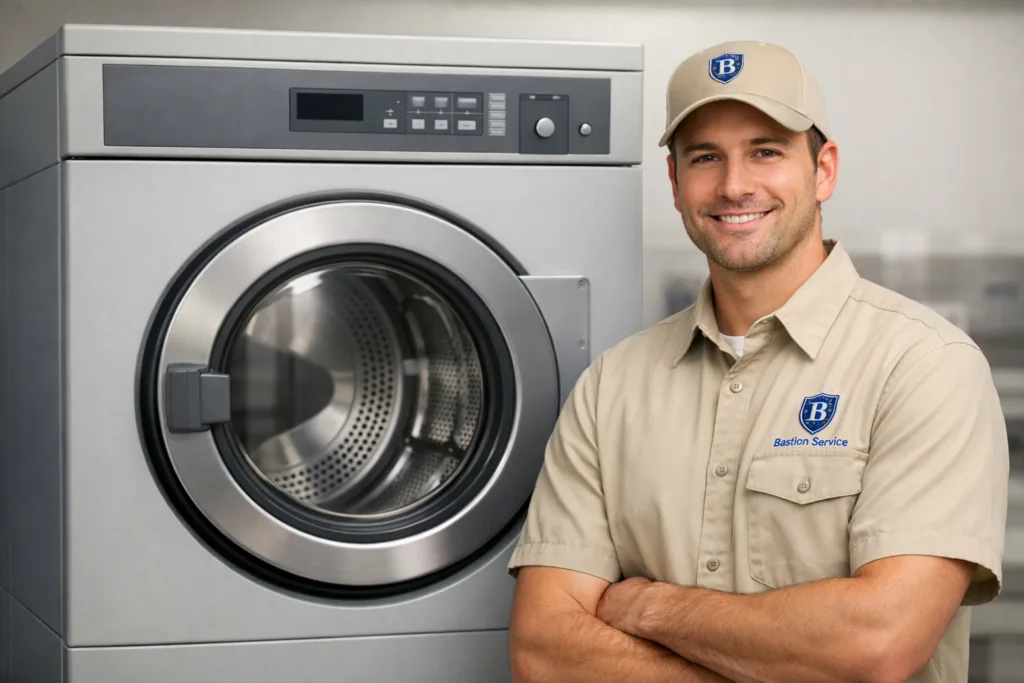




Wascomat dryer problems can disrupt load flow quickly when drying time becomes unpredictable, cycles stop early, or heat output changes from one load to the next. For businesses in Cheviot Hills, service is most effective when the machine is evaluated by symptom first, then tested to determine whether the problem is tied to airflow, heat production, controls, drive components, or a safety shutdown. Bastion Service provides Wascomat dryer repair for business settings where uptime, turnaround, and safe operation matter day to day.
Related commercial service paths in Cheviot Hills include Wascomat Commercial Repair in Cheviot Hills, Commercial Dryer Repair in Cheviot Hills, and Wascomat Washer Repair in Cheviot Hills.
What a symptom-based Wascomat dryer repair visit should address
A dryer may appear to have one obvious problem while the actual cause sits elsewhere in the system. A unit that seems to have lost heat may be dealing with restricted exhaust. A machine that stops mid-cycle may be protecting itself from overheating. A loud dryer may still run, but worn support or drive parts can continue damaging related components with every load.
That is why repair decisions should be based on testing and inspection rather than replacing the first part that seems likely. In many Cheviot Hills laundry operations, the right diagnosis can prevent repeat downtime, unnecessary parts costs, and additional strain on other machines handling overflow loads.
Common Wascomat dryer symptoms and what they often mean
No heat or weak heat
If the drum turns but fabrics remain damp, the problem may involve the heating circuit, temperature controls, ignition-related components, airflow restriction, or a high-limit condition. Weak heat can be just as disruptive as no heat because the dryer still appears to operate while productivity drops in the background.
Staff often notice this issue first as longer dry times, repeated cycle restarts, or loads that come out warmer than usual but not actually dry. Those patterns usually point to a machine that needs service before a complete heating failure develops.
Long dry times
Extended dry times are not always caused by a failed heater. Airflow restrictions, lint accumulation in critical paths, cycling problems, sensor issues, and temperature regulation faults can all lengthen the time needed to finish a load. If a Wascomat dryer is taking much longer than normal, the unit should be checked as a system rather than treated as a simple heat complaint.
For businesses in Cheviot Hills, this symptom often creates bottlenecks long before the dryer stops working altogether. Wash loads back up, staff rerun cycles, and available machine time becomes harder to manage.
Dryer stops before the cycle finishes
Mid-cycle shutdowns can result from overheating protection, motor issues, door switch faults, control failures, or intermittent electrical problems within the machine. A dryer that restarts later does not necessarily mean the issue has passed. Intermittent shutdowns often become more frequent as components weaken under normal operating demand.
When this happens repeatedly, continued use can increase wear on motors, belts, and heat-related parts while also making the machine less dependable during busy periods.
No start or inconsistent starting
If the dryer will not start at all, starts only sometimes, or requires repeated attempts, the issue may involve the door switch, start circuit, control interface, power-related components, or other electrical faults. This kind of failure can seem minor at first, especially if staff can eventually get the machine running, but intermittent starting usually signals a condition that should be addressed before the unit becomes unavailable.
Noise, vibration, or rough tumbling
Thumping, squealing, scraping, grinding, or unusual cabinet movement usually indicates mechanical wear. Support rollers, belts, pulleys, bearings, motor-related components, or drum support issues can all create noise that gets worse with continued operation.
These sounds should not be dismissed as normal aging. A dryer that is noisy but still usable can shift into a larger repair once worn parts begin affecting alignment, rotation, or motor load.
Overheating, burning odor, or repeated safety trips
These are high-priority symptoms. Restricted airflow, lint buildup, failing controls, or mechanical drag can push temperatures beyond normal operating range. Repeated resets or repeated overheating are signs that the underlying cause has not been corrected.
If a Wascomat dryer shows these symptoms, it is wise to limit use until the machine is inspected. In a business setting, trying to push through the issue can increase both safety risk and repair scope.
Why airflow problems are often mistaken for heat failure
One of the most common dryer complaints is “it is not heating,” even when the heating system is still partially working. Poor exhaust flow can trap hot air, disrupt normal temperature cycling, and cause the machine to dry slowly, overheat, or shut down on a safety condition. From the operator’s perspective, it may look like low heat when the real issue is that moisture is not being removed efficiently.
This matters because replacing heat-related parts without confirming airflow can leave the original problem untouched. A proper repair approach checks how the dryer is producing heat, how it is moving air, and how it is responding to load conditions during operation.
How overlapping symptoms can affect repair decisions
Wascomat dryer failures do not always present as one clean, isolated issue. A single site may report longer dry times, occasional shutdowns, and a new squeal all at once. Those symptoms can be related or completely separate, and the right recommendation depends on identifying the failure pattern accurately.
Examples of overlap include:
- Long dry times combined with overheating caused by restricted airflow
- Noise and shutdowns linked to drag in the drive system
- Inconsistent heat paired with cycling or control regulation problems
- No-start complaints caused by an electrical fault rather than a failed motor
- Damp loads caused by sensor or temperature-control issues rather than a full no-heat condition
When symptoms are evaluated together instead of one at a time, repair planning is usually more accurate and more cost-effective.
When to schedule Wascomat dryer service
It is usually better to schedule service when a repeat symptom first appears rather than waiting for total failure. Early attention can help avoid larger mechanical damage and reduce disruption to laundry throughput.
Scheduling service makes sense when you notice:
- Loads taking longer than normal to dry
- Heat that seems too low, too high, or inconsistent
- Cycles ending before the load is finished
- The dryer not starting reliably
- New squealing, grinding, thumping, or vibration
- A burning smell or signs of overheating
- Frequent staff workarounds just to keep loads moving
For many businesses in Cheviot Hills, these are not minor nuisances. They are signs that the dryer is already affecting scheduling, staffing, and equipment availability.
When continued use may increase damage
A dryer that still runs can still be in a failure state. Belts can slip, motors can overwork, supports can wear unevenly, and heat-related components can cycle outside normal limits even while the unit appears functional. Continued operation under those conditions may turn a manageable repair into a more expensive one.
If the machine is overheating, making strong mechanical noise, shutting down repeatedly, or producing poor drying results despite repeated cycles, reducing use until it is inspected is often the better decision for protecting the equipment and limiting downtime.
Repair or replace: what usually matters most
Many Wascomat dryer issues are repairable when the failure is isolated and the overall machine condition remains solid. Replacement becomes a more serious consideration when the dryer has repeated downtime history, multiple major system issues, or repair costs that no longer support reliable continued use.
The decision often comes down to:
- Whether the problem is limited to one system or spread across several
- How often the unit has needed service recently
- The expected reliability after repair
- The machine’s importance to daily workflow
- The cost of outage time compared with the cost of replacement
For many operations, the best first step is still diagnosis. Once the actual fault and overall condition are known, it becomes much easier to choose between targeted repair and a broader equipment decision.
How to prepare for a dryer service visit
Before service is scheduled, it helps to note the exact symptom pattern rather than describing the issue only as “not working.” Useful details include whether the dryer tumbles, whether it heats at all, how long the problem has been happening, whether it fails on every load or only some loads, and whether staff have noticed odors, shutdowns, or unusual sounds.
It is also helpful to identify whether the issue affects one unit or several, and whether the problem appeared suddenly or gradually. That information can shorten diagnosis time and help focus the inspection on the systems most likely involved.
Service focused on restoring reliable drying performance
Wascomat dryer repair in Cheviot Hills should do more than get a machine running for the moment. The goal is to identify why the dryer is underperforming, determine whether related wear is present, and recommend the next step based on actual operating condition. If your dryer is not heating, taking too long to dry, stopping early, or showing signs of mechanical wear, scheduling service promptly is the most practical way to reduce downtime and return the laundry line to stable operation.


