
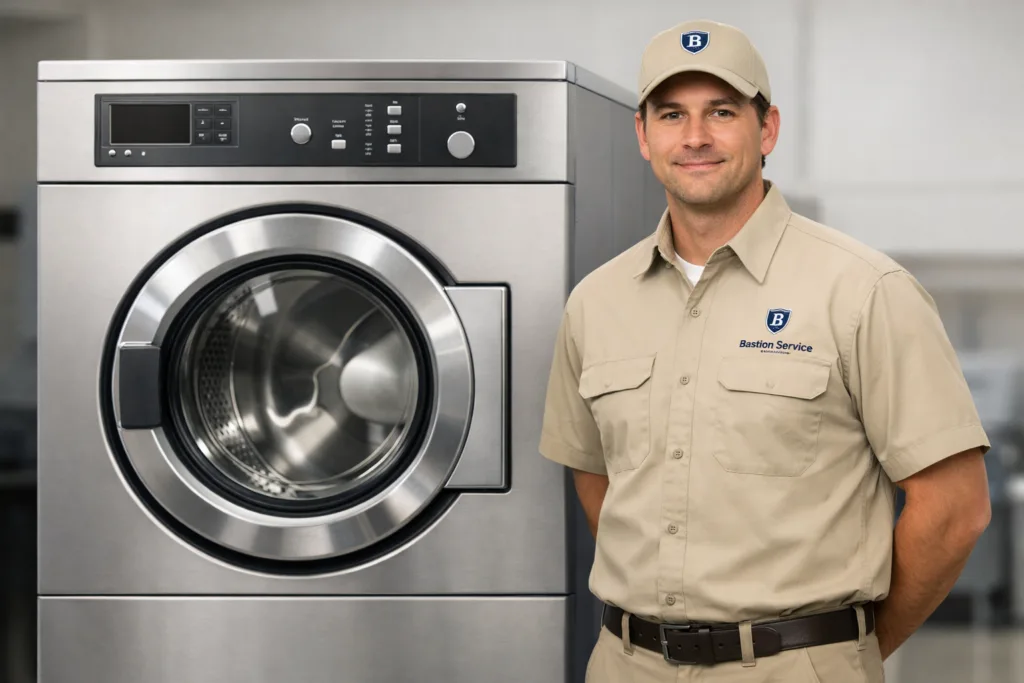




Dryer problems can slow production fast when loads are stacking up, customers are waiting, or staff have to re-run cycles that should have finished the first time. For businesses in Brentwood, the most useful service call starts by matching the exact symptom pattern to the most likely failure points so the repair solves the operating problem, not just the visible complaint. Bastion Service handles Wascomat dryer issues with attention to heat output, airflow, drum movement, controls, safety shutoffs, and the wear conditions that often develop before a full breakdown.
Related commercial service paths in Brentwood include Wascomat Commercial Repair in Brentwood, Commercial Dryer Repair in Brentwood, and Wascomat Washer Repair in Brentwood.
How Wascomat dryer issues usually show up in daily operations
A Wascomat dryer does not need to be completely down to create expensive disruption. Many units keep running while performance drops in ways that affect workflow: longer dry times, uneven results, repeated restarts, rising temperatures, or new sounds during the cycle. In a busy laundry room, hotel, care facility, or laundromat, those changes usually mean the machine needs service before the problem spreads into larger downtime.
Symptom-based diagnosis matters because the same complaint can come from different causes. A dryer that is not drying well may have an airflow restriction, a heating failure, a control problem, moisture-sensing issues, or a mechanical condition that prevents the machine from operating at normal temperature and airflow balance. Pinpointing the source is what makes the repair decision more efficient.
Why a Wascomat dryer may stop heating or fail to finish properly
Runs but produces little or no heat
If the drum turns but loads remain wet, the issue may involve the heating system, temperature controls, airflow restrictions, limit devices, ignition-related components, or wiring faults. This often appears first as complaints that one machine is taking much longer than the others. In some cases, the dryer still produces some warmth, but not enough to complete the cycle on time.
Heats up, but takes too long to dry
Long dry times often point to weak airflow, partial heat loss, restricted exhaust movement, sensor misreading, or cycling that is not staying in the proper range. This kind of problem reduces throughput even before staff recognize it as a repair issue. If attendants are increasing dry times, splitting loads differently, or running items twice, the dryer is already affecting productivity.
Stops before the cycle should end
A Wascomat dryer that shuts down mid-cycle may be overheating, tripping a protective limit, losing stable motor operation, or dealing with a control fault. Repeated stopping is not something to ignore. If the unit must cool down before it restarts, that usually points to an operating condition that can worsen with continued use.
Noise, drum, and movement problems that need attention
Drum will not turn
If the dryer powers on but the drum does not rotate, likely causes may include belt failure, motor trouble, worn support parts, idler issues, or a seized mechanical component. A no-turn condition can quickly take the machine out of rotation and should be checked before repeated start attempts cause additional strain.
Squealing, thumping, grinding, or scraping
Abnormal sounds are often early warning signs of wear in rollers, bearings, supports, the belt path, or the drum assembly. A dryer may still complete cycles while making noise, but that does not mean the problem is minor. Mechanical wear tends to spread, and a relatively limited repair can become more involved if the machine keeps running under stress.
Vibration or rough operation
Unusual vibration can come from worn drum supports, alignment problems, load-related stress, or loosened internal components. When the machine starts feeling different during operation, that is often the right time to schedule service rather than waiting for a complete stop.
Airflow and overheating symptoms that should not be delayed
Dryers depend on proper airflow as much as they depend on heat. If air is not moving correctly, temperatures can rise where they should not, moisture removal drops, and cycle times become inconsistent. A Wascomat dryer with restricted airflow may show up as slow drying, cabinet heat, safety shutoffs, or loads that come out hotter than expected but still damp.
Service should be prioritized if staff notice any of the following:
- Burning odor during or after the cycle
- Excessive heat around the machine cabinet
- Frequent overheating or thermal shutdowns
- Very long dry times despite visible heat
- Repeated lint or airflow-related performance issues
These symptoms can point to blocked airflow paths, failing temperature regulation, friction from worn moving parts, or electrical trouble. Continued operation under those conditions can increase repair scope and create avoidable safety concerns.
Control and sensor problems that create inconsistent results
Some Wascomat dryer complaints are not strictly heat or mechanical failures. A machine may have unresponsive controls, inconsistent cycle completion, interrupted programs, or display faults that make operation unpredictable. In those cases, the cause may involve sensors, control boards, wiring, switches, or communication faults within the machine.
Control-related issues can be especially frustrating because the dryer may work normally on one load and fail on the next. That inconsistency often leads staff to assume operator error or random behavior when the real issue is an electrical or sensor fault that needs testing.
When the machine is still running but service should be scheduled
Many businesses wait until the dryer stops completely, but the better time to schedule repair is when the pattern becomes repeatable. If one unit is always slower, louder, hotter, or less reliable than the others, that machine is already affecting output. Early service can help avoid added wear to the motor system, drum supports, heating components, and controls.
It is usually time to book service when:
- Loads stay damp after a normal cycle
- Dry times are getting longer week by week
- The dryer stops and restarts unpredictably
- Staff hear new noise during tumbling
- Temperatures seem too high or too low
- The machine shows intermittent errors or control issues
Repair or replace: how to think about the decision
Not every Wascomat dryer problem points to replacement. Many failures are limited to serviceable parts and can be corrected economically if the cabinet, drum, and major systems are otherwise in good condition. The decision usually depends on the unit’s age, maintenance history, part availability, the number of systems involved, and whether the problem is isolated or part of a broader wear pattern.
Repair is often the better choice when the fault is clearly defined and the machine has otherwise supported daily operations well. Replacement becomes a stronger consideration when there are repeated breakdowns, overlapping failures, or signs that the dryer can no longer keep up with the demands placed on it in Brentwood.
What to have ready before a service visit
A few details can make diagnosis faster and help the repair move in the right direction. If possible, note the exact symptom, when it started, whether the problem is constant or intermittent, and whether the dryer completes any part of the cycle normally. It also helps to know if the machine is heating at all, whether the drum is turning, and whether the issue appears with every load or only some loads.
Useful information includes:
- Whether the dryer has no heat, weak heat, or overheats
- Approximate cycle length compared with normal operation
- Any error code or unusual display behavior
- New sounds such as squealing, grinding, or thumping
- Whether the machine stops mid-cycle or fails to start
- Any noticeable odor, excess cabinet heat, or airflow concern
Service focused on restoring reliable dryer performance
Wascomat dryer repair should help a business decide what failed, whether the unit should stay in service, and what repair path makes the most sense for uptime and cost control. When a dryer in Brentwood starts missing heat, running too long, stopping mid-cycle, or developing drum and airflow problems, the next step is to schedule service before the issue creates more downtime, more labor, and more strain on the rest of the laundry operation.


