
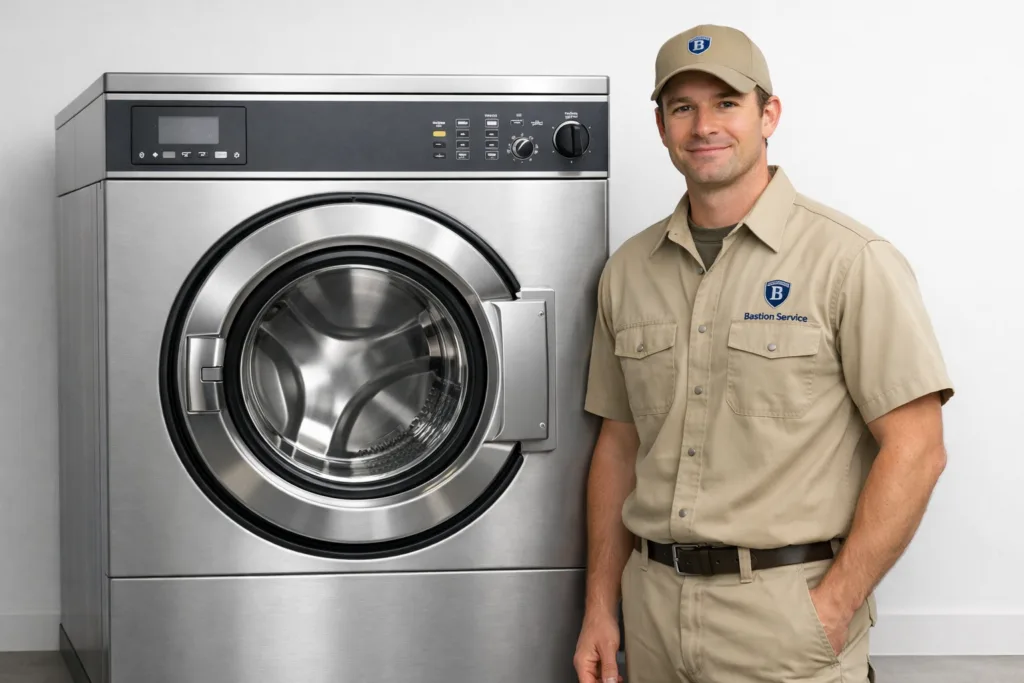




When laundry equipment begins causing missed turns, stalled loads, or unpredictable drying results, service decisions need to happen quickly. In laundromats, shared laundry rooms, hotels, and other Brentwood businesses, a washer or dryer problem can affect staff workflow, customer experience, and same-day output. Bastion Service evaluates Wascomat equipment based on the actual symptom pattern, the urgency of the interruption, and whether the unit can stay in operation until repair is completed.
For specific equipment paths in Brentwood, review Wascomat Washer Repair in Brentwood, Wascomat Dryer Repair in Brentwood, and Commercial Appliance Repair in Brentwood.
How washer and dryer issues affect daily operations
Wascomat laundry equipment problems rarely stay isolated for long. One washer that stops mid-cycle can leave wet loads waiting for rewash or transfer. One dryer with weak heat or long cycle times can slow the entire finishing side of the room. Even when a machine still runs, reduced performance often leads to longer processing times, more staff intervention, and avoidable strain on the rest of the equipment lineup.
That is why symptom-based repair matters. A leak, drain problem, vibration issue, no-heat complaint, or repeated fault code may come from very different causes. The goal of a service visit is to identify what is failing, what other components may be affected, and whether the repair is likely to restore stable operation without repeated callbacks.
Wascomat washer symptoms that usually need repair attention
Washer will not start or stops before the cycle finishes
If a washer does not begin a cycle, pauses unexpectedly, or shuts down with water still in the drum, the issue may involve door lock assemblies, control problems, power supply faults, fill problems, or other internal failures. In a business setting, repeated cycle interruption is more than an inconvenience. It creates load handling delays and often leads to staff repeatedly resetting the machine just to complete basic work.
Slow fill, no fill, or inconsistent water intake
When a unit fills too slowly or struggles to bring in water consistently, wash quality and cycle timing can suffer. This may point to inlet valve issues, supply restrictions, sensor-related faults, or control problems. If operators are noticing unusually long starts or repeated failed fills, the machine should be checked before the problem turns into repeated out-of-service downtime.
Drainage problems and standing water
A washer that leaves water behind, drains slowly, or fails to complete the spin portion of the cycle can create major transfer delays. Wet loads moving to the dryer side increase drying time and reduce throughput. Drain pumps, drain paths, controls, or related components may all contribute to this type of complaint, so it is important not to assume every drain issue has the same fix.
Excessive vibration, banging, or machine movement
Heavy vibration is a warning sign that should not be ignored. It may reflect suspension wear, balance issues, mounting concerns, or deeper mechanical problems. In high-use laundry rooms, continued operation with strong vibration can accelerate wear and create safety concerns around the machine. If the unit is walking, striking, or sounding harsher than normal, it should be inspected before additional damage develops.
Leaks, drips, or water around the base
Any visible water escape deserves prompt attention. Hose failures, seal problems, drain-related leaks, and internal component issues can all allow water to reach the floor. Beyond the washer itself, leaks can affect adjacent machines, utility connections, and surrounding surfaces. For facilities trying to keep the room open and safe, leak complaints are usually best treated as priority service issues.
Wascomat dryer symptoms that reduce output
No heat or weak heat
If the dryer tumbles but does not produce enough heat, loads may need extra cycles and staff may start compensating by reducing load size or rerunning items. Heating-system faults, airflow restrictions, sensor issues, and control failures can all contribute to poor drying performance. Because this symptom directly affects turnaround time, it often becomes one of the most disruptive dryer complaints in active laundry operations.
Long dry times
Long cycle times are not always caused by a single heating problem. Airflow restrictions, moisture-sensing issues, heating inconsistencies, and other performance faults can all lead to slow drying. For business operators, the real cost is usually seen in reduced machine availability, rising utility use, and slower load completion across the room.
Dryer shuts off too early or cycles unpredictably
When the dryer ends before loads are finished, stops intermittently, or behaves differently from one cycle to the next, the issue may involve sensors, controls, safety devices, or temperature-related faults. Unpredictable operation creates extra supervision for staff and makes it difficult to maintain consistent output during busy periods.
Overheating, burning odor, or unusually hot operation
Excess heat should be taken seriously. A dryer that overheats, smells hot, or behaves as though it is running beyond normal temperature may have airflow trouble, failing safety components, or other internal issues that should be evaluated before the machine stays in regular use. This is the kind of symptom where delaying service can increase both repair scope and operational risk.
Noise, scraping, squealing, or drum movement problems
Mechanical dryer noises often point to wear in rotating or support-related parts, belt issues, motor-related problems, or drum movement faults. If the noise is getting louder, appearing at startup, or occurring with inconsistent tumbling, service is usually warranted before a partial performance issue becomes a full shutdown.
What Wascomat laundry equipment problems do you troubleshoot?
Service typically involves washer and dryer symptoms that interfere with normal operation, including:
- Machines that will not start
- Units that stop mid-cycle or show repeated fault conditions
- Slow fill, poor draining, or water left in the drum
- Leaks, drips, or visible water escape
- Excess vibration, banging, or unusual movement
- No heat, weak heat, or extended dry times
- Dryers that shut off early or overheat
- Grinding, squealing, scraping, or burning odors
- Performance decline that is affecting throughput or reliability
This symptom-first approach helps business operators understand whether the issue appears isolated, whether continued use is likely to worsen the problem, and how quickly repair should be scheduled.
Signs it is time to stop relying on workarounds
Many laundry rooms continue using a troubled unit longer than they should because the machine still runs part of the time. But if staff are resetting controls, redistributing loads repeatedly, extending dry cycles, avoiding one particular machine, or cleaning up recurring leaks, the equipment is already affecting operations in a measurable way.
Those workarounds often hide the true cost of the problem. Labor time increases, customer turnover slows, and other machines take on extra use. Scheduling service at that stage is often more cost-effective than waiting for a complete failure during a busy operating window.
Repair planning for Wascomat equipment in Brentwood
Not every repair recommendation looks the same. Some service calls reveal a single failing component with a straightforward path back to normal operation. Others uncover multiple wear issues, repeat faults, or a machine that has become unreliable under daily demand. The right next step depends on the symptom severity, the machine’s condition, the likely scope of repair, and the amount of downtime the business can reasonably absorb.
For operators in Brentwood, repair planning is most useful when the equipment is still important to the workflow but no longer performing consistently. In those cases, the decision is not only whether the washer or dryer can be repaired, but whether the repair supports stable service moving forward.
Scheduling service before downtime spreads
If a Wascomat washer or dryer is leaking, failing to drain, showing unusual vibration, not heating, taking too long to dry, or stopping during normal use, the next step is to schedule an inspection based on the symptom and urgency. Early evaluation helps identify whether the unit can remain in service temporarily, whether prompt repair is the better option, or whether the equipment condition suggests a broader reliability concern that should be addressed before it disrupts more of the operation.


