
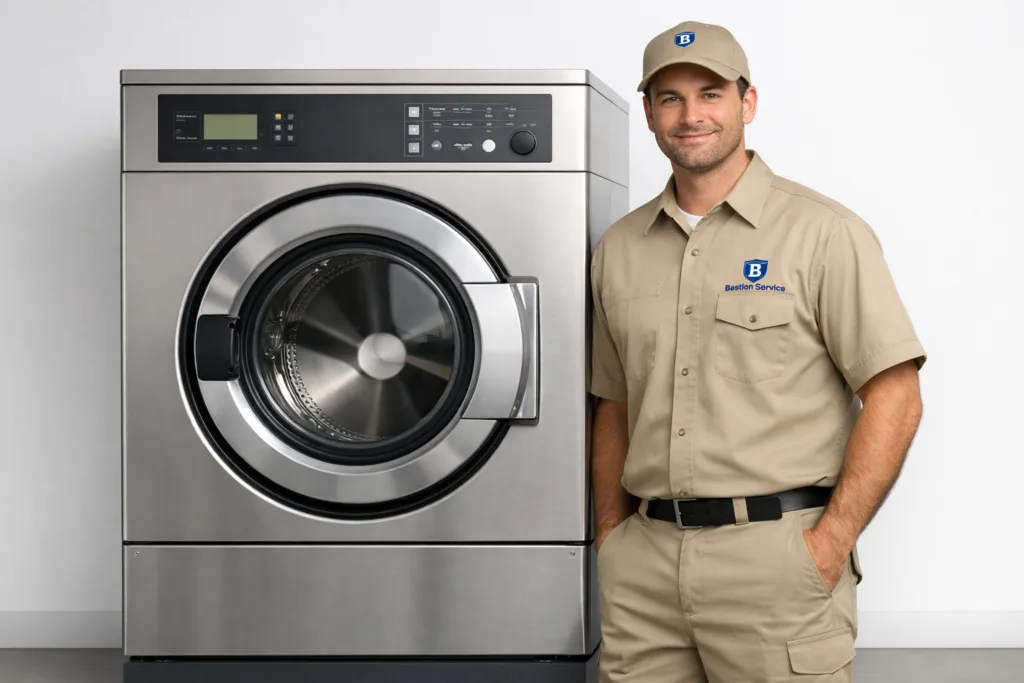




Equipment trouble rarely stays isolated for long in a busy laundry operation. When a Wascomat washer or dryer starts missing cycles, slowing output, leaking, overheating, or stopping unexpectedly, the best next step is to schedule service before staff have to build daily workarounds around an unreliable machine. Bastion Service helps businesses in Redondo Beach evaluate symptom patterns, identify the failed system, and plan repairs based on downtime impact, parts needs, and whether the unit should remain in use.
For specific equipment paths in Redondo Beach, review Wascomat Washer Repair in Redondo Beach, Wascomat Dryer Repair in Redondo Beach, and Commercial Appliance Repair in Redondo Beach.
Washer and dryer problems that commonly lead to service calls
Wascomat laundry equipment often shows a pattern before a full shutdown. Washers may stop filling, fail to drain, refuse to lock, spin poorly, or end a cycle with water still in the drum. Dryers may run with weak heat, take too long to finish, shut off mid-cycle, or produce unusual noise. While those symptoms can seem straightforward, the underlying cause may involve controls, motors, sensors, belts, pumps, airflow, heating components, door systems, or electrical faults.
For businesses in Redondo Beach, the repair decision is usually about more than one machine. When equipment performance drops, turnover slows, backed-up loads affect staffing, and customers or residents notice delays. Early service helps limit secondary damage and keeps one fault from turning into a broader scheduling problem.
Wascomat washer symptoms and what they can indicate
Washer will not drain or leaves standing water
If water remains in the basket at the end of the cycle, the issue may involve a drain pump problem, blockage, hose restriction, control fault, or a component that prevents the washer from advancing into extraction. A machine in this condition may still appear partly functional, but repeated restart attempts can increase strain and create inconsistent results from load to load.
Washer will not start or door lock problems appear
When the washer does not begin a cycle, displays door-related errors, or struggles to unlock correctly, the fault may be tied to the latch assembly, wiring, interlock components, or control communication. These issues should be addressed promptly because cycle interruptions around the door system tend to become repeat service events rather than one-time glitches.
Excessive vibration, banging, or movement during spin
Strong vibration can point to suspension wear, drum support issues, mounting problems, internal component wear, or persistent load-balance faults. In a laundry room environment, heavy movement is not just annoying noise. It can shorten equipment life, affect nearby machines, and turn a manageable repair into a larger mechanical problem if operation continues without inspection.
Leaks, slow fills, or inconsistent wash performance
Water under or around the washer may come from hoses, valves, seals, drain-related components, or internal wear. Slow filling or irregular cycle progress can also suggest inlet issues, valve faults, pressure-related problems, or control errors. Because these symptoms can overlap, service is often needed to confirm whether the problem is isolated or part of a broader water-handling issue.
Wascomat dryer symptoms and service considerations
Long dry times or poor heat
If loads need repeated cycles or leave the dryer damp after normal run time, the cause may be restricted airflow, heating component failure, venting problems, thermostat issues, or sensor-related errors. Long dry times reduce throughput quickly, especially in facilities that depend on predictable turnaround during peak hours.
Dryer tumbles but does not finish properly
A dryer that runs without producing consistent results may have temperature regulation problems, moisture-sensing faults, timer issues, drive wear, or board-related failures. These cases are easy to misread because the machine appears operational, yet output remains below expectation and staff compensate by rerunning loads.
Burning smell, thumping, squealing, or repeated shutdowns
These symptoms should be treated as a warning to stop normal use until the unit is checked. They can indicate overheating, friction, motor strain, worn support parts, lint-related airflow restriction, or a failing component under load. Continuing to operate the dryer may increase repair scope and create a more disruptive outage.
What Wascomat laundry equipment problems usually require prompt attention
Some symptoms justify faster scheduling because the risk of added damage is higher. Examples include:
- Washer not draining or not entering spin
- Persistent leak from the washer or supply area
- Door lock failures that stop cycle use
- Severe vibration or banging during extraction
- Dryer overheating or shutting down before completion
- No-heat or weak-heat drying performance
- Burning odor, scraping, squealing, or thumping sounds
- Repeat error conditions or intermittent power-related stoppages
In these situations, continued use often adds wear to related parts or creates more downtime later. Service is usually more manageable when the issue is addressed while the symptom pattern is still identifiable.
Why symptom-based diagnosis matters
Laundry equipment problems do not always point to a single obvious failure. A washer that stops mid-cycle might have a drain issue, a lock problem, or a control fault. A dryer with long run times might be dealing with heat failure, restricted airflow, or sensor behavior that is producing inaccurate cycle decisions. Symptom-based diagnosis helps separate look-alike problems so repair planning is based on the actual fault.
This also helps determine whether the machine can stay in limited use, should be removed from rotation, or needs coordinated scheduling around occupancy, staffing, or production demands. For businesses in Redondo Beach, that kind of information is often just as important as the repair itself.
Repair planning for laundromats, hotels, shared laundry rooms, and local businesses
Different sites experience the same equipment failure in different ways. A laundromat may feel the impact immediately through reduced available machines. A hotel may see turnover delays affect housekeeping flow. A shared laundry room may face resident complaints if one unit repeatedly goes offline. Other businesses in Redondo Beach may simply need reliable laundry output to keep daily operations moving.
Because of that, repair planning should account for more than the part that failed. It should consider whether the unit is safe to continue using, whether other signs suggest additional wear, how quickly the symptom is worsening, and how much disruption the machine is causing right now.
When repair makes sense and when replacement may come up
Many Wascomat equipment issues are best handled with targeted repair when the fault is limited and the machine remains structurally sound for the workload. Replacement becomes a more serious consideration when breakdowns are frequent, multiple systems are failing, parts lead times are too long for the operation, or the unit no longer delivers consistent performance even after recent service.
A proper inspection helps compare those options using condition, reliability, and operating impact rather than guessing from symptoms alone.
Scheduling service in Redondo Beach
If a Wascomat washer or dryer is showing repeat faults, lower output, unusual noise, heating problems, or water-handling issues, scheduling service early is usually the most efficient move. A repair visit in Redondo Beach can identify what failed, clarify whether the machine should stay in operation, and help the business move forward with the right repair plan before downtime spreads to the rest of the laundry workflow.


