
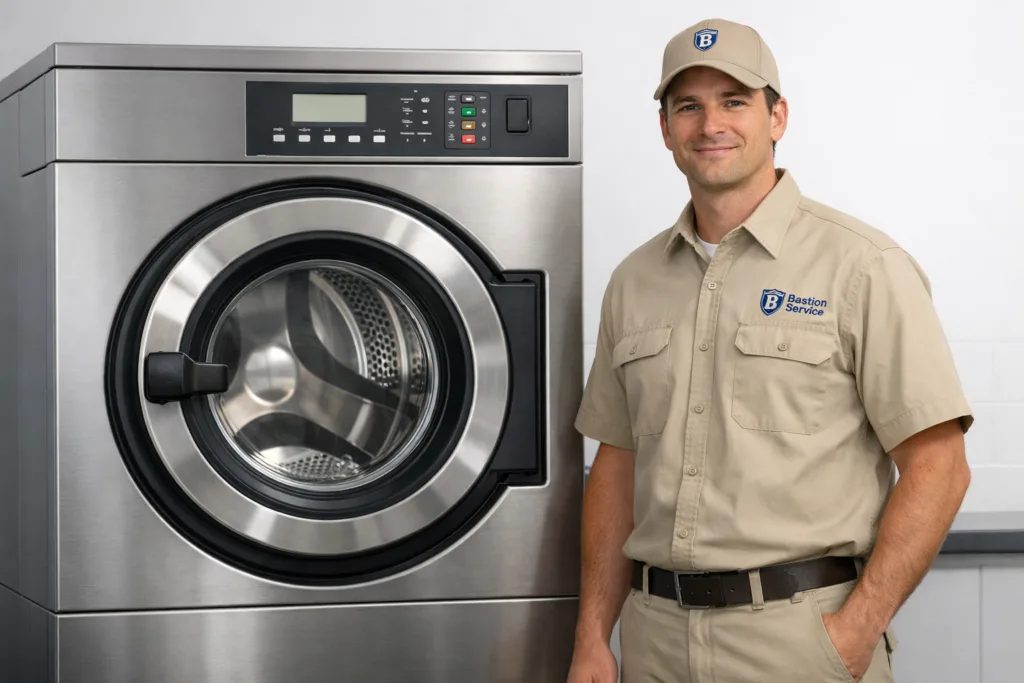




Equipment trouble rarely stays isolated for long in a laundry operation. A washer that starts missing cycles or a dryer that takes too long to finish loads can slow turnaround, affect staffing, and create avoidable pressure on the rest of the room. For businesses in Mar Vista, service is most useful when it moves quickly from symptom review to repair planning, so managers know whether a unit should stay in use, come out of rotation, or be scheduled for prompt repair.
For specific equipment paths in Mar Vista, review Wascomat Washer Repair in Mar Vista, Wascomat Dryer Repair in Mar Vista, and Commercial Appliance Repair in Mar Vista.
Bastion Service provides Wascomat laundry equipment repair for businesses in Mar Vista with attention to uptime, operating flow, and the real impact of washer and dryer failures. Whether the issue appears as a sudden shutdown or a gradual performance drop, the goal is to identify the source of the problem, explain what the symptom pattern suggests, and help schedule the next step around daily operations.
Washer and dryer symptoms that often point to repair needs
Wascomat laundry equipment usually shows warning signs before a complete outage. Early service can help limit secondary damage, reduce repeat interruptions, and keep one failing machine from disrupting the rest of the workload.
Washers that will not start or stop mid-cycle
If a washer does not start, locks out, pauses unexpectedly, or shuts down before the cycle ends, the problem may involve the door lock system, controls, water fill components, draining issues, or drive-related faults. From an operator standpoint, the main concern is not only the failed cycle but whether the issue is likely to repeat across every load. A unit that intermittently starts and stops can be harder on workflow than one that is fully offline because staff still spend time resetting, reloading, and monitoring it.
Service becomes especially important when cycle failures happen more than once, error conditions are recurring, or the machine behaves inconsistently under normal use. Those patterns usually point to a fault that needs proper repair rather than continued trial-and-error operation.
Washers with leaks, poor draining, or standing water
Water left in the drum, slow draining, overflow concerns, or visible leaking around the machine can indicate pump trouble, drain restrictions, hose issues, valve problems, or worn sealing components. These symptoms affect more than a single load. They can create cleanup time, limit machine availability, and raise concerns about nearby surfaces and surrounding equipment.
A washer that drains slowly may still appear usable for a short time, but repeated operation in that condition often leads to more serious stoppages. If water handling is already inconsistent, it is usually better to schedule repair before the unit becomes unusable during a busy period.
Dryers with no heat, weak heat, or extended dry times
When a Wascomat dryer tumbles normally but loads come out damp, the cause may involve heating components, airflow restrictions, sensors, controls, or wear affecting overall performance. Long dry times often show up first as a production problem: more loads waiting, more machine congestion, and more labor spent checking items that should already be finished.
No-heat conditions are easier to identify, but weak heat can be just as disruptive because it gradually reduces output without looking like a full breakdown. If drying times are climbing or one machine consistently lags behind the rest, service can help determine whether the issue is a single failed part or a broader airflow or control problem.
Noise, vibration, and movement during operation
Thumping, grinding, scraping, rattling, or excessive movement can signal worn supports, drum-related issues, mounting problems, imbalance, or drive component wear. In a washer, strong vibration may also show up during extraction or spin cycles. In a dryer, unusual sound can point to wear that will likely worsen with continued operation.
These symptoms matter because they often progress. A machine that is running loudly today may soon create a larger mechanical failure if left in rotation. When noise is paired with reduced performance, shutdowns, or visible movement, it is wise to have the unit assessed before the repair becomes more extensive.
What a service diagnosis helps determine
Repair decisions are easier when the symptom pattern is tied to the machine’s actual condition. A service diagnosis helps answer practical questions that matter in day-to-day operations:
- Is the problem isolated to one component or affecting multiple systems?
- Can the machine stay in limited use until the repair is completed?
- Is the fault likely to worsen quickly with continued operation?
- Does the equipment justify repair based on condition and workload demands?
- Are repeated symptoms connected to one root issue rather than separate failures?
That information helps managers decide how urgently to act, which unit to prioritize, and whether scheduling can be planned during a lower-impact window or needs to happen as soon as possible.
When performance problems should not be ignored
Not every issue begins with a full shutdown. Some of the most disruptive failures start as smaller changes in performance: slightly longer dry times, inconsistent draining, occasional control interruptions, or growing vibration during operation. These can be easy to postpone when the equipment still runs, but they often signal wear or developing faults that become more expensive once the unit fully fails.
Faster attention is usually warranted when you notice any of the following:
- Repeated cycle cancellations or lockouts
- Water not draining fully after loads
- Persistent leaking or moisture around the machine
- Overheating concerns or no-heat dryer operation
- Strong vibration, banging, or scraping sounds
- Controls that respond inconsistently or require repeated resets
In those cases, continuing to run the machine may increase wear on related parts and make downtime less predictable.
Repair planning for business laundry equipment
A good repair plan takes more into account than the immediate symptom. Machine age, daily use, prior service history, repeat failures, and the role of the unit in total output all matter. A single washer with a drain fault may be a straightforward repair. A dryer with heat issues plus airflow and control concerns may need a broader evaluation before the next step is decided.
For businesses in Mar Vista, the value of service is not just getting a part replaced. It is understanding whether the machine can realistically return to stable operation and how that repair fits into current workload demands. In many situations, a targeted repair restores reliable performance. In others, multiple wear-related issues may justify a more cautious decision about keeping the unit in active use.
Wascomat washer and dryer coverage in Mar Vista
Because laundry rooms depend on both washing and drying capacity, service needs to look at the whole operating picture. A washer problem can back up intake and sorting. A dryer problem can delay finished loads and reduce total throughput even when washers are running normally. Balanced repair coverage for Wascomat washer and dryer equipment helps businesses respond to whichever part of the process is being disrupted.
This is especially important when the symptoms are not dramatic but still affect output, such as one washer that repeatedly adds time to turnover or one dryer that requires second passes to finish loads. Those issues can quietly reduce productivity long before anyone describes the machine as completely down.
Scheduling service before downtime spreads
When laundry equipment starts showing repeated faults, the best next step is usually to schedule service before the issue spreads into a larger interruption. Prompt evaluation can help determine if the machine should be pulled from use, whether the repair is likely to be contained, and how to plan around existing workflow. If your Wascomat washer or dryer in Mar Vista is leaking, failing cycles, vibrating excessively, not heating, or taking too long to finish loads, arranging repair now is often the most practical way to protect uptime and reduce avoidable disruption.


