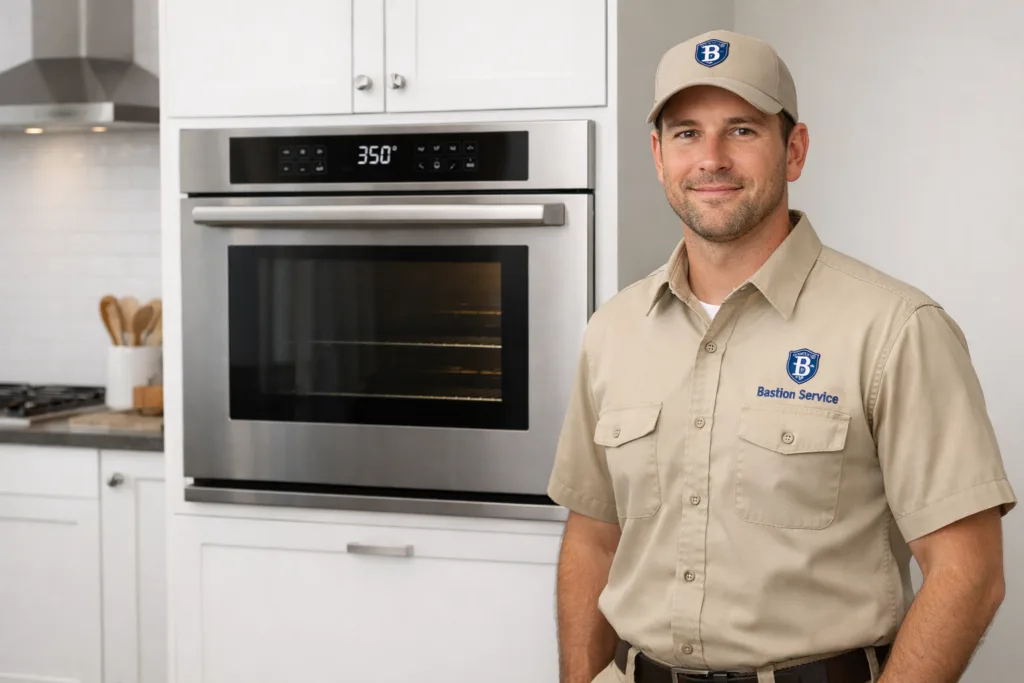
Wall ovens can fail in ways that look similar at first but come from very different causes. A unit that powers on without heating may have a failed bake element, a sensor problem, a relay or control fault, or a power issue affecting one side of the circuit. Slow preheat, uneven browning, and temperature swings can also point to different internal problems, which is why symptom patterns matter before any repair decision is made.
Common wall oven problems and what they may indicate
One of the most frequent complaints is an oven that seems to run but does not actually reach cooking temperature. On many electric wall ovens, that can happen when the bake element is weak or broken, even if the broil element still glows. In other cases, the oven heats somewhat but never stabilizes, which may suggest a failing temperature sensor, calibration drift, damaged wiring, or an electronic control issue.
Uneven baking is another common household frustration. If the top of a dish browns too quickly while the center stays undercooked, or one rack cooks faster than another, the problem may involve inconsistent element cycling, poor heat circulation, or inaccurate temperature sensing. If similar burner-related heat issues are happening on a separate cooking surface, Cooktop Repair in West Hollywood may be the better service path.
A wall oven that shuts off during cooking can indicate overheating protection, loose electrical connections, or a control board fault. Some units will also display error codes, stop responding to touch controls, or fail to start a cycle at all. Those symptoms often involve more than a simple heating element replacement and usually need full electrical and control testing.
Door, latch, and self-clean issues
Not every wall oven problem starts with temperature. A door that will not close fully can let heat escape and cause long cook times or poor baking results. After a self-clean cycle, some ovens may stay locked, show a latch error, or refuse to heat because the control still reads the door position incorrectly. Worn hinges, a damaged latch assembly, door alignment problems, and faulty switches can all contribute to these symptoms.
If the problem seems tied to a standard freestanding oven rather than a built-in unit, Oven Repair in West Hollywood may match the appliance setup more closely. That distinction helps when households in West Hollywood are trying to schedule the right type of service the first time.
When to stop using the oven
Some symptoms are inconvenient, while others should be treated as a reason to stop using the appliance right away. If the oven trips the breaker, produces a burning smell from behind the unit, sparks, overheats far past the set temperature, or loses power repeatedly during operation, continued use can create added damage and a safety risk. The same is true when the door will not latch properly during high-heat cycles.
For less urgent issues like slow preheating or mild temperature inconsistency, the oven may still operate, but the problem can worsen over time. A weak element can fail completely, unstable wiring can damage controls, and repeated overheating can stress nearby components. Early diagnosis often keeps a smaller failure from becoming a more expensive one.
What a diagnosis helps clarify
A proper diagnosis helps separate a failed part from a wiring issue, installation concern, or broader wear inside the appliance. That matters because replacing the wrong component can leave the original issue untouched. It also helps determine whether the problem is isolated and repairable or part of a larger pattern of decline in an older oven.
Technicians typically look at heating performance, sensor readings, control responses, wiring condition, door function, and any stored error behavior. In many homes, that process reveals whether the complaint is truly a wall oven problem or whether the symptom involves another cooking appliance. If both surface burners and the oven are acting up together, Range Repair in West Hollywood may be the better fit because that combination often points to a range rather than a standalone wall oven.
Repair versus replacement
Many wall oven repairs are worthwhile, especially when the appliance fits the kitchen well and replacement would mean cabinet modifications or finish-matching issues. A single failed element, sensor, igniter, latch component, or control-related part can often justify repair if the rest of the unit is in solid condition.
Replacement becomes more relevant when the oven has multiple major failures at once, parts are difficult to source, the cavity or door structure is heavily worn, or electrical faults keep returning. Age matters, but overall condition matters more. A well-kept oven with one clear failure can still be a good repair candidate, while a unit with recurring problems across heating, controls, and door function may not offer the same value.
Choosing the right cooking-appliance service
Households sometimes use “oven,” “stove,” and “range” interchangeably, which can make scheduling confusing. A wall oven is a built-in appliance separate from the cooktop, while a range combines an oven and surface burners in one unit. A stove is often used as a general term for that same combined setup. If the main complaint involves surface burners and oven performance on one appliance, Stove Repair in West Hollywood may be more relevant than wall oven service.
For homeowners in West Hollywood, the most helpful service visit is one that explains what failed, whether the oven is safe to use, and what repair path makes sense for everyday cooking. A focused evaluation can show whether the issue is a straightforward fix, an urgent electrical problem, or a sign that replacement should be considered before reliability gets worse.