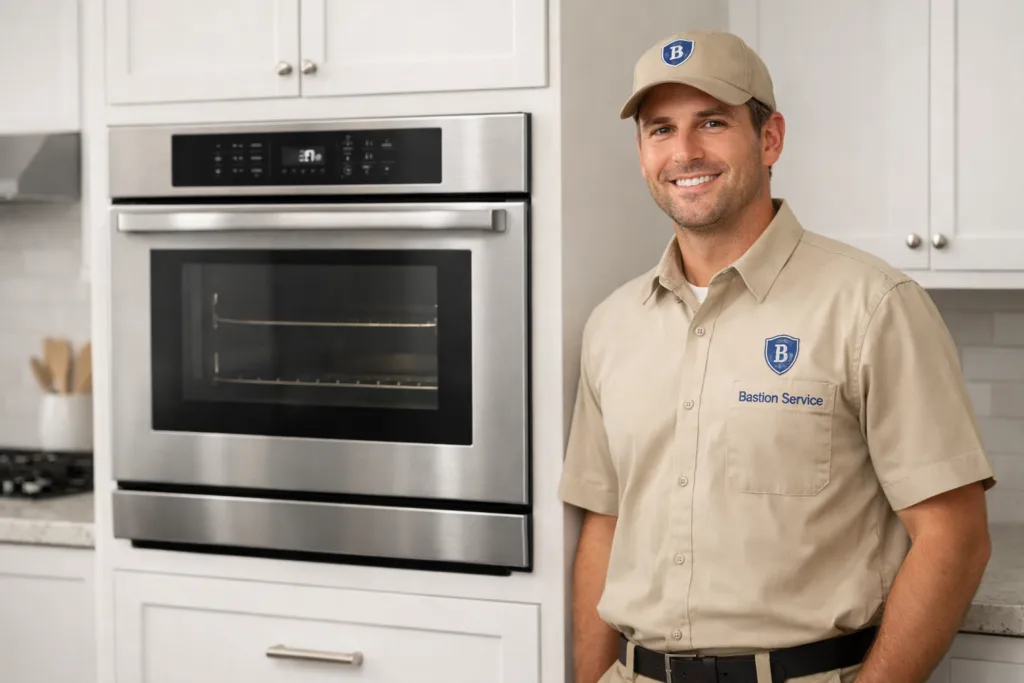
Wall ovens tend to fail in ways that look similar at first, but the underlying cause can be very different. A unit that will not heat at all may have a failed element, a bad igniter, a relay problem, a cutoff issue, or a power supply fault. One that heats inconsistently may instead be struggling with temperature sensing, airflow, or a control problem that only appears once the oven has been running for a while.
Common wall oven problems homeowners notice
Most service calls begin with a few recognizable complaints: no heat, very slow preheating, uneven baking, temperature swings, error codes, or a cycle that shuts off before cooking is finished. In Rancho Park homes, people also report broil working while bake does not, convection fans behaving oddly, or a door that does not close, lock, or unlock the way it should.
These symptoms matter because they help narrow the diagnosis. If the display is on but the cavity stays cold, the issue is often somewhere in the heating circuit rather than the panel alone. If preheat takes much longer than normal, the oven may still be operating, but not at full heating strength. If food browns too fast on one side or remains pale on another, the problem may involve calibration, element performance, airflow, or heat loss around the door.
What specific symptoms can indicate
A wall oven that trips the breaker, gives off a hot electrical smell, or shows signs of sparking should be turned off until it can be inspected. Those symptoms can point to wiring damage, shorted components, or control failures that may worsen with continued use.
If the bake function fails but the cooktop above is where the day-to-day problem started, Cooktop Repair in Rancho Park may be the better place to focus first. In some kitchens, a surface-heating complaint and an oven complaint happen at the same time, but they do not always come from the same component set.
When the oven reaches temperature on paper but food consistently comes out undercooked or overdone, the sensor may be reading inaccurately or the control may be cycling heat poorly. A door gasket that is worn, torn, or compressed can also allow heat to escape, making preheat feel slow and baking results unpredictable.
Signs the problem may be electrical, mechanical, or temperature-related
Electrical issues often show up as intermittent operation, blank displays, breaker trips, or functions that work one day and fail the next. Mechanical issues are more likely to involve the door, hinges, latch assembly, or fan noise. Temperature-related problems usually show up in cooking results first, such as uneven roasting, scorched bottoms, weak broiling, or recipes taking much longer than expected.
If the symptom is mainly about a standard cavity oven rather than a built-in wall unit, Oven Repair in Rancho Park may be the more relevant service path. That distinction helps avoid confusion when the kitchen includes more than one cooking appliance with similar heating complaints.
Self-cleaning cycles can also reveal hidden weaknesses. It is not unusual for a wall oven to develop latch problems, thermal cutoff issues, or electronic faults after a high-heat cleaning cycle. When a door stays locked, the control freezes, or the unit will not resume normal heating afterward, the repair approach should focus on the affected safety and control systems instead of assuming the appliance simply needs to cool down longer.
When to stop using the oven and schedule service
It is smart to stop using the oven if there is visible arcing, a repeated burning odor, breaker trips, or heat escaping around a door that no longer seals properly. Continued operation under those conditions can damage wiring, controls, and surrounding components.
You should also schedule service when cooking has become unreliable even without dramatic warning signs. A wall oven that runs too cool can affect food safety, while one that overheats can ruin meals and place unnecessary stress on the appliance. In Rancho Park households that use the oven frequently, waiting too long often turns a manageable repair into a more involved one.
If both top burners and oven heat are acting up on the same appliance, Range Repair in Rancho Park may be the better fit because the issue may involve a full range rather than a standalone wall oven. Looking at the full appliance layout can make the diagnosis faster and more accurate.
Repair versus replacement considerations
Repair is often worthwhile when the issue is limited to a sensor, element, igniter, latch assembly, switch, fan motor, or a single confirmed control fault. Replacement becomes more realistic when there are multiple major failures, severe interior damage, repeated electronic breakdowns, or repair costs that start approaching the value of a dependable new unit.
Age matters, but condition matters more. A well-maintained wall oven with one isolated failure may still have plenty of useful life left. On the other hand, an older unit with recurring temperature instability, wiring deterioration, and door problems may not be the best candidate for continued investment.
Some homeowners describe the appliance as a “stove” even when the configuration is different, and Stove Repair in Rancho Park may be more appropriate if the problem involves that style of cooking equipment instead of a built-in wall oven. Choosing the right service category helps match the symptoms to the correct appliance design.
What a productive service visit should accomplish
A worthwhile appointment should do more than confirm that the oven is not working. It should identify the failed part or system, determine whether continued use could cause additional damage, and explain whether repair is likely to restore consistent cooking performance. For wall ovens, that usually means checking heating behavior, temperature response, door condition, control output, safety devices, and any stored fault indicators.
For homeowners in Rancho Park, the goal is straightforward: understand why the oven is failing and what repair path makes sense for normal household cooking. A careful diagnosis reduces unnecessary part swapping, gives a clearer picture of repair value, and helps restore confidence in everyday meal preparation.