
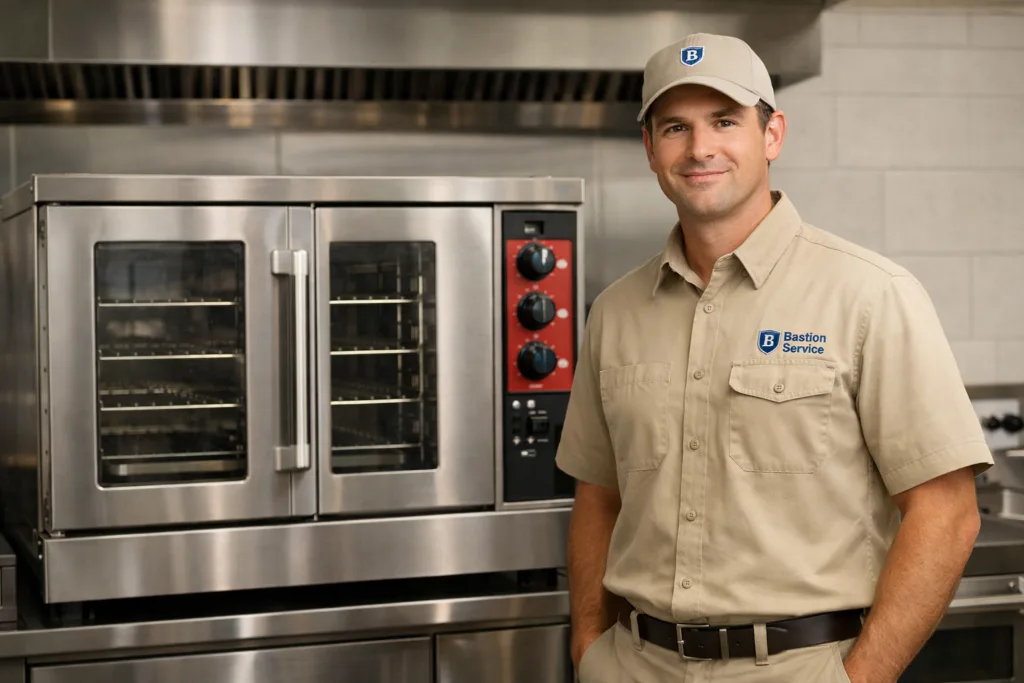





Oven problems rarely stay isolated for long in busy kitchens. When a Vulcan unit starts missing temperature, heating unevenly, or shutting down during use, the most useful response is service built around the exact symptom pattern, how often it occurs, and how it is affecting production. In Century City, timely repair scheduling can help prevent product loss, avoid unnecessary part replacement, and reduce the risk of a small fault turning into a full outage.
Related commercial service paths in Century City include Vulcan Commercial Repair in Century City, Commercial Oven Repair in Century City, and Vulcan Range Repair in Century City.
Bastion Service works with businesses in Century City to diagnose Vulcan oven issues that interfere with heat consistency, preheat time, ignition, controls, and normal daily workflow. The goal is to identify what is actually failing, whether the oven can keep operating safely in the meantime, and what repair path makes the most sense for the condition of the unit.
Common Vulcan Oven Symptoms That Need Attention
Slow preheat or failure to reach set temperature
If the oven takes much longer than normal to heat up, struggles to reach the programmed temperature, or appears hot without cooking properly, the problem may involve the ignitor, heating element, temperature sensor, thermostat, control board, gas flow, or calibration. In a working kitchen, this usually shows up as delayed prep, longer ticket times, or staff adjusting cook times to compensate for equipment that is no longer performing normally.
Uneven baking or hot and cold spots
When one tray finishes faster than another or the results change from rack to rack, the issue may be tied to airflow, convection fan performance, weakened heat output, poor door sealing, sensor drift, or internal wear that affects temperature distribution. Uneven baking is often mistaken for loading technique, but repeated inconsistency usually points back to the oven itself.
Ignition problems or intermittent heat loss
An oven that clicks without lighting, ignites late, cycles irregularly, or loses heat during operation may have an ignition fault, flame-sensing problem, gas-valve issue, wiring problem, or control failure. Intermittent symptoms are especially important to address because they can become harder to predict and more disruptive during active service.
Temperature swings during cooking
If the oven overshoots, cools too far between cycles, or cannot recover properly after the door is opened, the cause may involve the sensor circuit, thermostat response, relays, control communication, or heat-retention issues around the door and gasket. Temperature swings affect consistency even when the display appears normal, which is why actual performance matters more than the setpoint alone.
Control panel issues and error conditions
Unresponsive buttons, flashing codes, incorrect temperature displays, lost settings, or inconsistent cycle behavior can point to control-board problems, wiring faults, interface failure, or bad sensor feedback. These problems can look minor at first, but they often affect how the oven regulates heat and responds during repeated daily use.
Door, hinge, and gasket wear
Heat escaping around the door, doors that do not close squarely, weak latching, or worn gaskets can all reduce cooking consistency. Even if the burners or elements are working, poor sealing forces the oven to work harder, lengthens cook times, and increases strain on the heating system.
Why a Vulcan Oven May Not Heat Evenly or Reach Set Temperature
This is one of the most common complaints because several different faults can produce the same result. A sensor that reads inaccurately may cause the control system to stop heating too soon. A weak ignitor or heating element may allow the oven to warm slowly but not recover under load. A failing convection fan can leave stagnant areas inside the cavity. A worn gasket or misaligned door can let heat escape faster than the system can replace it.
Because these symptoms overlap, replacing one part based on guesswork can waste time and leave the real problem unresolved. Diagnosis should confirm whether the issue is related to heat generation, temperature sensing, airflow, retention, or control response before repair decisions are made.
How Symptom-Based Diagnosis Helps Businesses
A useful service visit is not just about confirming that the oven has a problem. It should narrow the complaint to a specific failure path. For example, “not heating” may mean no ignition, poor heat output, false temperature readings, or repeated safety shutdowns. “Uneven cooking” may be caused by airflow loss, sensor error, or a door that is leaking heat on every cycle.
That level of diagnosis helps management and kitchen staff answer practical questions:
- Is the oven still usable in the short term, or should it be taken out of service?
- Is the fault likely to worsen quickly under continued use?
- Does the problem point to a single repair or multiple worn components?
- Will the repair restore consistent performance or only partial operation?
When to Schedule Vulcan Oven Repair
Service should be scheduled promptly when the oven starts showing repeated performance changes rather than a one-time irregular result. Warning signs include longer preheat times, inconsistent browning, partial heating, ignition delays, error codes, unexpected shutdowns, or staff needing to monitor the unit more closely than usual just to keep production moving.
It also makes sense to schedule repair when the oven still runs but no longer behaves predictably. Many failures begin as partial faults. The oven may heat, but not reliably. It may work during one shift and fail during the next. Addressing these symptoms early is often the best way to avoid a breakdown during peak production.
When Continued Use Can Make the Problem Worse
Running an oven with unresolved faults can increase wear on related components. A weak door seal can force longer heating cycles. Ignition problems can stress controls and flame-sensing components. Inconsistent airflow can create uneven internal temperatures that affect product quality and put extra demand on the heating system. What begins as a temperature complaint can expand into a broader repair if the unit keeps operating under strain.
If the oven shows abnormal ignition behavior, repeated shutdowns, or signs that it is not operating safely, staff should stop using it until it has been evaluated. Protecting uptime includes knowing when continued use is more costly than taking the unit offline for service.
Repair or Replace?
Many Vulcan oven issues are repairable when the main structure of the unit is still in good condition and the failure is limited to serviceable components such as ignitors, sensors, controls, fans, switches, wiring, gaskets, or related gas-system parts. Repair becomes less attractive when the oven has multiple major failures, chronic repeat issues, severe wear, or downtime that no longer matches the needs of the operation.
The decision usually depends on four things: the exact fault, the age and condition of the oven, the impact of downtime on the business, and whether the recommended repair is likely to restore stable day-to-day performance. A symptom-based assessment gives businesses in Century City a better basis for deciding whether to proceed with repair or plan for replacement.
What to Have Ready Before a Service Visit
If possible, it helps to note when the problem occurs and how the oven behaves. Useful details include whether the issue happens during preheat, under full load, after cycling for a period of time, or only intermittently. Error messages, unusual sounds, inconsistent ignition, visible door gaps, and changes in cook quality can all help shorten the diagnostic process.
It is also helpful to know whether the problem is getting worse, whether staff have changed procedures to work around it, and whether any resets have been needed to keep the oven running. These details often reveal whether the fault is isolated or part of a larger pattern of decline.
Service-Focused Next Step
If your Vulcan oven in Century City is no longer heating evenly, reaching temperature, igniting reliably, or responding correctly at the controls, the next step is to schedule repair based on the actual symptoms rather than trial-and-error part replacement. A targeted evaluation helps determine urgency, supports smarter downtime planning, and gives your business a clearer path back to consistent oven performance.


