





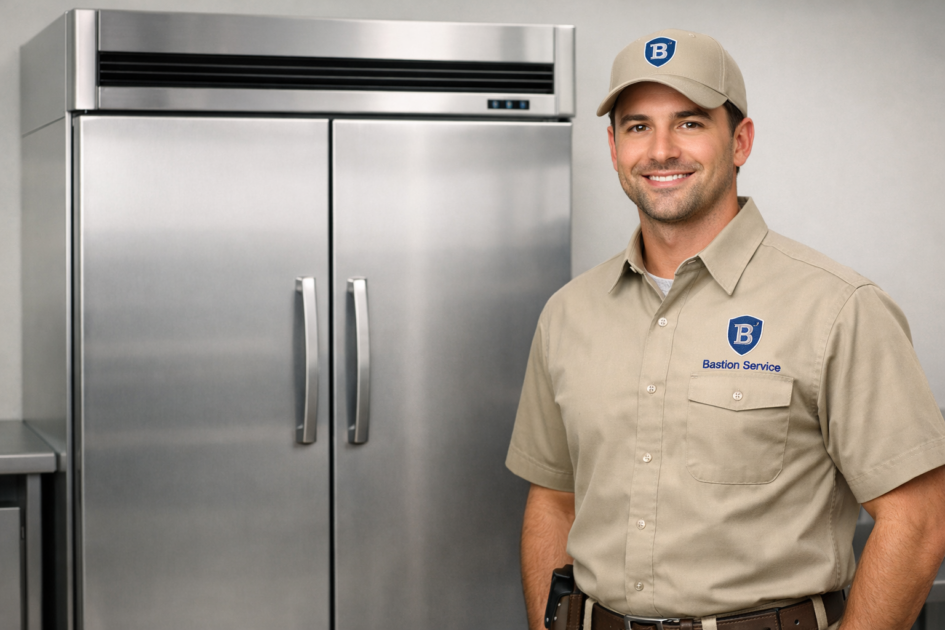
When a Turbo Air refrigerator starts running warm, icing over, leaking, or short cycling, the most useful next step is service based on what the unit is actually doing in daily operation. For businesses in Fairfax, refrigerator trouble can affect product protection, prep timing, staffing flow, and opening schedules fast. Bastion Service handles Turbo Air refrigerator repair with attention to symptom verification, component testing, repair planning, and downtime considerations so the issue is addressed at the source rather than guessed at.
Related commercial service paths in Fairfax include Turbo Air Commercial Repair in Fairfax, Commercial Refrigerator Repair in Fairfax, and Turbo Air Freezer Repair in Fairfax.
How Turbo Air refrigerator problems are typically diagnosed
Many refrigerator faults look similar at first. A cabinet that is not holding temperature may be dealing with weak airflow, a fan issue, a control or sensor problem, a door sealing problem, frost restricting circulation, or a larger cooling-system failure. Because those symptoms overlap, repair decisions usually depend on checking temperature behavior, frost pattern, compressor run time, fan operation, drain condition, and how the cabinet recovers after normal door openings.
In Fairfax kitchens, food-service businesses, hotels, and other work environments, those details matter. A refrigerator that seems fine first thing in the morning may drift later under load. Another unit may hold temperature when closed but struggle during active service. Looking at the pattern of failure helps determine whether the problem is tied to airflow, controls, defrost, electrical components, or the cooling system itself.
Common Turbo Air refrigerator symptoms and what they often point to
Cabinet temperature is too warm
If the refrigerator is running but the interior is warmer than it should be, common causes include dirty condenser coils, poor condenser airflow, evaporator fan failure, inaccurate sensing, control problems, refrigerant loss, or compressor weakness. Warm operation should be taken seriously because the unit may continue running without actually protecting product at the needed temperature.
In some cases, staff notice the cabinet struggling most during heavy use, after frequent door openings, or during busy prep windows. That can indicate an airflow or recovery issue rather than a total shutdown, but it still needs inspection before it becomes a larger cooling failure.
Temperature swings throughout the day
Temperature fluctuation often points to intermittent control response, sensor drift, inconsistent fan performance, partial frost buildup, or a unit that is losing cooling capacity under load. Repeated setpoint changes by staff can temporarily mask the issue without fixing it, and that can make the cabinet harder to evaluate later.
When temperatures bounce between acceptable and unsafe ranges, repair should be scheduled before the problem leads to spoilage, repeated alarm conditions, or excessive run time.
Frost or ice keeps returning
Frost buildup inside a Turbo Air refrigerator often involves a defrost problem, door gasket leakage, warm-air intrusion, poor door closure, or restricted airflow across the evaporator section. Ice accumulation can make the unit appear to have a major cooling problem even when the root cause is a failed heater, control issue, sensor problem, or door-related air leak.
If frost returns soon after being cleared, that usually means the underlying cause is still active. Letting the problem continue can reduce airflow further and place more strain on fans and the compressor.
Water is leaking onto the floor
Water around the refrigerator may come from a blocked drain, frozen drain line, defrost runoff issue, excess condensation, or a door sealing problem that is allowing too much moisture into the cabinet. In a business setting, even a small recurring leak can become a slip hazard or damage nearby surfaces.
A leak that shows up during specific times of day, after defrost cycles, or only during heavy use can offer useful clues about whether the issue is drainage, condensation, or ice melt related.
Noisy operation or unusual vibration
Buzzing, rattling, clicking, fan noise, or vibration can point to worn fan motors, loose panels, mounting issues, compressor starting trouble, or airflow restrictions causing components to work harder than normal. A new sound matters even if the refrigerator is still cooling, because mechanical stress often shows up before a complete failure.
Short cycling is especially important to address early. Repeated starts and stops can increase wear on electrical components and put added strain on the compressor.
Doors are closing poorly or gaskets are damaged
Door problems are easy to underestimate, but poor sealing can lead to temperature instability, heavy condensation, frost, and long run times. Torn gaskets, sagging doors, misalignment, or stored product blocking closure can all reduce performance significantly.
On Turbo Air refrigerators, what appears to be a major cooling problem is sometimes a combined issue involving door fit, airflow blockage, and overdue coil cleaning rather than a full system failure.
Why these problems should be handled quickly
Refrigeration issues rarely stay contained for long. Restricted airflow can overwork fan motors and the compressor. Ongoing frost can block circulation and reduce usable cabinet performance. Dirty condenser conditions can increase heat stress and energy use. Water leaks can spread beyond the unit and create cleaning, safety, or flooring concerns.
For Fairfax businesses, delay often means more than inconvenience. It can mean disrupted prep, moved inventory, added staff workarounds, and uncertainty about whether the refrigerator can make it through the next shift.
When to schedule service instead of continuing to monitor the unit
- The cabinet is not reliably holding temperature.
- Frost returns after clearing or defrosting.
- Water leakage keeps coming back.
- The compressor runs constantly or cycles abnormally.
- Alarms, error conditions, or inconsistent readings continue.
- Doors do not close firmly or gaskets are visibly failing.
- Staff have to keep adjusting settings to keep the unit usable.
Those are all signs that continued operation may increase wear, reduce temperature stability, or turn a smaller repair into a broader equipment problem.
Repair decisions depend on the actual fault
Not every Turbo Air refrigerator issue calls for replacement. Many problems involve serviceable parts such as fan motors, sensors, controls, defrost components, drains, electrical parts, gaskets, or door hardware. Repair is often the sensible choice when the cabinet is still in good condition and the fault is isolated.
Replacement becomes more likely when there are multiple major failures, unstable cooling tied to overall system wear, or equipment condition that no longer supports reliable daily use. The key is confirming whether the problem is concentrated in one repairable area or part of a wider decline in performance.
What helps prepare for a service visit
Before repair is scheduled, it helps to note the specific symptoms staff are seeing. Useful details include when the problem started, whether the cabinet is warm all the time or only during busy periods, whether ice appears in the same area repeatedly, whether water shows up after defrost, and whether unusual noise happens at startup or throughout the day.
It is also helpful to know if anyone has recently changed settings, cleared ice manually, moved product to improve airflow, or noticed doors not closing fully. Small observations often shorten diagnosis and help determine whether the issue is operational, electrical, mechanical, or related to the cooling system.
Service-focused next steps for Fairfax businesses
If your Turbo Air refrigerator is showing warm temperatures, airflow problems, frost buildup, leaks, noise, or inconsistent recovery, the best next move is to have the unit evaluated before the problem spreads into product loss or longer downtime. A service appointment should focus on confirming the failure pattern, identifying the root cause, and deciding whether repair can restore stable operation without unnecessary parts changes. For businesses in Fairfax, early scheduling is often the most practical way to protect workflow and keep a refrigerator problem from affecting the rest of the day.


