
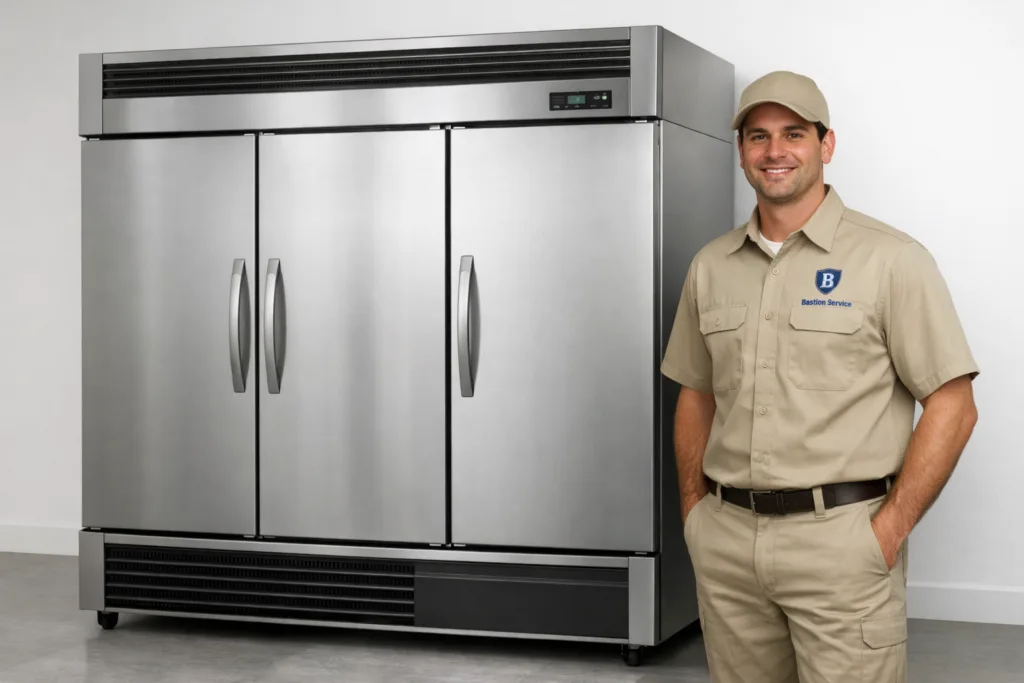




When Turbo Air refrigeration equipment starts running warm, icing over, leaking, or recovering too slowly, the priority is not guesswork. Rancho Park businesses usually need service that identifies the actual fault, explains the operational risk, and helps schedule repair around product protection and daily workflow. Bastion Service provides Turbo Air refrigeration equipment repair for refrigerator and freezer symptom patterns that interfere with storage reliability, kitchen timing, and normal business operations.
For specific equipment paths in Rancho Park, review Turbo Air Refrigerator Repair in Rancho Park, Turbo Air Freezer Repair in Rancho Park, and Commercial Appliance Repair in Rancho Park.
Effective repair starts with how the problem behaves in real use. A cabinet that feels slightly warm in the morning, a freezer that falls behind during peak hours, or a unit that seems to cool unevenly from shelf to shelf can all point to different causes. Looking at temperature performance, airflow, defrost behavior, fan operation, controls, drain condition, and compressor response helps determine whether the issue is minor, escalating, or already affecting the rest of the system.
Turbo Air refrigerator and freezer symptoms that need attention
Refrigeration problems often show up as operating symptoms before they become full shutdowns. Businesses in Rancho Park typically call for service when food holding temperatures become harder to maintain, frost keeps returning, water appears around the cabinet, or the unit no longer cycles normally. Those symptoms matter because they can affect inventory, prep schedules, and confidence in the equipment from one shift to the next.
Turbo Air refrigerator and freezer issues are often connected. Weak airflow can lead to uneven cooling. Defrost trouble can lead to ice buildup. Door sealing problems can create both frost and temperature instability. A proper repair visit is meant to separate surface symptoms from the failed part or condition causing them.
Common cooling problems and what they may indicate
Cabinet running warm or not reaching set temperature
If a refrigerator or freezer runs but does not pull down to the expected temperature, several causes are possible. Common ones include evaporator or condenser airflow restriction, fan motor failure, sensor or control issues, door gasket leakage, excessive frost, or compressor-related performance loss. On the surface, these can all look like the same warm-cabinet complaint.
For a business, the important question is whether the unit is still protecting product and how quickly the condition is worsening. A unit that is a few degrees off today may be unable to recover at all after door openings or loading tomorrow. Early diagnosis helps determine whether the equipment can stay in limited use while repairs are arranged or whether it should be taken out of service.
Freezer slow recovery after door openings
Slow recovery is a common warning sign in busy environments. If the freezer temperature rises during normal use and takes too long to come back down, the problem may involve airflow loss, icing on the coil, fan trouble, door sealing issues, or declining refrigeration performance. This is especially disruptive when staff depend on predictable holding conditions throughout the day.
When recovery slows down, the issue is rarely solved by adjusting the control setting alone. Service is usually needed to find out why the equipment cannot move cold air or remove heat as designed.
Uneven temperatures inside the cabinet
When some shelves stay cold while others run noticeably warmer, airflow should be checked first. Blocked vents, frost accumulation, evaporator fan problems, poor loading patterns, or control faults can all create temperature variation inside the same unit. In practice, uneven cooling often leads to product rotation issues and uncertainty about where items can be stored safely.
This type of complaint is worth addressing quickly because the cabinet may appear to be operating while still underperforming in key storage zones.
Frost buildup, ice formation, and airflow restriction
Heavy frost on freezer surfaces or around the evaporator area
Frost that keeps returning usually points to a system condition, not a one-time event. Possible causes include a defrost failure, fan problem, warm air entering through a worn gasket or misaligned door, or control issues that keep components running out of sequence. As frost builds, airflow drops, cooling becomes less consistent, and the equipment has to work harder to maintain temperature.
In business-use refrigeration equipment, repeated manual defrosting may buy time, but it does not correct the reason the ice formed. If icing returns after clearing, a repair call is usually the more practical next step.
Airflow feels weak from normal circulation points
Weak airflow is often one of the earliest signs that performance is changing. Ice on the coil, a failing evaporator fan motor, blocked internal passages, or control problems can all reduce circulation. Once air movement drops, refrigerator compartments may feel damp or warm, and freezers may begin showing frost in the wrong places.
Because airflow loss can also push compressors and fans to run longer, delaying service may increase wear on other parts of the unit.
Leaks, condensation, and moisture-related issues
Water collecting under or inside the unit
Water leaks around Turbo Air refrigeration equipment can come from blocked drain lines, defrost drainage problems, melting internal ice, or excess condensation caused by temperature instability. In a busy kitchen or storage area, even a small leak can become a slip risk or spread into nearby equipment zones.
Moisture complaints are worth evaluating promptly because they often overlap with other refrigeration faults. A leaking cabinet may also be dealing with frosting, poor door sealing, or inconsistent internal temperature.
Condensation on doors, frames, or product areas
Visible condensation can indicate warm air infiltration, door closure problems, gasket wear, or cooling performance issues that are changing the cabinet environment. If moisture appears repeatedly, it should not be treated as a housekeeping issue alone. It may be the visible symptom of a temperature-control problem that is already affecting reliability.
Noise, cycling changes, and unstable operation
Unusual noise during normal operation
Buzzing, rattling, fan noise, or louder-than-normal compressor operation can point to worn motors, mounting issues, vibration, airflow obstruction, or a system under strain. Noise complaints are easy to postpone when the cabinet is still cooling, but they often show up before a more serious loss of performance.
For Rancho Park businesses, it often makes sense to schedule inspection when the sound profile changes rather than waiting for a complete failure during operating hours.
Short cycling or running too long
If the unit starts and stops too frequently, or runs almost continuously without reaching the target temperature, the cause may involve controls, sensors, dirty heat exchange surfaces, airflow restrictions, door leakage, or refrigeration performance loss. Either pattern can reduce efficiency and place extra stress on major components.
Changing cycle behavior matters because it often signals that the equipment is no longer operating within normal load conditions, even if it has not stopped cooling entirely.
What a repair visit is meant to clarify
A service appointment is not only about replacing a part. It should answer the questions that matter to the business: what failed, what else may have been affected, whether the unit can remain in operation, and what repair timing makes sense. That is especially important with refrigerator and freezer equipment used every day for storage, prep, and service continuity.
During diagnosis, the goal is to connect symptoms with actual operating conditions rather than treating every warm-cabinet complaint the same way. That helps avoid unnecessary parts replacement and reduces the chance of repeat downtime caused by an incomplete fix.
When repair should be scheduled without delay
- Cabinet temperature is drifting above normal holding range
- Freezer recovery is getting slower during routine use
- Frost returns shortly after clearing
- Airflow feels weak or uneven
- Water is leaking onto the floor or collecting inside the cabinet
- The unit is running constantly or cycling unpredictably
- Noise, alarms, or operating behavior changed suddenly
These symptoms usually mean the equipment needs more than monitoring. If performance is changing fast, waiting can turn a manageable repair into product loss, a scheduling problem, or a larger component failure.
Repair versus replacement considerations
Many Turbo Air refrigeration issues are repairable, especially when the problem is tied to fans, controls, sensors, gaskets, drains, electrical components, or isolated operating faults found early. Replacement becomes more relevant when the equipment has a long breakdown history, major system deterioration, or repair cost that no longer makes sense for the unit’s overall condition.
The value of diagnosis is that it turns a vague symptom into a real decision. Instead of guessing based on warm temperatures or frost alone, the business can weigh repair scope, timing, downtime impact, and expected reliability after service.
Service support for Rancho Park businesses
If your Turbo Air refrigerator or freezer is not holding temperature, building frost, leaking water, or showing unstable cycling, the next step is to schedule repair service based on the current symptom pattern. For businesses in Rancho Park, timely diagnosis helps protect inventory, reduce avoidable downtime, and determine whether the equipment should stay in use, be limited, or be taken offline until repairs are completed.


