
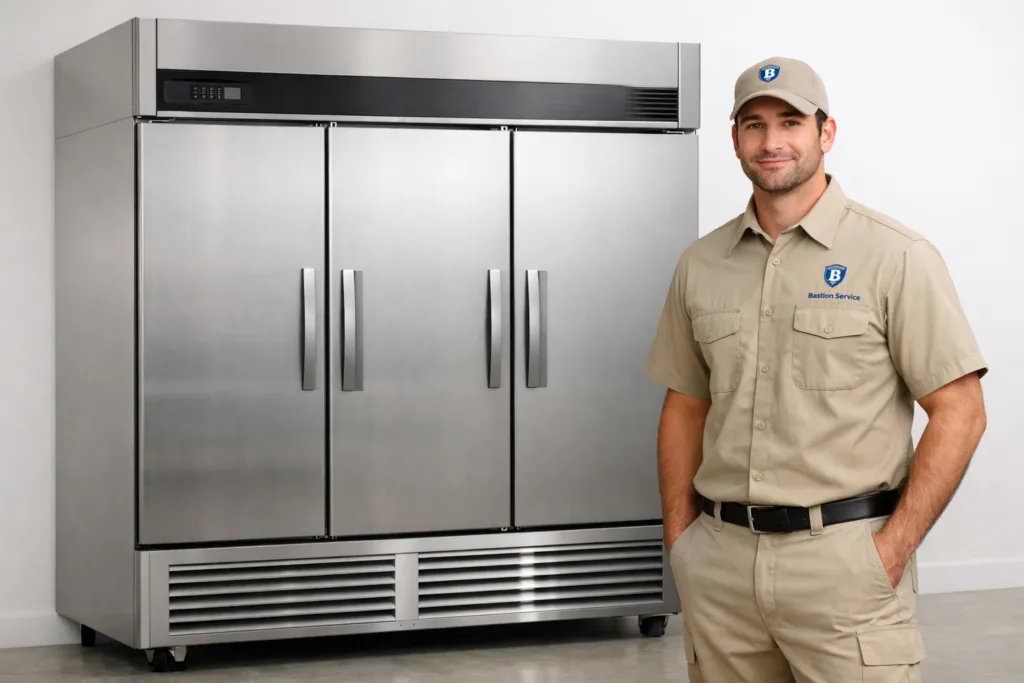




Refrigeration problems usually show up first as an operations issue: a cabinet stops recovering after the door opens, product temperatures become inconsistent, frost starts spreading, or staff notice water on the floor. When that happens, the most useful next step is to have the symptom pattern evaluated so repair scheduling, continued use decisions, and downtime planning are based on how the unit is actually performing rather than guesswork.
For specific equipment paths in Palms, review Turbo Air Refrigerator Repair in Palms, Turbo Air Freezer Repair in Palms, and Commercial Appliance Repair in Palms.
For businesses in Palms, service is often needed before a complete cooling failure occurs. A refrigerator or freezer that is still running can already be creating inventory risk, uneven storage conditions, longer prep delays, and added strain on fans, controls, and compressors. Bastion Service works on Turbo Air refrigeration equipment with attention to fault isolation, repair timing, and what the equipment can realistically handle until service is completed.
Turbo Air refrigerator and freezer symptoms that deserve attention
Turbo Air refrigeration equipment can develop problems gradually or all at once. In either case, the warning signs are usually visible in cabinet temperature, airflow, frost, drainage, or runtime behavior. Addressing those changes early often helps prevent a smaller repair from turning into a broader interruption.
Warm cabinet temperatures and slow recovery
If a refrigerator is running warm or a freezer is taking too long to pull back down after normal door openings, the issue may involve dirty condenser coils, weak airflow, a failing evaporator fan, sensor problems, control faults, door seal leakage, compressor strain, or a sealed-system performance loss. Similar symptoms can come from different causes, which is why repeated thermostat adjustment rarely solves the actual problem.
Warm storage conditions matter even when the unit has not stopped completely. Product may sit in inconsistent temperature zones, staff may begin shifting inventory around to compensate, and the equipment may run longer than normal without reaching the target range. That is usually the point to schedule repair rather than wait for a no-cool call.
Uneven airflow and hot spots inside the cabinet
When one shelf stays colder than another, airflow is weak at the discharge area, or certain sections never seem to hold temperature, circulation should be checked closely. Refrigerator and freezer cabinets depend on steady internal airflow to move cold air where it belongs. If that flow is disrupted, the unit may appear to cool while still storing product unevenly.
Common causes include fan motor trouble, evaporator icing, blocked air paths, heavy frost, or loading patterns that restrict circulation. This type of problem is easy to misread because it can resemble a thermostat issue or a broader cooling failure. A service visit helps confirm whether the repair is centered on airflow components, defrost performance, or another cooling fault behind the symptom.
Frost buildup, ice formation, and defrost-related issues
Recurring frost is more than a cosmetic problem. On a freezer, it can choke airflow and force the system to work harder just to maintain basic temperature. On a refrigerator, it may point to moisture intrusion, a door that is not sealing correctly, a control issue, or a defrost problem that is allowing ice to accumulate where it should not.
Businesses in Palms often notice this first as frost on interior panels, ice near the evaporator section, or repeated condensation around doors. If frost keeps returning after staff clear it, the underlying cause should be diagnosed. Continued operation with heavy ice buildup can lead to reduced airflow, fan damage, and further temperature instability.
Water leaks, pooling, and excess condensation
Water under or inside refrigeration equipment should not be dismissed as a minor nuisance. Drain line blockage, defrost drainage issues, melting ice, poor door sealing, or cooling problems that create abnormal condensation can all lead to leakage. In a busy work area, that also raises safety and sanitation concerns.
Some leaks are straightforward drainage problems. Others are only the visible result of a larger issue, such as recurring frost or poor temperature control. Repair becomes more effective when the source of the water is tied back to the operating condition causing it.
Unusual noise and nonstop running
A refrigerator or freezer that suddenly sounds louder, runs almost constantly, or cycles differently than usual may be showing early signs of component stress. Fans can become noisy as bearings wear. Compressors may run longer when heat exchange drops, airflow is restricted, or the system is struggling to maintain set temperature. Rattling, humming changes, or hard-start behavior are all worth checking before the unit reaches a full breakdown.
Even when the cabinet still feels cold, nonstop runtime often means efficiency and temperature stability are already slipping. That can increase wear on major components and make later repair more involved.
Why symptom-based diagnosis matters
Many refrigeration complaints overlap. A warm cabinet can be caused by poor airflow, a door issue, control trouble, a failing fan, heavy frost, or loss of cooling capacity. Water on the floor may start with drainage, but it can also be tied to ice accumulation or temperature drift. Because the same symptom can point in several directions, the repair decision should come from tested findings instead of replacing parts by assumption.
That matters for scheduling too. Some issues can be corrected during a standard visit if the failed component is accessible and the cabinet condition is otherwise sound. Other situations may require parts ordering, unloading the unit, or limiting use until follow-up service is completed. Knowing which situation applies helps businesses plan around downtime more effectively.
When a running unit should still be serviced
Businesses often wait because the equipment has not failed completely. But refrigeration equipment does not need to be fully down to be affecting operations. Service should move up in priority when you notice:
- temperature readings that drift or do not match expected cabinet conditions
- freezer product softening or refrigerator contents warming during normal use
- airflow that feels weak or inconsistent across shelves or sections
- frost returning after it has already been cleared
- water leaks, condensation, or ice melt around the cabinet
- long recovery times after doors are opened
- fans or compressors sounding different than usual
- runtime increasing without stable cooling performance
These signs often show up before a complete cooling loss. Acting early can reduce spoilage risk and help keep the repair limited to the component or system actually causing the problem.
Repair versus replacement considerations
Not every Turbo Air issue points toward replacement, and not every unit that still runs is a good candidate for continued repair. The decision usually depends on the age and condition of the cabinet, how severe the fault is, whether the problem is isolated or recurring, and how important the unit is to daily operations.
Repair is often the better choice when the cabinet is structurally sound and the issue is tied to a fan motor, control component, gasket, drain problem, defrost part, or another serviceable failure. Replacement becomes a more serious consideration when the equipment has repeated breakdown history, significant cabinet deterioration, major cooling-system trouble, or repair cost that no longer supports the equipment’s role in the business.
What to expect from a service visit
A refrigeration service appointment should do more than confirm that the cabinet feels warm. It should help clarify what is failing, whether the equipment can remain in use temporarily, whether additional parts are likely needed, and how quickly the problem should be addressed to avoid broader disruption. For businesses in Palms, that kind of assessment helps with staffing, product movement, and short-term operating decisions while repair is being planned.
If your Turbo Air refrigerator or freezer is showing temperature drift, weak airflow, frost buildup, leaking water, or inconsistent recovery in Palms, the practical next step is to schedule service before the problem spreads into inventory loss or a longer shutdown. Early diagnosis helps define the repair path, set realistic timing, and protect day-to-day operations.


