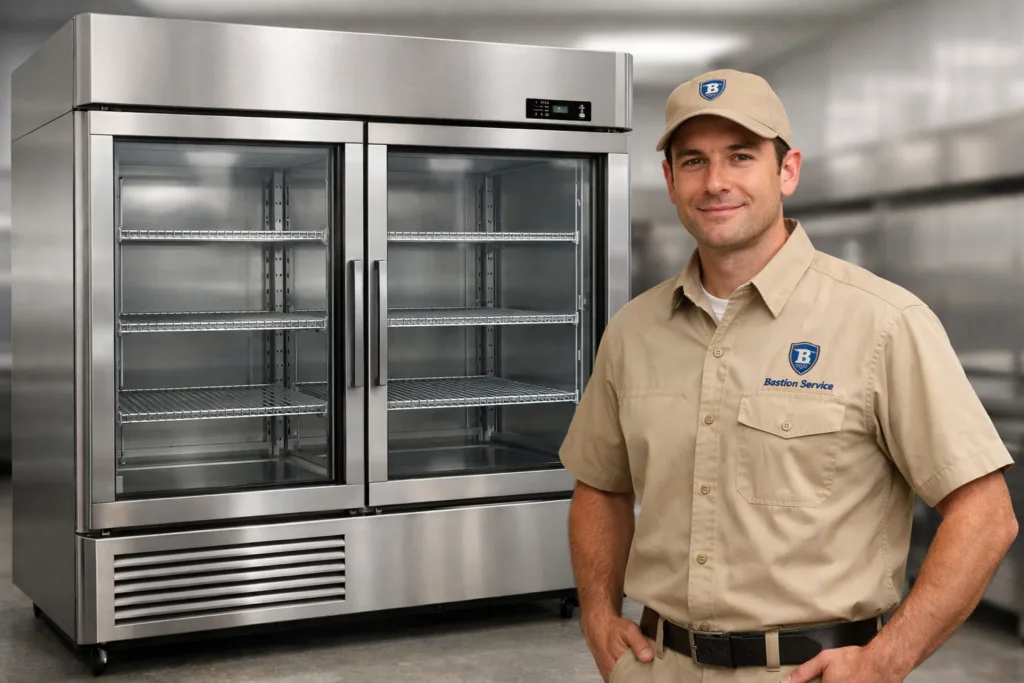




Turbo Air refrigeration equipment that runs warm, frosts over, leaks, or cycles unpredictably can disrupt prep, storage, and service well before it stops completely. Similar symptoms can come from very different causes, so the next step should be based on how the unit is actually behaving, not just the most visible problem.
For specific equipment paths in Los Angeles, review Turbo Air Refrigerator Repair in Los Angeles, Turbo Air Freezer Repair in Los Angeles, and Commercial Appliance Repair in Los Angeles.
How Turbo Air refrigeration problems usually show up
In restaurants, cafés, markets, and other food-service settings, refrigerator and freezer problems often begin as small operating changes. Staff may notice slower temperature recovery after door openings, uneven cooling from one section to another, extra condensation, returning frost, or a cabinet that seems to run constantly. Those signs often point to airflow restrictions, door seal wear, fan issues, controls, sensors, defrost faults, drainage problems, or heavier system strain.
Because Turbo Air equipment is used for day-to-day holding and workflow support, symptom patterns matter. A freezer with heavy ice buildup and a refrigerator with weak airflow may both have temperature complaints, but the repair path can be very different. Identifying the failure correctly helps prevent unnecessary parts replacement and reduces the chance of repeat downtime.
Temperature problems in refrigerators and freezers
Cabinet running warmer than normal
When a refrigerator or freezer is not holding temperature, the cause may be as simple as restricted condenser airflow or as serious as a compressor or sealed-system issue. Other common possibilities include faulty evaporator fans, sensor drift, thermostat problems, control board faults, door gasket leakage, or defrost trouble that restricts air movement across the coil.
Warm cabinets should be taken seriously because the unit may still sound normal while performance continues to decline. If staff are lowering temperature settings repeatedly just to keep product cold, that usually signals an underlying mechanical or control problem rather than a settings issue.
Slow recovery after door openings
Recovery time matters in busy kitchens and storage areas. If the cabinet temperature rises during normal access and takes too long to pull back down, the unit may be losing efficiency through poor airflow, dirty coils, weak fan performance, worn door gaskets, or refrigerant-related problems. Slow recovery is often one of the earliest signs that the system is under strain.
One section cold, another section warm
Uneven temperature across a cabinet can indicate blocked air channels, evaporator fan problems, sensor placement issues, loading patterns that interfere with circulation, or an early-stage control fault. This is especially important when staff trust one reading while product in another area is not being held at the same temperature.
Frost, ice, and airflow issues
Heavy frost buildup
Frost inside a freezer or on interior surfaces often points to warm air intrusion, door alignment issues, gasket damage, defrost failure, or evaporator airflow problems. Frost is not just a cosmetic issue. As ice builds, airflow becomes more restricted, temperatures become less stable, and run times increase.
Ice returning soon after clearing
If frost or ice comes back quickly after being removed, the root cause has not been resolved. This often suggests a failed heater, thermostat, sensor, timer, control issue, or ongoing air leak at the door. Repeated icing can also place extra load on fans and contribute to poor freezer recovery.
Weak or blocked airflow
Turbo Air refrigerators and freezers depend on steady air movement to keep temperatures even. When airflow is weak, the unit may cool unevenly, develop warm spots, or show moisture and frost in places where it normally does not. Fan motor wear, ice on the evaporator, blocked returns, and coil-related issues are all common reasons airflow drops off.
Water leaks and moisture problems
Water inside or around refrigeration equipment can create sanitation concerns, slippery floors, and avoidable interruptions in busy work areas. Leaks may come from clogged drain lines, frozen drain paths, condensate handling problems, or ice melt caused by unstable cabinet temperatures.
Moisture around door frames or inside the cabinet can also suggest warm air entering through damaged gaskets or poor door closure. In some cases, what looks like a simple leak is actually a sign of a larger cooling or defrost issue.
Noises, constant running, and cycling changes
Unit running all the time
A refrigerator or freezer that rarely cycles off may be struggling with dirty coils, airflow restriction, door seal leakage, sensor problems, low cooling capacity, or rising ambient heat load. Constant running increases wear and can turn a manageable repair into a larger failure if left alone too long.
Short cycling or repeated starting attempts
Repeated starts and stops can indicate control faults, relay or capacitor problems, compressor starting trouble, or electrical issues affecting normal operation. Short cycling should be checked early because repeated restart stress can damage related components.
Buzzing, rattling, clicking, or fan noise
Abnormal sound changes often help narrow down the problem. Fan blade contact, worn motors, loose panels, vibration, compressor-related noise, or failing start components can all show up as new or worsening sounds. Noise by itself does not confirm the exact failure, but it is often an important clue when matched to temperature, frost, or cycling symptoms.
Turbo Air refrigerator repair considerations
Refrigerators often show trouble through warmer cabinet temperatures, condensation, poor recovery, inconsistent shelf temperatures, or noisy evaporator and condenser operation. These issues affect prep timing, ingredient holding, and normal line support. When the cabinet and core structure are still in good condition, repair is often the more sensible option if the problem is limited to serviceable parts or a defined cooling fault.
Early attention is especially important when the refrigerator still works part of the time. Partial cooling can be misleading and may cause staff to keep relying on a unit that is no longer performing consistently.
Turbo Air freezer repair considerations
Freezers usually draw attention faster because product softening, frost accumulation, and ice formation tend to become obvious quickly. Common warning signs include long run times, poor pull-down, heavy frost near the evaporator area, door seal issues, temperature swings, and alarms that return after resetting.
Freezer issues can escalate quickly because reduced performance often leads to longer compressor run time and growing ice restriction at the same time. If stored product quality is becoming difficult to trust, the problem has moved beyond routine inconvenience.
When Los Angeles businesses should schedule service
Service makes sense when the equipment shows recurring temperature drift, repeated frost buildup, standing water, unusual noise, weak airflow, or visible strain such as constant operation. It is also worth scheduling when the symptom is intermittent. Intermittent control, fan, and defrost failures often become more disruptive over time and may be less expensive to address before they lead to a full shutdown.
For Los Angeles operators managing inventory, prep schedules, and kitchen flow, even a unit that temporarily recovers may still be headed toward a larger failure. Waiting usually increases the risk of product loss, staff disruption, and additional part damage caused by the same unresolved issue.
When continued use may make the problem worse
Continuing to run a refrigerator or freezer that is warm, heavily iced, leaking, or cycling abnormally can increase wear on fans, controls, and compressor-related components. A unit that must run continuously to keep up is usually operating under stress. In that condition, the system may be maintaining appearance more than actual reliability.
If temperatures are no longer stable, frost keeps returning, or staff have to keep adjusting settings to maintain performance, it is better to have the equipment evaluated than to treat the condition as temporary.
Repair or replacement: what usually matters most
Many Turbo Air refrigerator and freezer problems are still worth repairing when the cabinet condition is solid and the fault is isolated. Replacement becomes a more realistic discussion when failures are repeating across multiple systems, efficiency has dropped significantly, or repair cost no longer makes sense compared with the equipment’s condition and remaining useful life.
The most helpful service visit is one that separates a single failed component from broader equipment decline. That gives business operators a better basis for deciding whether to restore the unit, plan for a larger repair, or move toward replacement without unnecessary disruption.
What a service assessment should clarify
A useful service assessment should identify what is failing, what related systems should be checked, how the current symptom affects safe operation, and whether the expected repair is likely to hold up under normal business use. That is especially important with refrigeration equipment because warm temperatures, poor airflow, and frost can all overlap while coming from different root causes.
For Turbo Air refrigeration equipment in Los Angeles, symptom-based troubleshooting gives businesses a clearer path forward for both refrigerator and freezer issues. The goal is not just restoring cooling, but understanding whether the equipment can return to stable, workable operation in the environment where it is used every day.