
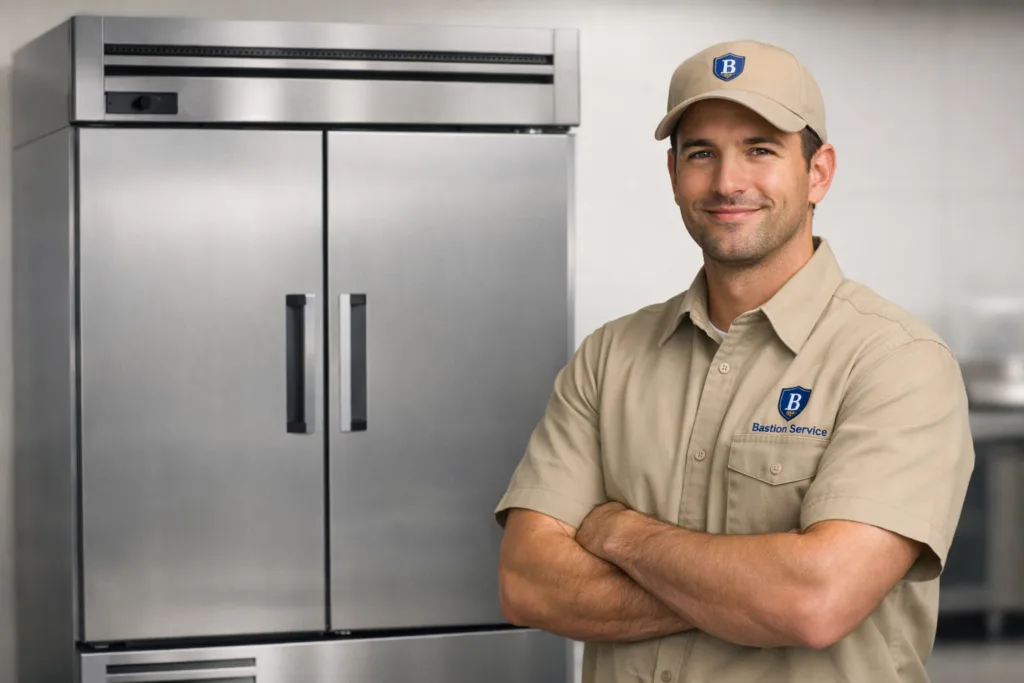




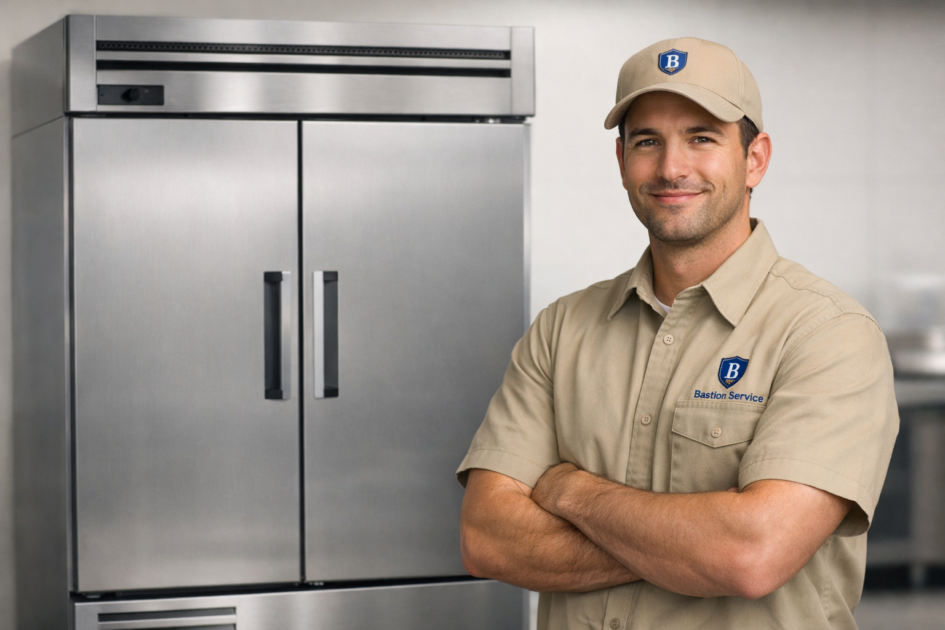
Freezer problems rarely stay small for long in a busy operation. If a True unit is warming, icing over, leaking, or running harder than usual, service should focus on the exact symptom pattern, how quickly conditions are changing, and whether continued operation risks product loss or added component stress. Bastion Service helps businesses in Inglewood evaluate True freezer issues, schedule repair at the right time, and move from uncertainty to a repair decision based on what the equipment is actually doing.
Related commercial service paths in Inglewood include True Commercial Repair in Inglewood, Commercial Freezer Repair in Inglewood, and True Refrigerator Repair in Inglewood.
Common True freezer symptoms and what they often mean
Not staying cold enough
A freezer that cannot hold temperature may have more than one contributing problem. Dirty condenser coils, weak airflow, evaporator ice buildup, fan motor failure, sensor drift, control faults, or refrigerant-related issues can all produce similar warming symptoms. In a business setting, the important question is not just whether the cabinet is cold at the moment, but whether it is recovering normally after door openings and holding stable through the day.
If product is softening, the display is creeping upward, or the cabinet seems cold in one area and warm in another, the unit should be checked before the problem spreads into compressor strain or inventory loss.
Frost buildup in the cabinet or around the door
Excess frost usually points to unwanted air entering the cabinet or to a defrost problem that is not clearing ice as it should. Worn gaskets, a door that is misaligned, frequent door openings, damaged heaters, control issues, or fan problems can all lead to frost patterns that interfere with normal airflow.
As ice builds, the freezer may start to look like it has a major cooling failure when the original issue is actually airflow restriction or moisture intrusion. That is why frost location matters. Ice at the evaporator, along interior panels, or around the door opening can each suggest different repair paths.
Runs constantly or cycles too often
A True freezer that rarely shuts off may be trying to overcome heat entering the cabinet, poor coil conditions, weak airflow, or reduced cooling capacity. Short cycling can point to electrical faults, control problems, overheating, or early compressor trouble. Both operating patterns deserve attention because they affect temperature consistency and increase wear on important components.
Fan noise, buzzing, rattling, or vibration
New sounds often show up before a full breakdown. Scraping can indicate ice contacting a fan blade. Rattling may come from loose panels or mounting hardware. A buzzing sound can be tied to electrical parts, motors, or compressor-related issues. If the noise changes with door openings, defrost cycles, or certain times of day, that detail can help narrow down the source.
Water on the floor or moisture inside
Water near the unit is not just a housekeeping issue. It can indicate a blocked or frozen drain, excess frost melt, a gasket problem, or humid air entering the cabinet too often. Interior moisture can also be a sign that the door is not sealing correctly or that the freezer is struggling to control temperature evenly.
Why a warm freezer is not always a refrigeration failure
One of the most common repair mistakes is assuming every temperature problem means the sealed system has failed. In practice, many warming complaints trace back to airflow restrictions, fan problems, control faults, defrost issues, or door sealing problems. Those faults can make the cabinet act like it has lost cooling capacity even when the root problem is elsewhere.
That is why symptom-based testing matters. A freezer that warms during busy periods but improves overnight may point in one direction, while a unit that never fully recovers may point in another. The difference affects parts decisions, repair urgency, and whether temporary continued use is realistic.
Signs the problem is becoming urgent
- Product temperature is no longer stable from one shift to the next.
- Ice buildup is increasing quickly instead of staying minor and predictable.
- The freezer runs almost nonstop and still struggles to recover.
- Fans stop intermittently or airflow feels weak inside the cabinet.
- The unit begins making new mechanical or electrical noises.
- Moisture, dripping, or floor water appears repeatedly.
- Door gaskets are torn, loose, or no longer sealing firmly.
Any of these can indicate that the unit is moving past a manageable performance issue and into a condition that creates higher downtime risk.
What technicians typically look at during diagnosis
Effective freezer repair starts with the operating pattern, not a guess. That usually includes checking cabinet temperature behavior, airflow, fan operation, evaporator condition, door seal integrity, coil condition, controls, defrost function, drainage, and overall cycling behavior. The goal is to identify the fault that is driving the symptom rather than replacing parts based only on appearance.
For businesses in Inglewood, this matters because downtime costs are not limited to the unit itself. A freezer that cannot recover properly affects prep schedules, storage decisions, staffing rhythm, and confidence in held product. Good diagnosis helps determine whether the unit needs prompt repair now or whether a broader equipment decision should be considered.
When continued use may cause more damage
Some units can stay in limited operation briefly while awaiting service, but others should not be pushed. If the freezer is running constantly, building heavy ice, showing repeated temperature swings, or struggling after every door opening, continued operation may overwork the compressor and fan motors. The same is true when airflow is blocked by frost or when a failing gasket is allowing constant warm-air intrusion.
If the cabinet is no longer holding reliably, it should not be treated as dependable simply because it is still on. In many cases, waiting adds strain and turns a contained repair into a larger event.
Repair or replacement: how businesses usually decide
Repair is often the sensible option when the cabinet is structurally sound and the problem is tied to serviceable components such as fans, controls, gaskets, defrost parts, drains, sensors, or electrical items. Replacement becomes a more serious conversation when the freezer has repeated cooling failures, multiple age-related issues at once, or a repair scope that no longer supports reliable daily use.
The best decision usually comes down to more than age alone. Condition, downtime history, temperature stability, and the role the unit plays in daily operations all matter. A freezer used heavily for core storage needs a different standard of reliability than a unit with lighter demand.
How to prepare for a True freezer service visit
- Note whether the problem is constant or intermittent.
- Record any recent temperature swings or alarm conditions.
- Check whether frost is forming in one area or throughout the cabinet.
- Pay attention to unusual sounds and when they occur.
- Identify whether the door closes firmly every time.
- Be ready to describe if recovery is slow after loading or door openings.
These details can make diagnosis faster and help separate a cooling complaint from an airflow, defrost, or access-related problem.
Service-focused next steps for businesses in Inglewood
When a True freezer starts showing temperature loss, frost buildup, fan noise, leaking, or erratic cycling, the best next step is to schedule service before the unit becomes harder to stabilize. For businesses in Inglewood, timely repair helps protect stored product, reduce unnecessary strain on key components, and restore freezer performance with a plan based on the actual fault instead of guesswork.





