
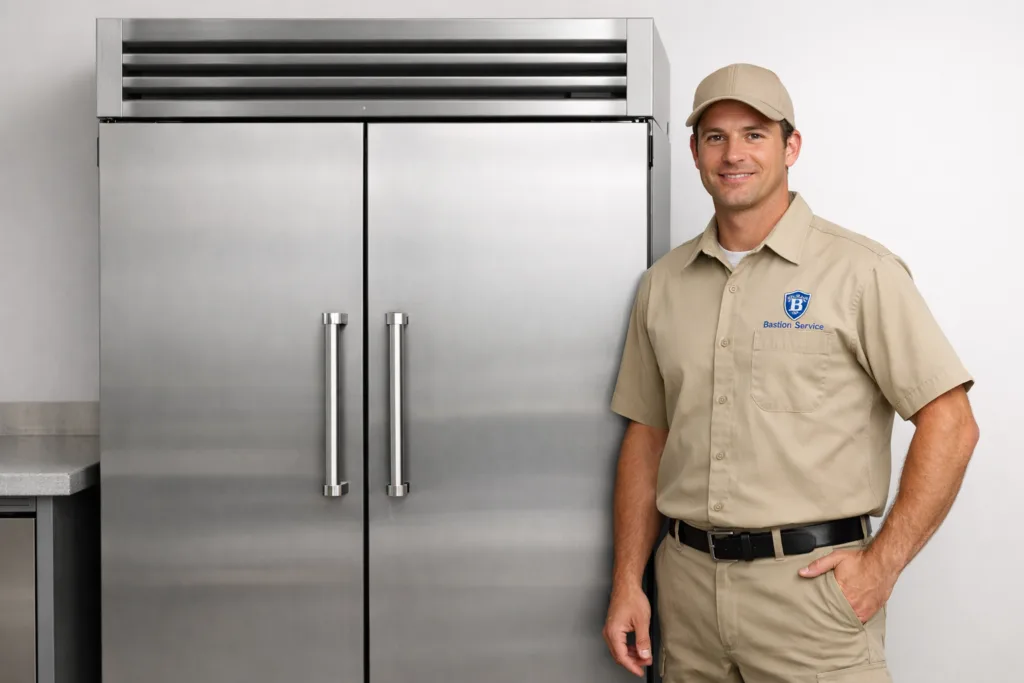




When a True refrigerator or freezer starts losing temperature control, building frost, or showing airflow problems, the next step is usually about protecting inventory and keeping the workday moving. For businesses in Santa Monica, repair service is most useful when it focuses on the actual symptom pattern, the likely cause, and how urgently the equipment should be addressed based on current operating risk.
For specific equipment paths in Santa Monica, review True Refrigerator Repair in Santa Monica, True Freezer Repair in Santa Monica, and Commercial Appliance Repair in Santa Monica.
Bastion Service provides True refrigeration equipment repair for businesses that need a service-oriented response: determine what is failing, identify whether continued operation could worsen the problem, and schedule repair around the realities of daily kitchen and storage use.
True refrigeration equipment problems that need prompt repair attention
True refrigeration equipment is often relied on for consistent holding temperatures, but several common issues can disrupt that performance quickly. What looks like a simple warm-cabinet complaint may actually come from fan failure, control problems, door sealing loss, frost restriction, drainage issues, or a deeper cooling-system fault. The value of service is in separating those possibilities before downtime expands.
- Cabinets running warm or taking too long to recover
- Freezers developing frost or heavy interior ice
- Uneven temperatures from shelf to shelf or section to section
- Constant running or short cycling
- Water leaks, condensation, or interior dripping
- Weak airflow or dead spots inside the cabinet
- Buzzing, clicking, rattling, or fan-related noise changes
For restaurants, hospitality operations, and other businesses in Santa Monica, these symptoms are rarely isolated inconveniences. They affect food safety, prep flow, product consistency, and confidence in whether the equipment can stay online through the next shift.
Temperature problems in True refrigerators and freezers
Warm cabinets and poor cooling recovery
If a refrigerator or freezer is slow to pull down, struggles after normal door openings, or cannot hold stable product temperature, repair should be scheduled before the issue turns into stock loss or compressor stress. Warm operation can come from restricted condenser performance, evaporator fan trouble, sensor errors, control board faults, gasket leakage, or sealed-system problems.
One reason professional diagnosis matters is that partial cooling can be misleading. A unit may still feel cold enough at first glance while actually operating outside the range needed for reliable daily use. In that condition, runtime increases, recovery gets weaker, and the chance of a larger failure goes up.
Temperature swings during normal use
Temperature drift that comes and goes often points to a system that is no longer responding consistently. In some cases, the problem appears only during busy periods or after repeated door openings. In others, the cabinet may recover overnight but fall behind once operations pick up again.
That pattern can indicate airflow imbalance, failing sensors, control instability, door seal issues, or developing frost on the evaporator side. When temperatures fluctuate rather than fail completely, it is still worth treating as a repair issue rather than waiting for a full shutdown.
Airflow loss and uneven cooling inside the cabinet
Airflow is one of the most important parts of refrigerator and freezer performance. When circulation weakens, cold air may not move correctly through the cabinet, which creates hot spots, inconsistent holding, and longer recovery times. Operators often notice that product near one area stays colder than product in another, or that the unit sounds different while running.
Common airflow-related causes include fan motor failure, ice restricting coil airflow, blocked air paths, or component wear that reduces normal circulation. These issues should be addressed promptly because uneven cooling tends to worsen gradually, making the cabinet look partly functional while reliability continues to drop.
- Top shelves warmer than lower sections
- Back areas colder than front product zones
- Cold output that seems weaker than usual
- Longer pull-down after loading or restocking
- Noticeable sound change from internal fan operation
Frost buildup, ice formation, and defrost-related symptoms
What frost usually means
Frost inside a True freezer or around interior panels is usually a sign that the equipment is dealing with moisture intrusion, poor sealing, defrost malfunction, or restricted airflow. As frost thickens, circulation becomes less effective and temperatures become harder to control. What starts as a light buildup can turn into a much bigger operating problem if it begins interfering with fans or coil performance.
Frost should not be treated as a minor cosmetic issue. It often signals a functional problem that is already reducing efficiency and putting additional strain on the equipment.
Door gaskets and sealing problems
When doors do not seal correctly, warm air enters the cabinet and introduces moisture that contributes to frost, condensation, and longer run times. Worn gaskets, alignment issues, or doors that do not close fully can create a chain reaction of performance problems. Repair service can determine whether the main issue is a sealing fault, a defrost issue, or multiple conditions happening together.
Leaks, condensation, and water around the unit
Water on the floor, interior dripping, or excessive condensation around a refrigerator or freezer should be evaluated before it leads to sanitation concerns or slip hazards. These symptoms may come from clogged drains, icing and thawing in the wrong areas, seal failure, or temperature conditions that are no longer staying balanced.
Not every leak points to the same repair path. Some problems are water-management issues tied to drainage and condensation, while others are secondary signs of a larger cooling failure. That is why leak complaints are best handled as part of a full refrigeration diagnosis instead of being treated as stand-alone cleanup problems.
Noise changes, long run times, and other warning signs
True refrigeration equipment often gives warning signs before a complete loss of cooling. A unit that suddenly becomes louder, cycles differently, or seems to run without resting is usually telling you that one or more components are under stress. Clicking, buzzing, rattling, fan noise, or abnormal vibration can all help narrow down where the fault may be developing.
Long run times are especially important because they usually mean the cabinet is fighting heat load, restricted airflow, frost buildup, control issues, or cooling loss. If the equipment no longer cycles normally, feels hot around the mechanical section, or cannot keep up during routine use, repair should be scheduled before the unit falls too far behind to remain usable.
Repair decisions for businesses relying on daily cold storage
For many businesses in Santa Monica, the key question is not just whether the unit can be made cold again, but whether it can return to stable operation without repeated interruptions. That makes symptom history important. A single recent issue may point to an isolated repair, while recurring temperature drift, repeated icing, or chronic leak problems can suggest a broader reliability concern.
During service evaluation, it helps to consider:
- Whether temperatures are currently safe and stable
- How often the issue has happened recently
- Whether airflow, frost, and noise symptoms are happening together
- How the problem affects prep, storage, and workflow
- Whether continued use may increase damage or downtime
This kind of assessment helps business operators make an informed repair decision instead of waiting for the equipment to stop completely.
When to schedule service
Repair should be scheduled when a True refrigerator or freezer shows recurring warm temperatures, weak recovery, frost buildup, water leaks, inconsistent airflow, unusual sounds, heavy condensation, or nonstop operation. These are all signs that the equipment is no longer performing normally and may become less reliable with continued use.
If your business in Santa Monica is seeing these symptoms, the most practical next step is to book service while the problem is still active enough to evaluate clearly. That makes it easier to identify the fault, explain the repair path, and decide whether the equipment can remain in operation or should be taken offline until repairs are completed.


