
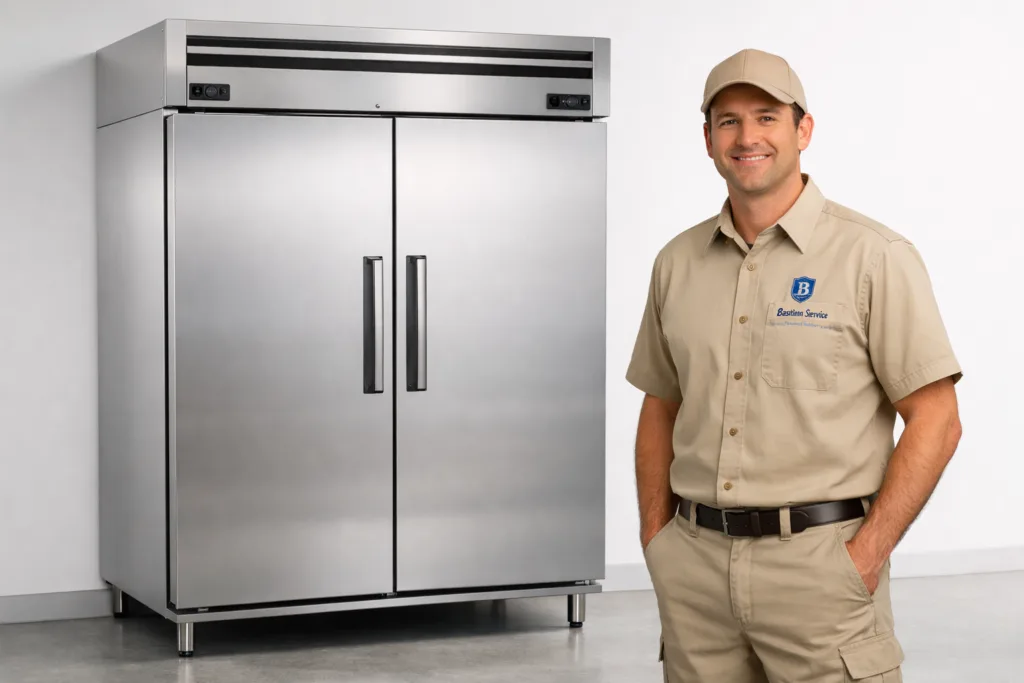




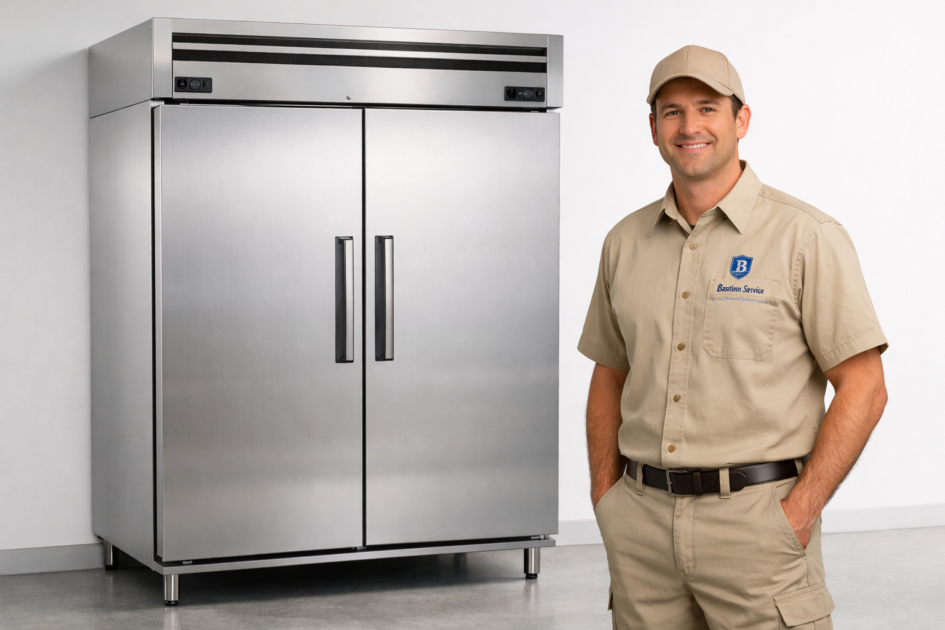
When a True refrigerator or freezer starts drifting out of temperature, the next step should be a service call that identifies the fault before a small performance issue turns into product loss or a workday disruption. For businesses in Mar Vista, repair decisions often need to happen quickly, but they still need to be based on what the equipment is actually doing: running constantly, icing over, leaking, failing to recover, or holding uneven temperatures from one section of the cabinet to another.
For specific equipment paths in Mar Vista, review True Refrigerator Repair in Mar Vista, True Freezer Repair in Mar Vista, and Commercial Appliance Repair in Mar Vista.
Bastion Service helps Mar Vista businesses troubleshoot True refrigeration equipment with a repair-first approach centered on diagnosis, scheduling, parts planning, and downtime impact. That matters because the same symptom can come from very different causes, and the right repair path depends on whether the problem involves airflow, controls, door sealing, defrost operation, fan failure, or a deeper cooling-system issue.
True refrigerator and freezer symptoms that often lead to repair
True refrigeration equipment is built for day-to-day business use, but heavy door traffic, dust, moisture, wear, and aging components can gradually reduce performance. In some cases the warning signs are subtle at first. Staff may notice longer recovery after doors open, warmer product near certain shelves, more frost than usual, or a cabinet that seems to run without shutting off. In other cases, the problem is immediate and obvious, such as a freezer softening product overnight or a refrigerator no longer circulating cold air.
Service becomes more important when the unit still appears to run but no longer performs consistently. A cabinet that powers on is not necessarily cooling correctly, defrosting correctly, or moving air the way it should. That is why symptom-based testing is usually the most useful starting point.
Temperature swings and warm cabinet conditions
If a refrigerator is no longer staying in range, or a freezer is warming during normal operation, there may be more than one possible cause. Dirty condenser coils, fan motor failure, inaccurate sensors, thermostat or control problems, low airflow, refrigerant loss, and weak door sealing can all show up as weak cooling. From the outside, these failures may look similar even though the repair needed is completely different.
Warm cabinet complaints deserve prompt attention when the equipment cannot recover after routine door openings, when temperatures vary widely during the day, or when product quality is becoming harder to trust. The longer the unit runs in that condition, the more strain it can place on the cooling system and the harder it may be to schedule repairs around operations.
Freezer recovery problems and soft product
Freezers often show trouble through delayed pull-down, soft corners on stored product, interior frost, or a cabinet that seems colder near one area than another. These patterns may point to airflow restrictions, evaporator icing, defrost component failure, sensor issues, fan problems, or sealed-system trouble. A unit that starts the day close to normal but loses performance as hours pass often needs inspection before the issue becomes a full outage.
For businesses in Mar Vista, freezer performance problems can affect inventory decisions quickly. If staff are rotating product to different sections, watching temperatures more closely than usual, or compensating with repeated setting changes, those are strong signs that the equipment needs service rather than observation alone.
Airflow loss and uneven cooling
True refrigerators and freezers depend on consistent air movement to keep storage conditions stable. When airflow drops, the cabinet may develop warm spots, ice in unusual places, poor recovery after loading, or top-to-bottom temperature differences. Products near one shelf may stay acceptable while items in another area trend too warm or too cold.
Airflow problems can be tied to evaporator fan issues, blocked air passages, frost around the coil area, damaged gaskets, or controls that are not managing defrost and cooling cycles properly. A service visit helps separate a simple fan or gasket repair from a larger issue that is disrupting overall cabinet performance.
Frost buildup and repeated icing
Frost that returns after clearing usually means the underlying cause has not been addressed. In freezers, recurring frost often points to door-seal leakage, heavy moisture entering the cabinet, defrost heater failure, sensor faults, or a problem with the defrost control sequence. In refrigerators, icing may also appear when airflow is reduced or when the evaporator area is not clearing properly between cycles.
Once frost starts affecting fans or air circulation, temperature stability usually declines soon after. What begins as an annoyance can become a cooling complaint, a noisy unit, or a cabinet that no longer reaches the target range. Repair at that stage is less about removing visible ice and more about correcting why the frost keeps coming back.
Water leaks and condensation issues
Water on the floor or excess moisture inside the cabinet should not be treated as a cosmetic problem. Leaks may come from blocked drains, defrost drainage trouble, condensation from poor door sealing, or melting ice caused by weak cooling. In a busy kitchen or storage area, repeated leaking also creates cleanup demands and slip risk.
Moisture issues often overlap with temperature and airflow problems, so the repair plan should account for the full symptom pattern rather than only the water itself. If the unit is leaking and also struggling to hold temperature, both symptoms may be tied to the same failure.
What a symptom pattern can suggest about the repair path
Not every failure points to the same level of repair. Some service calls lead to targeted fixes such as replacing a fan motor, door gasket, sensor, drain component, or defrost part. Others reveal broader concerns involving compressor performance, refrigerant circulation, or multiple worn components affecting reliability at once.
A helpful diagnosis looks at the relationship between symptoms. For example:
- Warm temperatures plus constant running can suggest airflow restriction, control issues, or a cooling-system problem.
- Frost plus weak airflow often points toward a defrost or evaporator-related fault.
- Leaks plus interior icing may indicate drainage trouble connected to repeated freeze-thaw buildup.
- Uneven temperatures plus noisy operation can suggest fan problems or ice interfering with air movement.
- Poor freezer recovery after loading may indicate a unit that is no longer cycling or transferring heat normally.
Looking at symptoms this way helps businesses in Mar Vista make better repair decisions. Instead of treating each issue as separate, the service process can identify whether there is one root cause or several related failures developing at the same time.
When to schedule service instead of continuing to monitor
Some equipment problems can be observed briefly, but certain conditions usually justify immediate scheduling. Service should move up the list when temperatures are no longer dependable, frost returns quickly after clearing, the unit runs continuously with poor results, fans sound abnormal or stop altogether, or staff have to keep adjusting settings to maintain acceptable performance.
Repeated alarms, visible ice around internal panels, water collecting around the unit, and cabinets that feel warmer during peak use are also signs that continued operation may carry unnecessary risk. Even if the equipment is still partially functional, unstable refrigeration performance rarely improves on its own.
Repair planning for downtime, parts, and continued use
Once the fault is identified, the next question is usually whether the unit can stay in service while parts are ordered or whether it should be taken offline right away. That decision depends on the severity of the symptom, current holding performance, risk to stored product, and whether continued use could damage additional components.
Repair planning should also consider the age of the equipment, recent breakdown history, and whether the problem is isolated or part of a larger reliability trend. A refrigerator with a sound cabinet and one failed component may be an easy repair decision. A freezer with recurring cooling complaints across multiple visits may require a broader discussion about overall condition and expected future downtime.
When repair is often the right move
Repair is commonly the practical option when the cabinet structure is in good shape and the issue is limited to a specific functional area. Fan motors, sensors, gaskets, drains, and many defrost-related parts often fall into this category. When these faults are addressed before they create more strain, the unit can often return to stable operation without a major equipment decision.
When a replacement discussion starts to make sense
Replacement may become part of the conversation when the equipment has repeated major failures, poor reliability across more than one system, or repair costs that no longer match the unit’s remaining service value. Even then, the immediate symptom still needs proper diagnosis. What appears to be a major cooling failure may turn out to be a more contained repair, while a seemingly minor complaint may reveal wider system wear.
Service-oriented next steps for True refrigeration equipment in Mar Vista
If a True refrigerator or freezer is showing warm cabinet conditions, frost buildup, leaks, airflow loss, or slow recovery, the most useful next step is to schedule repair evaluation based on the actual symptom pattern. For businesses in Mar Vista, timely service can help protect stored product, reduce avoidable downtime, and clarify whether the unit should remain in operation, be repaired promptly, or be set aside for a broader equipment decision.


