
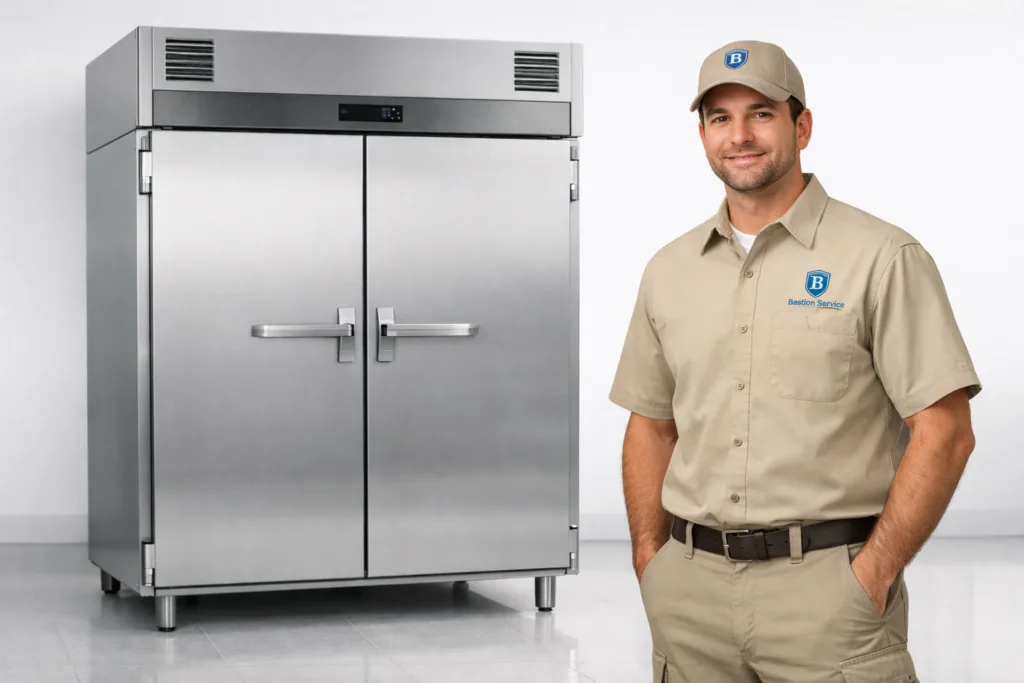




When a Traulsen refrigerator or freezer starts running warm, building frost, leaking, or cycling in unusual ways, the right next step is to have the symptom pattern evaluated before the problem spreads. For businesses in Torrance, refrigeration equipment issues can interrupt prep, storage, service flow, and inventory protection, so repair decisions usually depend on how the unit is performing now, how quickly conditions are changing, and whether continued operation is creating more risk.
For specific equipment paths in Torrance, review Traulsen Refrigerator Repair in Torrance, Traulsen Freezer Repair in Torrance, and Commercial Appliance Repair in Torrance.
Bastion Service helps businesses in Torrance troubleshoot Traulsen refrigeration equipment with a service-oriented approach focused on inspection, repair planning, and scheduling around operational downtime. The goal is to identify the source of the failure, explain what the symptoms suggest, and determine whether the unit should stay in use, be repaired promptly, or be considered for replacement planning.
Common Traulsen refrigerator and freezer symptoms
Refrigeration equipment problems often begin with small changes that become bigger operating issues over time. A cabinet that seems only slightly warm may also be running longer than normal. A little frost may be restricting airflow. A small leak may point to a drain or defrost problem that is affecting cabinet performance. Looking at symptoms in groups helps narrow down what the equipment is actually doing.
Warm cabinet temperatures and weak cooling
If a refrigerator is not holding temperature or a freezer is no longer freezing product consistently, several systems may be involved. Common causes include restricted airflow, sensor or control issues, fan failures, ice buildup around the evaporator, gasket problems, or declining refrigeration performance. In a busy kitchen or storage area, even a mild temperature shift can become serious if staff has to keep checking product, move items between units, or adjust routines to compensate.
Warning signs in this category often include:
- Cabinet temperatures rising during normal use
- Product softening in a freezer
- Recovery taking too long after door openings
- The unit running almost constantly
- Alarms or repeated temperature concerns
These symptoms usually need more than a simple reset. A repair visit helps determine whether the issue is isolated to controls or airflow, or whether a larger cooling fault is developing.
Uneven airflow and inconsistent cooling zones
When one section of the cabinet stays cold and another does not, airflow is often part of the problem. Refrigeration equipment depends on proper circulation to move cold air where it is needed. If a fan motor is weak, an evaporator area is iced over, interior loading blocks circulation, or door seals are allowing warm air in, the cabinet can develop hot spots and unstable performance.
This type of issue is easy to overlook because the unit may appear to be working at first glance. In actual use, however, inconsistent cabinet conditions can affect product holding, force staff workarounds, and create uncertainty about what can safely remain in the unit. Inspection helps confirm whether the problem is airflow-related alone or tied to a defrost or control issue behind it.
Frost buildup, ice formation, and defrost-related trouble
Frost that keeps returning is usually a sign that something in the operating cycle is not working as intended. On a Traulsen freezer, heavy ice can reduce usable space, interfere with door closure, and block airflow through critical components. On a refrigerator, moisture and light icing can still signal a larger problem involving door sealing, air infiltration, or defrost function.
Service is often needed when you notice:
- Ice accumulating on interior panels or around the evaporator area
- Frost returning quickly after staff clears it
- Doors that do not seal tightly
- Fans running but air movement feeling weak
- Cooling complaints appearing alongside visible ice
In many cases, frost is not the root problem but the result of another failure. That is why repeat ice buildup usually calls for diagnosis rather than repeated manual clearing.
Leaks, standing water, and moisture around the unit
Water around refrigeration equipment can come from blocked drains, frozen drain lines, excess condensation, or ice that melts after forming where it should not. Leaks may seem minor, but they can create slip hazards, sanitation concerns, and confusion about whether the problem is purely drainage-related or part of a broader cooling issue.
If water appears near the cabinet base, underneath the unit, or inside the storage area, it helps to assess the problem in context. A drain issue may be straightforward. But if the leak appears with frost, poor cooling, or repeated cycling changes, the moisture may be a symptom of a larger repair need.
What diagnosis helps a business decide
A service diagnosis is not only about identifying a failed part. It also helps answer practical questions that matter during day-to-day operations. Can the refrigerator or freezer stay in use for the short term? Is the equipment protecting product reliably enough to support normal workflow? Is the problem likely to worsen quickly? Is the repair likely to be limited, or does the symptom pattern suggest wider system stress?
That information matters because similar complaints can come from very different causes. A warm cabinet may be tied to a fan issue, a sensor problem, a door seal leak, or restricted evaporator airflow. A moisture complaint may point to drainage alone or to repeated freeze-thaw behavior caused by another fault. Getting the diagnosis right helps businesses avoid spending time and money on the wrong repair path.
Signs the equipment should be serviced soon
Some refrigeration problems can wait for planned scheduling, while others should be moved up because continued use may increase repair scope or raise the risk of product loss. If the equipment is still on but no longer operating normally, the decision should be based on reliability, not simply whether the lights are on and the cabinet still feels somewhat cold.
Prompt repair scheduling is usually warranted when you notice:
- Temperatures that do not recover after normal door openings
- Constant running with poor cooling results
- Recurring frost or ice accumulation
- Water leaks that keep returning
- Unusual fan noise or changes in airflow
- Freezer performance dropping during active use
- Staff needing repeated manual adjustments to keep the unit usable
These symptoms often indicate that the equipment is no longer operating within a stable range and may become less predictable with continued use.
Repair versus replacement factors
Not every failing unit needs to be replaced, and not every repair makes sense if the equipment has become a frequent source of downtime. The decision usually depends on the age of the unit, the severity of the failure, recent repair history, the overall condition of the cabinet, and how critical that equipment is to daily operations.
Repair is often the better option when the issue is contained and the refrigerator or freezer is otherwise in sound working condition. Replacement becomes a stronger consideration when problems are recurring, cooling performance has declined across multiple components, or the business cannot keep absorbing repeated interruptions. A proper evaluation helps frame that choice around actual equipment condition rather than guesswork.
Service planning for Traulsen refrigeration equipment in Torrance
For businesses in Torrance, refrigeration downtime can affect inventory management, kitchen timing, and staff efficiency well beyond a single shift. Scheduling service early can help reduce uncertainty, especially when a unit is still partially operating but no longer doing the job consistently. A site visit can clarify urgency, confirm the likely cause, and set expectations for the repair path based on the current symptom pattern.
If your Traulsen refrigerator or freezer is showing temperature drift, airflow problems, frost buildup, leaks, slow freezer recovery, or general cooling instability, the most useful next step is to schedule an inspection and review the condition of the equipment before the issue becomes harder to manage. That gives your business a clearer repair decision, a better sense of downtime impact, and a practical path forward in Torrance.


