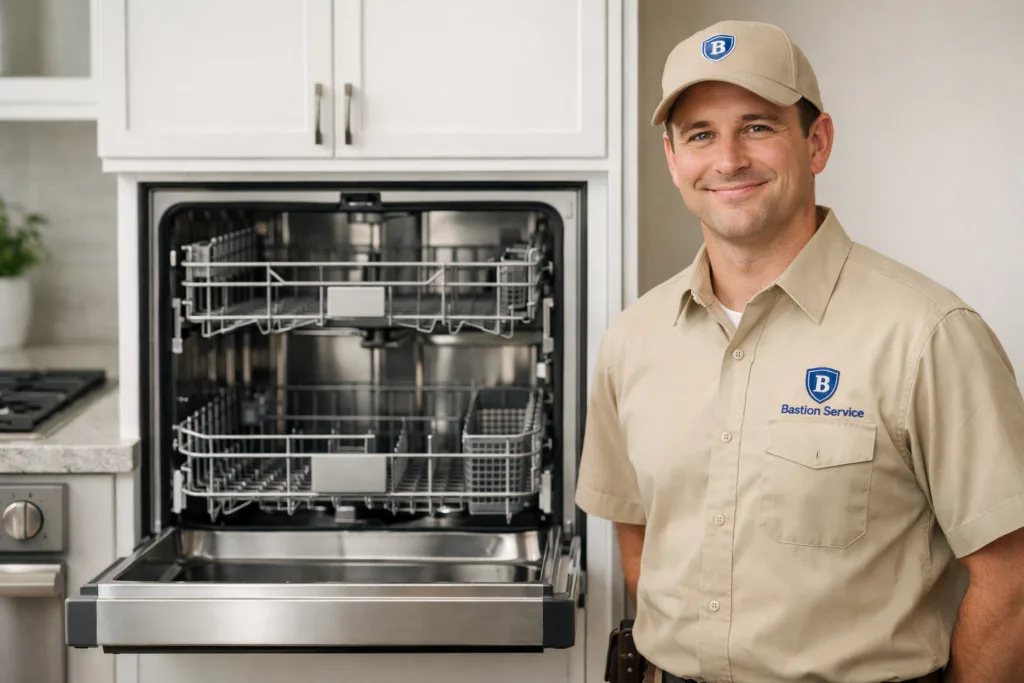
Dishwasher problems rarely stay isolated for long. A small drain issue can turn into odor and pump strain, poor wash performance can become baked-on residue after every load, and a slow leak can damage flooring or cabinet edges before it is obvious. With a Thermador unit, the fastest way to a sensible repair is to match the symptom to the system that is actually failing.
Common Thermador dishwasher symptoms in Mid-Wilshire homes
Most service calls start with one of a few patterns: water left behind, dishes that are still dirty, leaking around the door or beneath the machine, weak drying, or a cycle that stops partway through. The same dishwasher can also show more than one symptom at once, which is why it helps to look at the full behavior of the machine instead of one complaint in isolation.
Standing water after the cycle
If the tub still contains water when the cycle ends, the cause may be a blocked filter area, a restricted drain path, a drain pump problem, or a control issue that prevents the dishwasher from completing the drain sequence. Some owners also notice a sour smell or residue in the bottom of the tub when this problem has been developing for a while.
When a Thermador dishwasher drains slowly rather than not at all, that often points to a partial blockage or a pump that is still working but no longer moving water efficiently. Repeatedly running new cycles without resolving the cause can make the problem worse.
Dishes come out dirty, cloudy, or gritty
Poor wash results do not always mean the detergent is the problem. Reduced spray pressure, clogged spray arms, low water fill, circulation pump weakness, or heating issues can all leave dishes looking unfinished. If glasses are cloudy, plates feel gritty, or food particles remain after a normal cycle, the wash system needs closer inspection.
In some cases the issue appears gradually. Homeowners may first notice one rack cleaning worse than the other, then a decline across the full load. That pattern can help narrow the fault to circulation, spray distribution, or buildup affecting internal components.
Leaks under the door or beneath the unit
Dishwasher leaks often begin small. You might see moisture at the front corners, a damp toe-kick area, or occasional water under the machine after a heavier load. Possible causes include a worn door gasket, lower seal wear, an overfill condition, loose hose connections, pump housing issues, or leveling problems.
Even a minor recurring leak deserves attention. Water can travel farther than expected and affect nearby cabinetry, subfloor materials, and the area hidden beneath the appliance.
Low rinse temperature or poor drying
If dishes finish wet every time, plastic items stay soaked, or the interior feels cooler than usual at the end of the cycle, the dishwasher may not be heating as it should. Thermador dishwasher performance depends on proper temperature through the cycle, not only for drying but also for effective cleaning and detergent activation.
Heating-related faults can involve the heating circuit, sensors, control behavior, or another condition that interrupts the expected sequence. When poor drying appears together with poor cleaning, it often suggests more than a simple loading issue.
Humming, grinding, or new mechanical noise
A Thermador dishwasher that suddenly becomes loud should not be ignored. Grinding can indicate debris in the pump area, buzzing can point to a motor struggling to start or move water, and repeated humming may happen when a component is energized but not operating normally.
Pay attention to when the sound occurs. Noise during fill, wash, or drain each suggests a different part of the system. That timing can help separate a drain fault from a circulation issue or a water inlet problem.
Cycle failures and intermittent stopping
Some dishwashers still power on but fail to complete a load. They may pause mid-cycle, restart oddly, show inconsistent error behavior, or leave detergent partly undissolved because the wash sequence did not proceed normally. Intermittent faults are especially frustrating because the machine may seem fine for one load and fail on the next.
When the cycle fails only under certain conditions, such as heavier loads or longer programs, that can point to a component weakening under demand rather than a complete part failure.
Why symptom-based diagnosis matters on Thermador dishwashers
Thermador dishwashers can present one visible symptom while the real fault sits elsewhere in the system. A unit that appears to have only a drain problem may actually be stopping early because of a sensor reading, a heating fault may reduce both cleaning and drying, and a leak at the front can originate from leveling or overfill rather than the door gasket alone.
That is why the most useful repair process is not guessing from the surface symptom. It is identifying which system has failed, whether there is secondary wear, and whether the problem has already affected nearby components.
Signs the dishwasher should be taken out of regular use
Some issues can wait a short time for scheduling. Others should prompt you to stop running the machine until it is checked. It is usually best to pause use if you notice:
- Water leaking onto the floor or into surrounding cabinetry
- Standing water that remains after repeated drain attempts
- A burning smell or breaker trip during operation
- Sharp grinding or loud new humming noises
- Repeated cycle cancellation or failure to finish
- Very poor cleaning combined with low heat or detergent left behind
Continuing to run the dishwasher in these conditions can increase pump wear, allow moisture damage to spread, or turn a single failed part into a larger repair.
What can cause poor results even when the dishwasher still runs
One of the more confusing situations for homeowners is a machine that technically operates but no longer performs well. It may fill, wash, and drain, yet still leave residue, fail to rinse completely, or produce inconsistent results between loads. This often happens when a component is weak rather than fully failed.
Examples include a circulation system that has lost pressure, a heating problem that lowers wash effectiveness, or a sensor issue that changes how long the machine spends in key parts of the cycle. In these cases, the dishwasher may not look broken at first glance, but performance has clearly dropped.
Repair versus replacement: how to think it through
Many Thermador dishwasher problems are still good repair candidates, especially when the issue is limited to one major system such as draining, pumping, sealing, or latching. A repair decision becomes less favorable when there are multiple failing systems at once, signs of extensive water damage, or a pattern of repeated breakdowns that suggests broader wear.
For homeowners in Mid-Wilshire, the practical question is not just whether a part can be replaced. It is whether the repair addresses the root problem and leaves the rest of the dishwasher in solid working condition. Age, overall performance history, and the presence of hidden moisture damage all matter.
What a service visit should help clarify
A productive service visit should explain what failed, why the symptom appeared the way it did, and whether any related parts show wear that could affect reliability after repair. That is especially important when the dishwasher leaks only occasionally, stops intermittently, or has both wash and drain complaints at the same time.
If your Thermador dishwasher in Mid-Wilshire is not draining, not cleaning properly, leaking, running cool, or failing to finish cycles, the best next step is a practical repair plan based on the actual fault rather than trial and error.