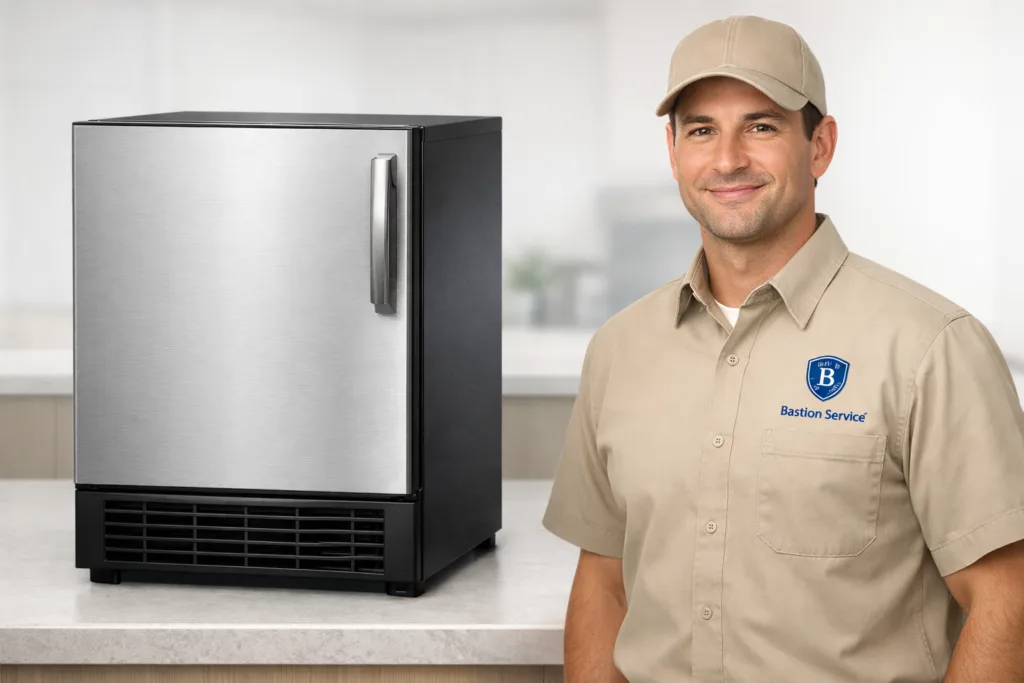
Summit ice makers usually fail in patterns that homeowners can notice before the unit stops completely. A machine that suddenly makes no ice, produces soft or hollow cubes, leaks at the base, or drops clumped ice into the bin is telling you something specific about water flow, freezing conditions, or the harvest cycle. The key is matching the symptom to the likely system involved instead of assuming every no-ice problem needs the same repair.
Common Summit Ice Maker Symptoms and What They Often Mean
No Ice at All
If the unit is on but the bin stays empty, the problem may be tied to the water supply, inlet valve, fill tube, thermostat, sensor, or control board. In some cases, the machine is cold enough to seem operational but not completing the sequence that fills, freezes, and releases ice. A shutoff arm or bin sensor issue can also stop production even when the rest of the machine appears normal.
Homeowners in Brentwood often first notice this after a period of slower output, which can be a clue that the failure was developing gradually rather than happening all at once.
Slow Ice Production
When the ice maker still works but cannot keep up, temperature is one of the first things to consider. Ice production depends on the machine reaching the right internal conditions consistently. If cooling is weak, airflow is restricted, or a component is delaying the cycle, output can drop well before the unit stops entirely.
- Warm surrounding temperatures near the unit
- Dirty condenser areas on applicable models
- A door or lid that is not sealing correctly
- Water fill problems that create incomplete batches
- Control or sensor issues that slow harvest timing
Small, Hollow, or Misshapen Cubes
This symptom usually points to an incomplete water fill. If the mold does not receive enough water, cubes may form too small, break easily, or come out hollow in the center. A partially restricted valve, kinked line, low household water pressure, or frozen fill path can all create the same visible result.
Because the cubes still look like ice, this issue is easy to ignore at first. Over time, though, repeated weak fills can lead to inconsistent batches and extra wear from repeated cycling.
Water Leaking Around the Unit
A leak should always be taken seriously. Water may come from a loose connection, cracked line, overfilling condition, blocked drain, or ice buildup that sends meltwater in the wrong direction. In a residential kitchen, bar area, or pantry, even a minor leak can affect nearby flooring, trim, or cabinetry.
If the leak appears only during production, the issue may be related to filling or draining. If it appears after a period of non-use, melting ice, poor sealing, or temperature loss may be involved.
Ice Clumping in the Bin
When separate cubes fuse together into a solid mass, the machine may be making ice but failing to hold it at the proper temperature. That can happen if warm air is entering the compartment, the unit is cycling irregularly, or partially melted ice is refreezing between batches. Clumping is often a storage-condition symptom, not just a production symptom.
Buzzing, Clicking, or Grinding Sounds
New sounds during fill or harvest can point to a valve straining to open, a motor working against an obstruction, or a component failing mechanically. A brief sound during normal operation is one thing; repeated or unusually loud noises usually mean the machine is struggling through part of the cycle.
Why Symptom-Based Diagnosis Matters
Two Summit ice makers can show the same problem on the surface and need entirely different repairs. A no-ice complaint could come from a failed water valve, but it could also come from a temperature issue that prevents the unit from reaching harvest. A leak may look like a plumbing problem when the real cause is internal frost buildup redirecting water.
That is why repair decisions should follow the symptom path:
- Is the unit filling with water correctly?
- Is it freezing at the right rate?
- Is the ice releasing from the mold properly?
- Is meltwater draining where it should?
- Is the machine holding produced ice at a stable temperature?
Answering those questions helps determine whether the issue is isolated to one component or part of a broader refrigeration problem.
When to Stop Using the Ice Maker
Some ice maker issues are inconvenient but manageable for a short time. Others should be paused immediately to avoid added damage. It is usually best to stop using the unit and shut off the water supply if you notice:
- Active leaking or pooling water
- Heavy frost or ice buildup inside the machine
- Repeated failed cycles with buzzing or clicking
- A burning smell or electrical irregularity
- Water overflowing into the bin or cabinet area
Continued use in these situations can worsen internal damage or create household moisture problems that are more expensive than the original appliance repair.
What a Repair Visit Usually Needs to Confirm
For Summit Ice Maker Repair in Brentwood, the most useful service call is one that confirms where the cycle is breaking down. That may involve checking water entry, verifying freezing performance, inspecting sensors and controls, and looking for blockages, damaged lines, or signs of recurring frost and melt patterns.
In many homes, the repair path becomes clearer once these points are verified:
- Whether the machine is receiving proper water flow
- Whether internal temperatures support normal ice production
- Whether the fill, freeze, harvest, and hold stages are all working
- Whether the issue is isolated or connected to a larger refrigeration fault
Repair or Replace: How Homeowners Usually Decide
Repair is often the sensible choice when the problem is limited to a serviceable part such as a valve, sensor, switch, drain component, fan, or control-related failure, and the rest of the unit is in good condition. If the machine has recurring cooling trouble, visible corrosion, structural cabinet damage, or multiple failing systems at once, replacement may make more sense.
A few practical factors usually shape the decision:
- The age and overall condition of the ice maker
- Whether this is the first major problem or part of a pattern
- The extent of water or moisture-related damage
- Whether the issue is contained to one repairable system
Helpful Next Steps for Brentwood Homeowners
If your Summit ice maker is still running but producing poor-quality ice, make note of what the cubes look like, whether the bin is wet, and whether any unusual sounds happen during fill or release. If the machine is leaking or not producing at all, it is usually better to pause use than let it continue cycling unsuccessfully.
In Brentwood homes, the fastest way to avoid wasted time and unnecessary parts is to base service on the exact symptom pattern. Whether the problem is no ice, slow production, leaks, clumped ice, or fill trouble, a targeted diagnosis gives you the clearest path to a repair that makes sense for the appliance and the household.