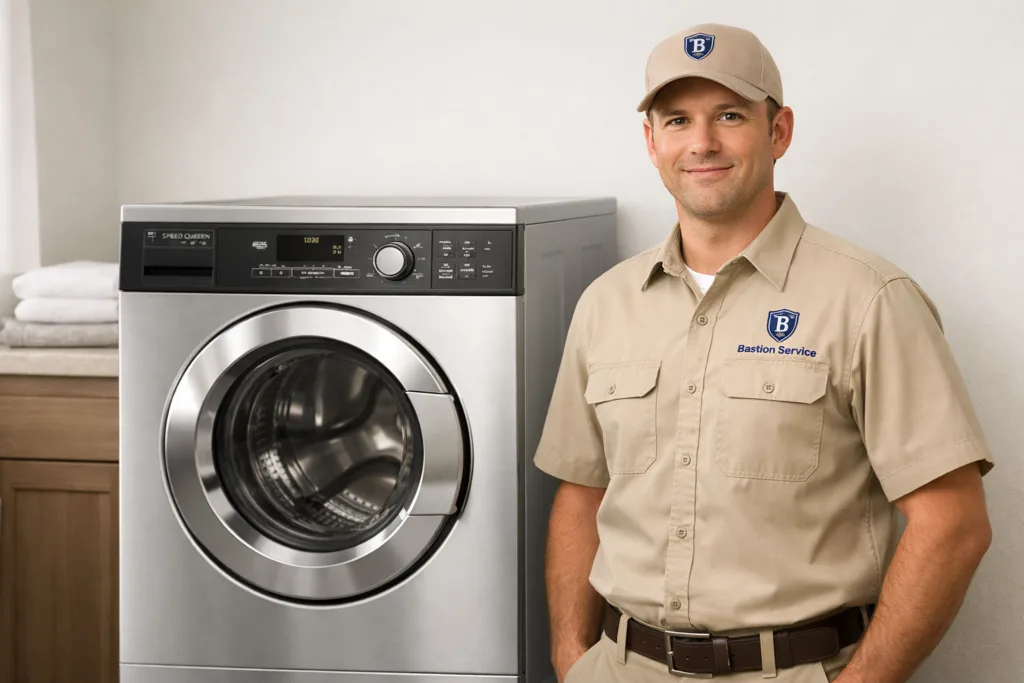
Washer symptoms often overlap, which is why the most useful starting point is matching the failure to when it happens in the cycle. A Speed Queen washer that fills but will not move clothes points to a different repair path than one that agitates normally but stalls before spin. The same is true for leaks, noise, and wash-quality complaints. Looking at the sequence of events helps narrow the likely cause much faster than guessing at parts.
How Speed Queen washer problems usually show up
Most service calls begin with one of a few patterns: the washer will not start, it will not drain, it leaves clothing too wet, it leaks, or it makes noise that was not there before. In many homes, the issue starts intermittently. A cycle may finish one day and fail the next, or the machine may only act up with heavier loads, bulky items, or certain settings.
That pattern matters. Intermittent failures can point to a lid switch issue, wiring fault, control problem, drain restriction, or a component that is beginning to wear out under load. A washer that fails the same way every time usually gives a narrower set of likely causes, which makes the repair decision more straightforward.
Symptom-based troubleshooting homeowners notice first
Washer will not start
If the washer is completely dead, the problem may involve incoming power, a tripped breaker, a failed switch, damaged wiring, or the control system. If it powers on but will not begin the cycle, the machine may not be registering a closed lid or locked door, or it may be stopping itself because another fault is present.
What homeowners in Brentwood often notice is that the controls seem normal, but nothing happens after pressing start. In that situation, the issue is not always the same as a washer that loses power entirely. The difference between “no power” and “won’t begin” is important because it changes the likely repair path.
Not draining or leaving water in the tub
Standing water after a cycle usually points to a drain problem first. That can mean a clogged drain path, pump trouble, a kinked hose, or a drainage installation issue. In some cases, the washer is trying to drain but cannot move water fast enough to progress into spin.
If the machine hums, pauses, or stops with water still inside, it is best not to keep restarting the cycle. Repeated attempts can strain the pump and motor system. Slow draining is also worth addressing early, since partial drainage often becomes a complete no-drain failure over time.
Not spinning or clothes coming out too wet
When clothing is much wetter than normal, the washer may not be reaching full spin speed. That can happen because the machine is out of balance, because water is not draining fully, or because a drive-related component is slipping or failing. A motor or control issue can also interrupt spin without affecting every other stage of the cycle.
This symptom usually shows up outside the laundry room first. Loads take longer to dry, towels feel unusually heavy, and homeowners may assume the dryer is the problem when the washer is actually sending soaked items downstream.
Poor wash results or residue on clothing
If clothing is not coming out clean, the cause is not always detergent or load size. A washer that is underfilling, not agitating properly, stopping early, or failing to complete rinse can leave visible residue, detergent streaks, or an overall dingy result. Temperature-related issues can also affect performance on cycles that depend on proper water conditions.
When poor results appear together with long cycle times, partial draining, or inconsistent movement in the basket, those symptoms often connect to a broader mechanical or control problem rather than user error.
Leaks during fill, wash, or drain
Leaks are easiest to narrow down by timing. Water on the floor right when the washer begins filling may come from supply hoses, inlet-related problems, or overflow conditions. Leaks during agitation can suggest tub, seal, or internal hose issues. Water that appears mainly during drain or spin may point to the pump, drain hose, or high-speed movement exposing a worn component.
Even a small recurring leak should be taken seriously. In addition to damaging floors, moisture can spread underneath or behind the unit and create a much larger cleanup and repair problem than the washer issue itself.
Banging, grinding, scraping, or vibration
Not every loud washer has a failed part. An uneven load or bulky items can cause severe shaking, especially in spin. But repeated banging on normal loads is different. That can indicate suspension wear, support issues, an out-of-balance condition the washer cannot correct, or movement in components that should remain stable.
Grinding, scraping, or metal-on-metal sounds are more concerning. Those noises can mean internal wear in drive or bearing-related parts, and continued use may cause secondary damage. If the sound becomes harsher as the basket speeds up, stopping the machine is the safest move.
Problems that can feel minor but deserve attention
- Cycles taking longer than usual
- Occasional failure to unlock or restart
- A faint burning smell after spin
- Water level that seems too low or inconsistent
- Intermittent stopping before rinse or spin
- New vibration on loads the washer used to handle normally
These issues are easy to postpone because the machine still works some of the time. But they often show early wear in a switch, pump, belt, motor-related part, or control system. Catching the problem before the washer stops completely can help limit the scope of the repair.
When to stop using the washer
It is smart to stop using the washer if it is leaking onto the floor, tripping power, giving off a burning or electrical odor, making harsh grinding noise, or refusing to drain. Those symptoms can lead to added damage inside the machine and around it. Flooring, walls, and nearby cabinetry can all be affected by continued operation when water is escaping.
Stopping use also makes diagnosis easier. If the washer is repeatedly forced through cycles after a fault begins, one failing part can create stress on others, which can blur the original cause and increase repair costs.
Repair or replace: what usually matters most
Many Speed Queen washers are worth repairing when the issue is isolated and the rest of the machine is in solid condition. The decision usually comes down to the failed component, the age and wear level of the unit, and whether there is a history of repeated major breakdowns. A single pump, switch, hose, or drive-related repair can be reasonable. Multiple worn systems at once may point toward replacement instead.
Households in Brentwood often benefit from looking at how the washer is used as well. A machine handling frequent large loads may show broader wear than one with lighter weekly use, even if both are the same age. The right choice depends on the actual condition of the appliance rather than age alone.
What a good service visit should clarify
A useful service visit should identify the failed part, explain why the symptom is happening, and note whether any related wear has been found. That helps answer the questions homeowners actually care about: Is the washer safe to use? Is the repair likely to hold? Is this a single failure or the start of a larger pattern?
For Speed Queen washer repair in Brentwood, the goal is not simply to get the unit running for one more cycle. It is to determine whether the machine can return to reliable daily use without trial-and-error part replacement. That kind of practical repair guidance helps households make a confident next-step decision and get laundry back on track.