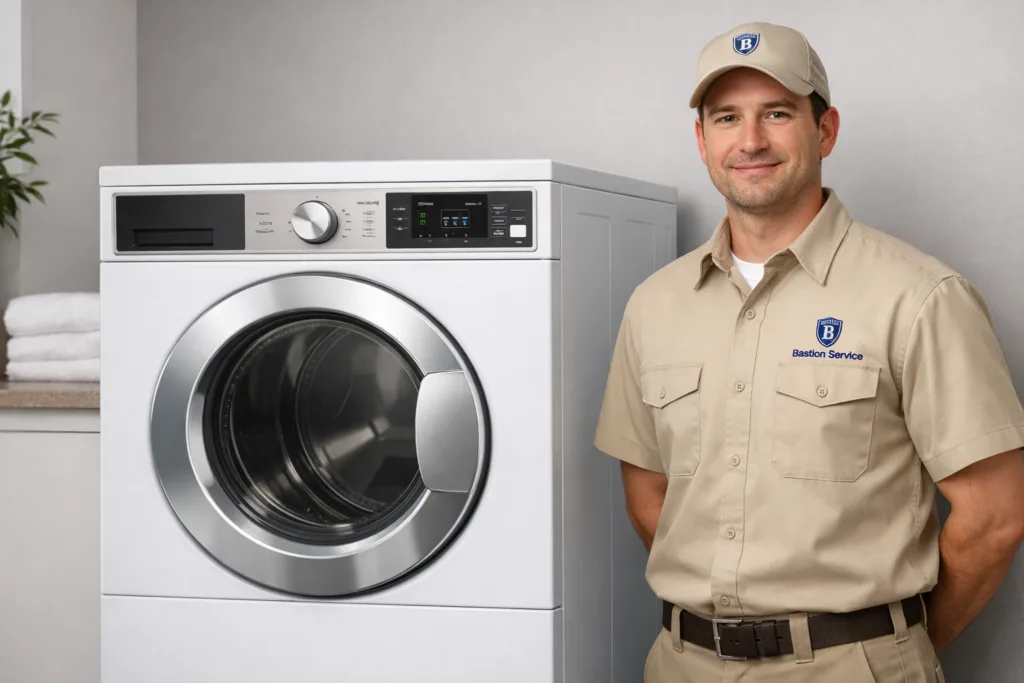
Dryer problems usually show up as a symptom first, not a part failure. Clothes stay damp, the drum starts making noise, a cycle stops early, or the machine simply will not start. With a Speed Queen dryer, those symptoms can come from the heating system, airflow, controls, the drive system, or the home’s power supply, so it helps to look at the exact pattern before assuming what is wrong.
Start with what the dryer is actually doing
A dryer that tumbles with no heat is a different repair path from one that will not run at all. A loud dryer points toward wear in moving parts, while long dry times often involve airflow as much as heating. Looking at the behavior in order makes the problem easier to narrow down:
- Does the drum turn?
- Is there heat, weak heat, or no heat?
- Does it stop mid-cycle?
- Are clothes coming out hot but still damp?
- Did the problem appear suddenly or get worse over time?
Those details matter because two dryers can have the same end result, such as wet laundry, but need completely different repairs.
Common Speed Queen dryer symptoms and likely causes
No heat or very little heat
If the dryer runs but does not heat well, the cause may be a failed heating element on electric models, an igniter or gas valve issue on gas models, a blown thermal fuse, a thermostat problem, or restricted venting. Weak heat often shows up as clothes that feel warm but remain damp after a normal cycle.
When this symptom is ignored, dry times usually get longer and the dryer may overwork itself trying to finish loads that should dry much faster.
Dryer runs too long
Long dry times are often tied to poor airflow. Lint buildup, a crushed vent, or an exhaust path that is not moving air properly can keep moisture trapped in the drum. Moisture sensor issues can also cause a dryer to continue running longer than it should. If towels and heavier items take multiple cycles, airflow deserves attention right away.
Dryer will not start
If nothing happens when you press start, possibilities include a tripped breaker, door switch failure, blown thermal fuse, faulty start switch, control issue, or a broken belt on designs that use belt-related safety functions. Sometimes the panel may appear normal even though an internal safety component has failed.
Drum turns slowly or not at all
A non-turning drum often points to a broken belt, seized rollers, a bad idler pulley, or motor trouble. In some cases the dryer may hum, try to start, or sound strained without actually rotating. Continuing to test it repeatedly can put more stress on the motor.
Squealing, scraping, thumping, or rattling
Noise is usually a wear issue in the drum support system. Rollers, glides, pulleys, and supports can wear gradually, then become suddenly loud. A thump may suggest a worn drum support part, while a high-pitched squeal often points to friction in moving components. Metal-on-metal sounds should not be ignored.
Dryer shuts off before the cycle should end
If the machine starts normally but stops after a short time, overheating protection, vent restriction, a failing motor, or sensor-related issues may be involved. This symptom is especially important when the cabinet feels hotter than usual.
Clothes come out too hot, still damp, or unevenly dried
When one load is fine and the next is not, the issue may be inconsistent airflow, thermostat cycling problems, sensor trouble, or a developing heating failure. Mixed results often mean the dryer is still running, but not controlling heat and moisture removal the way it should.
When airflow is the real problem
Many homeowners assume long dry times automatically mean a bad heater, but airflow problems can create nearly identical results. A clogged or restricted vent can cause:
- Longer cycle times
- Overheating
- Damp clothes after a full cycle
- Repeated thermal fuse failures
- Excess heat around the dryer cabinet
In Culver City homes, it is worth considering the full exhaust path whenever a Speed Queen dryer seems to be heating poorly or shutting down unexpectedly. If airflow is not corrected, even a successful part replacement may not solve the underlying issue for long.
Signs you should stop using the dryer
Some symptoms are more than an inconvenience. Stop using the dryer and have it checked if you notice:
- A burning smell
- Visible sparking or repeated breaker trips
- Harsh scraping or grinding sounds
- The drum not turning while the motor runs
- Unusual exterior heat
- The dryer shutting off and restarting unpredictably
These warning signs can point to overheating, electrical faults, motor strain, or severe wear in moving parts.
Repair or replace: how the decision is usually made
Many Speed Queen dryers are worth repairing when the problem is limited to a specific serviceable part, especially if the machine has otherwise been reliable. Belts, rollers, idler pulleys, thermostats, fuses, igniters, and some heating components are often practical repairs when the rest of the dryer is in good shape.
Replacement may make more sense when there are multiple problems at once, repeated service history, heavy overall wear, or a major repair cost that does not fit the condition of the unit. The best decision usually comes from comparing the present failure with the dryer’s overall condition, not from age alone.
What helps make diagnosis faster
Before service, it helps to note exactly what happens during a cycle. Useful details include:
- Whether the drum turns
- Whether heat is present
- If the problem happens on every cycle or only sometimes
- Any recent change in noise level
- Whether heavier loads are affected more than light loads
- If the dryer stops early or runs too long
That information can shorten the path to the real cause and prevent guesswork.
Helpful guidance for Culver City homeowners
If your dryer is still running but performance is getting worse, early service is often easier than waiting for a complete shutdown. A squeal can turn into a seized roller, restricted airflow can damage heat-related parts, and repeated overheating can lead to additional failures. Addressing the first symptom usually gives you more repair options and fewer surprises.
For households in Culver City, the most useful approach is symptom-based service that looks at heat, airflow, controls, and moving parts together. That makes it easier to decide whether the issue is a straightforward repair or a sign of broader wear inside the dryer.