
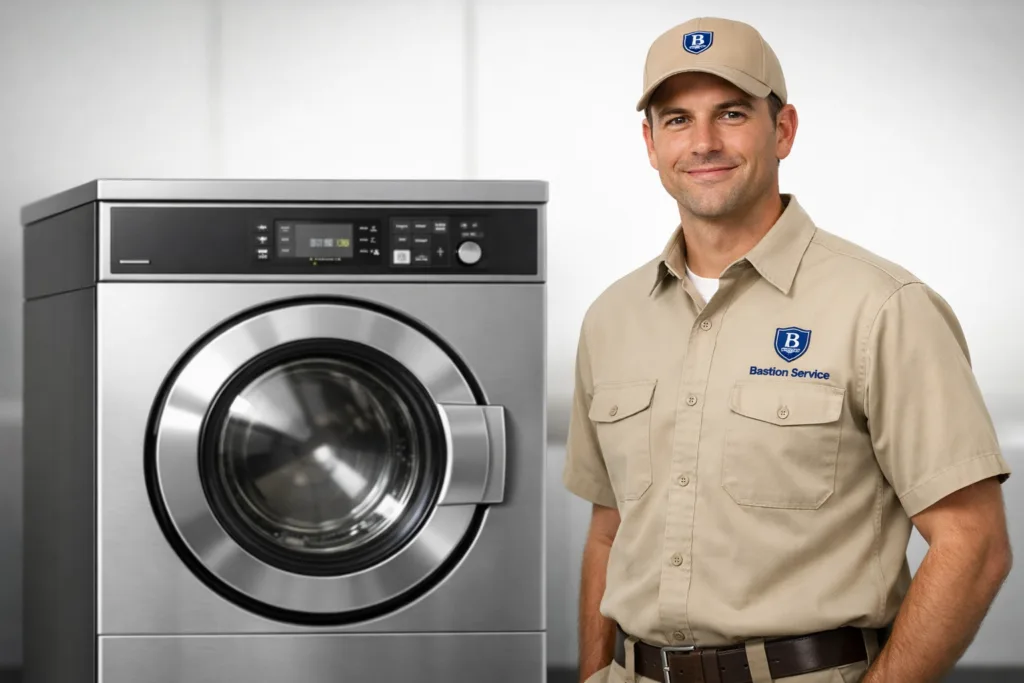




When a Speed Queen washer is down or acting unpredictably in a Rancho Palos Verdes business, the issue can ripple through the whole workflow. Wet loads waiting for rewash, delayed turnover, and staff time spent monitoring a failing machine all add up quickly. Bastion Service handles Speed Queen washer repair with symptom-based troubleshooting so the visit stays focused on what is actually failing, how urgent it is, and whether the unit should stay in use before repair.
Related commercial service paths in Rancho Palos Verdes include Speed Queen Repair in Rancho Palos Verdes, Commercial Washer Repair in Rancho Palos Verdes, and Speed Queen Dryer Repair in Rancho Palos Verdes.
Service is usually most effective when the problem is described by cycle stage and behavior rather than by one broad complaint. A washer that fills but never advances, drains slowly only on heavy loads, or spins with unusual vibration points to very different systems. That is why a repair appointment should begin with how the machine behaves under normal use, what changed recently, and whether the fault is constant or intermittent.
Common Speed Queen washer problems businesses notice first
Not starting or not completing the cycle
If the washer will not begin, shuts off during operation, or stalls before the final spin, the cause may involve the door or lid lock system, control problems, timer issues, power supply interruptions, or a fault that is preventing the next step in the cycle. In some cases the machine appears dead; in others it starts normally and then stops at the same point every time. That difference matters because repeat failures at one cycle stage often help narrow the repair path much faster.
Not draining or leaving standing water
Water left in the tub usually affects operations immediately. Slow drain performance may be caused by a restricted drain path, pump wear, hose blockage, trapped debris, or a control issue that prevents the washer from moving into drain and spin correctly. If loads are repeatedly left wet at the end, the problem may not be only the spin system. A drain fault is often the first thing that has to be ruled out.
Weak spin or poor extraction
When loads come out too wet, drying time increases and machine turnover slows down. Poor extraction can be tied to imbalance sensing, motor or belt issues, suspension wear, drain problems, or a control fault that prevents full-speed spin. If the washer seems to wash normally but never reaches proper final spin, that symptom should be checked promptly before strain spreads to other components.
Leaks, overflow, or fill problems
Visible water around the washer may come from hoses, valves, the pump system, seals, or internal overflow conditions. A unit that fills too slowly, keeps filling too long, or does not fill at all may point to inlet valve trouble, pressure-sensing issues, or supply restrictions. In business settings, even a small leak matters because it can affect surrounding flooring, nearby equipment, and safe movement in the laundry area.
Noise, shaking, or movement during spin
Grinding, thumping, scraping, or excessive vibration often signals more than normal wear. Possible causes include bearing problems, suspension wear, basket issues, loose hardware, drive-system faults, or installation-related instability. If the washer has started walking, striking the cabinet, or becoming much louder than usual, continued use can turn a repairable issue into broader damage.
How symptom patterns help narrow the repair
The same machine can produce similar complaints for very different reasons. A washer reported as “not spinning” may actually be stopping because it never drained properly. A unit described as “leaking from the front” may only show water there after an overfill or a drain backup. A “dead” washer may be receiving power but failing at the lock or control stage.
Useful details to note before scheduling service include:
- Whether the washer fails at the same point in every cycle
- Whether the issue happens on every load or only on heavier loads
- If any fault lights, beeps, or unusual delays appear before shutdown
- Whether water remains in the tub after the cycle stops
- If vibration, odor, or noise started before the main failure
Those observations help separate control problems from drainage, drive, water-level, or lock-related faults and make the service visit more productive.
When the washer should be taken out of service
Some problems allow a short window for limited use, but others justify stopping the machine right away. A Speed Queen washer should generally be removed from use until diagnosis if it is leaking onto the floor, producing a burning smell, slamming during spin, repeatedly shutting down, tripping protection devices, or failing to drain with standing water left inside.
Continued operation under those conditions can increase repair scope. What starts as a pump issue, suspension problem, or lock fault can lead to motor stress, control damage, surrounding water exposure, or additional wear from repeated failed cycles. For businesses relying on steady laundry output, early intervention is often less disruptive than waiting for a full breakdown.
What to expect from a service-oriented diagnosis
Repair decisions are easier when the failure is isolated to the correct system first. Instead of treating every no-start, no-spin, or leak complaint as a quick part swap, the better approach is to verify the symptom, test the related functions, and determine whether the issue is electrical, mechanical, drainage-related, or tied to water input and sensing.
That process typically answers the questions businesses care about most:
- Is the washer safe to keep using before repair?
- Is the problem limited to one component or part of a larger wear pattern?
- Is the failure likely to worsen quickly under daily use?
- Does repair make sense compared with the machine’s current condition and workload?
For laundromats, hotels, care facilities, and other businesses in Rancho Palos Verdes that depend on consistent laundry turnover, those answers matter more than guesswork.
Repair or replacement considerations
Many Speed Queen washers are good repair candidates when the machine is otherwise in solid condition and the fault is isolated to a serviceable component or system. Replacement becomes a more serious discussion when there are multiple overlapping issues, repeated downtime history, or major wear affecting reliability even after repair.
The decision is usually clearer once the source of the failure is confirmed. A single pump, lock, valve, or drive-related repair is very different from a machine showing broad mechanical wear, repeated control issues, and chronic performance decline. Looking at the actual fault, expected reliability after repair, and effect on daily workflow gives a more useful answer than age alone.
Preparing for a washer repair visit
Before service is scheduled, it helps to gather a few basics from staff who have used the machine recently. Note the exact symptom, whether the problem is constant or intermittent, what kind of load was in the washer when it failed, and whether any unusual sounds or water issues were noticed beforehand. If the unit stopped mid-cycle, leave it as found when possible so the failure condition can be evaluated more accurately.
For businesses in Rancho Palos Verdes, the most productive next step is usually to schedule service as soon as the washer begins failing consistently, leaking, or leaving loads unfinished. Prompt repair reduces downtime, helps prevent secondary damage, and gives you a clearer path on whether the machine should be restored to service, monitored temporarily, or removed from rotation until the problem is resolved.


