
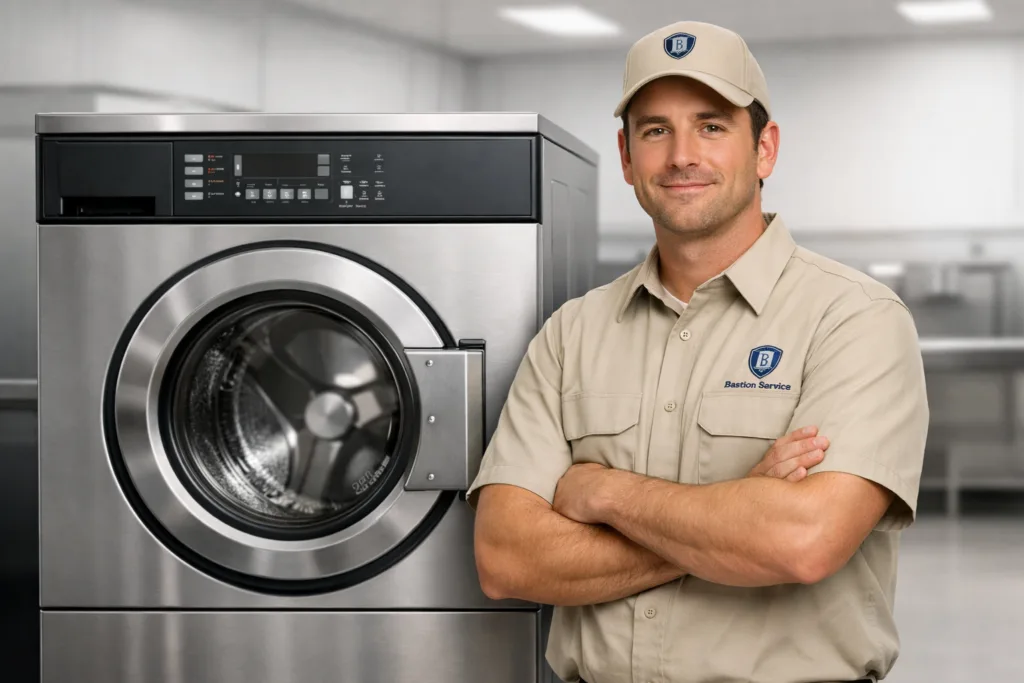




Unplanned washer downtime can disrupt staffing, delay linen turnover, and create bottlenecks for any business that depends on steady laundry output. When a Speed Queen washer begins stopping mid-cycle, leaving loads wet, leaking, or refusing to start, the next step should be service that identifies the actual failure rather than guessing at parts. In Los Angeles, Bastion Service provides repair support centered on symptom testing, operating checks, and repair recommendations that fit the machine’s condition and the urgency of getting it back into use.
Related commercial service paths in Los Angeles include Speed Queen Commercial Repair in Los Angeles, Commercial Washer Repair in Los Angeles, and Speed Queen Dryer Repair in Los Angeles.
How Speed Queen washer problems affect daily operations
For laundromats, hotels, apartment laundry rooms, fitness facilities, care environments, and other businesses with frequent wash demand, one washer problem rarely stays isolated. A single unit that will not drain or extract properly can slow dryer turnover, create load backups, and increase labor spent moving or re-running laundry. Problems that seem minor at first, such as slow filling or occasional cycle interruptions, often become larger service issues once the machine is under repeated daily use.
That is why service should focus on what the washer is doing under real operating conditions. A machine may appear to have a control issue when the root problem is drainage, a lock assembly, a motor response fault, or inconsistent water intake. Symptom-based testing helps narrow the problem before repair decisions are made.
Common Speed Queen washer symptoms and what they may mean
Not starting or not completing the cycle
If the washer has power but does not begin, pauses unexpectedly, or stops before the cycle finishes, several systems may be involved. Door or lid lock faults, control board issues, wiring problems, failed switches, and sensing errors can all interrupt operation. In some cases, the unit starts normally but fails to advance to wash, drain, or spin, which points to a more specific breakdown in the sequence.
This type of problem is important to address early because repeated restarts can waste staff time and leave loads sitting in the machine while other equipment is waiting.
Slow fill, no fill, or overfilling
Fill problems often trace back to inlet valves, clogged screens, pressure sensing components, water supply restrictions, or control-related misreading of water level. A washer that fills too slowly can stretch cycle times and reduce throughput. A washer that overfills can create a leak risk and may indicate a problem that should not be ignored.
Because the same complaint can come from either the machine or the supply side, proper testing matters before approving replacement parts.
Not draining or leaving water in the tub
When a Speed Queen washer finishes with standing water still inside, likely causes include a failing drain pump, partial blockage, drain hose restriction, or a control failure that prevents the machine from entering the drain stage correctly. If operators keep restarting the washer without resolving the cause, the machine may continue to stop with soaked loads and repeated cycle loss.
Drain issues also affect extraction. If water is not leaving the unit as it should, spin performance usually suffers as well.
Weak spin or no spin
A washer that will not spin, spins slowly, or leaves heavy moisture in the load can be dealing with balance sensing problems, drive system wear, belt issues, motor faults, lock failures, or control-related interruptions. In business settings, weak extraction does more than slow the washer itself. It pushes extra moisture into the drying stage, increases drying time, and reduces overall equipment turnover.
Excessive vibration, banging, or walking
Severe movement during spin can be tied to suspension wear, leveling issues, overloaded use, basket support problems, or internal damage. This symptom should not be treated as normal wear alone. Continued operation under heavy vibration can increase strain on the cabinet, drive parts, connections, and surrounding floor area.
If a washer is striking hard during spin or shifting out of position, it is usually best to stop use until the condition is checked.
Leaks during fill, wash, drain, or spin
Leak location and timing are important clues. A leak at the beginning of the cycle may indicate inlet or hose issues, while a leak during drain may point to the pump or discharge path. Water appearing only during spin can suggest movement-related leakage, seal issues, or a problem that becomes noticeable under higher pressure and vibration.
Even a small leak deserves attention because floor moisture creates safety concerns and can damage nearby surfaces over time.
Error codes, resets, or repeated interruptions
Error conditions are often the washer’s way of flagging a system that is not responding as expected. That may involve lock status, water level sensing, motor behavior, drainage, or communication between controls and components. Clearing the code may restore operation briefly, but if the source of the error is still present, the problem usually returns.
Why accurate diagnosis matters for repair decisions
Speed Queen washer symptoms can overlap. A unit that will not reach spin may actually have a drain problem. A machine that appears unresponsive may have a lock fault rather than a failed main control. A leak complaint may originate from one connection during fill and a different component during drain. Without proper testing, it is easy to replace the wrong part and extend downtime.
Accurate diagnosis helps determine whether the washer needs a targeted component repair, a broader correction involving wear-related parts, or a deeper discussion about whether the machine is still a good candidate for continued service. For businesses in Los Angeles, that matters because repair decisions affect labor planning, load capacity, and how quickly normal workflow can resume.
When washer service should be scheduled
Service should be scheduled when the washer shows any of the following:
- It does not start consistently
- It stops before the cycle is complete
- It leaves loads wetter than normal
- It drains slowly or not at all
- It leaks onto the floor
- It shakes excessively or makes abnormal noise
- It displays recurring fault codes
- It has inconsistent fill behavior
Intermittent issues are also worth addressing. A washer that fails only on some loads or only during certain cycle stages is often showing an early warning sign of a larger failure. Waiting for a full shutdown may create more disruption than scheduling service when the pattern first appears.
Repair versus replacement considerations
Repair is often the sensible option when the washer is structurally sound and the failure is limited to a serviceable system such as drainage, filling, drive components, locking, or controls. Replacement becomes a more serious consideration when the machine has repeated breakdowns, multiple unrelated failures, major wear, or repair cost that no longer supports reliable use.
For a business, the decision is not just about the immediate invoice. It also includes how the unit fits into daily demand, whether downtime has become frequent, and whether the washer is likely to return to stable operation after the repair is completed.
What to note before scheduling service
Before booking a repair visit, it helps to record what the washer is doing and when the problem happens. Useful details include whether the unit fills, drains, locks, spins, leaks, shows a code, or stops at a specific point in the cycle. If the issue is inconsistent, note whether it happens with heavier loads, certain cycle selections, or only after the machine has been running for part of the day.
These details can help narrow the fault faster and make the service visit more efficient, especially when downtime is already affecting laundry flow.
Speed Queen washer service support in Los Angeles
When a washer problem begins affecting output, waiting through repeated failed cycles usually costs more in disruption than addressing the fault directly. Speed Queen washer repair in Los Angeles is most useful when service is scheduled around the actual symptom pattern, the operating demands on the machine, and the practical goal of restoring dependable use. If your washer is not draining, not spinning, leaking, failing to finish cycles, or showing recurring errors, arranging service promptly is the best next step to reduce downtime and prevent the problem from spreading into a larger operational issue.


