
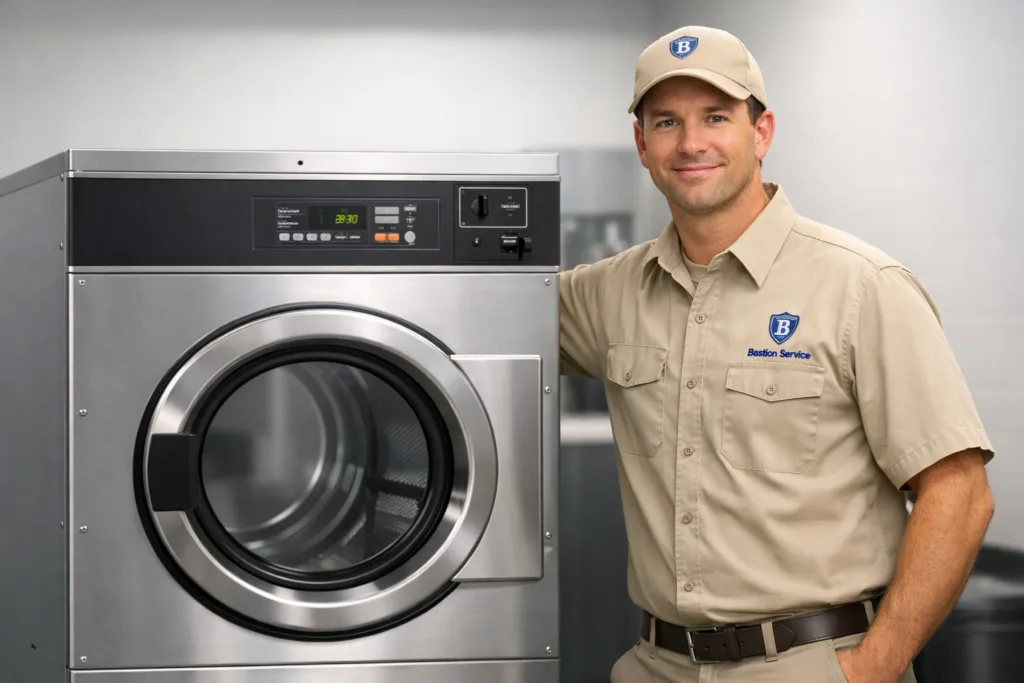




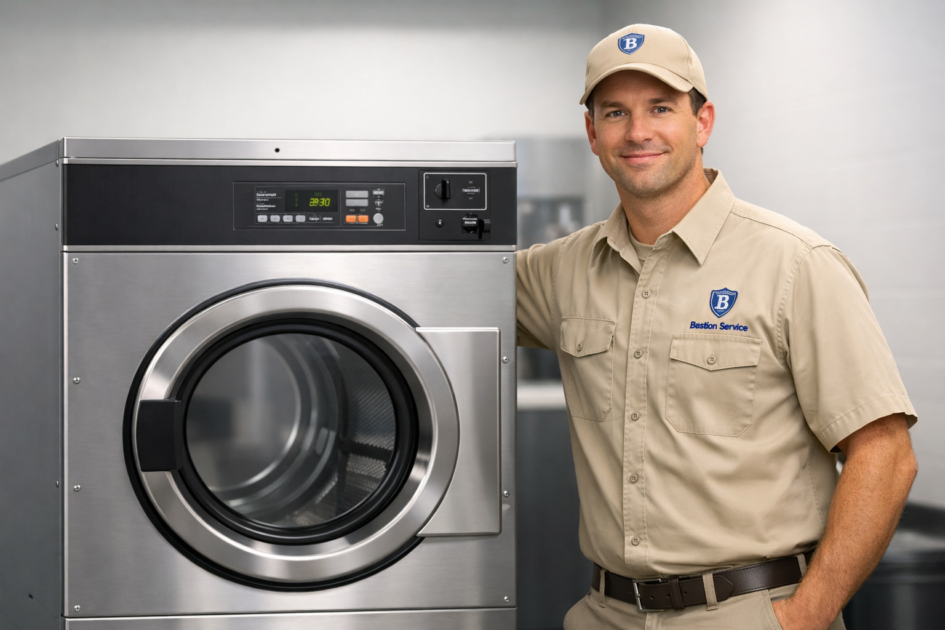
Dryer downtime can disrupt room turns, laundry volume, staff routines, and customer-facing operations faster than many teams expect. When a Speed Queen dryer starts running too long, losing heat, making noise, or stopping mid-cycle, the best next step is service that identifies the actual fault before parts are approved. Bastion Service works with Los Angeles businesses that need symptom-based Speed Queen dryer repair scheduling focused on restoring safe, consistent drying performance.
Related commercial service paths in Los Angeles include Speed Queen Commercial Repair in Los Angeles, Commercial Dryer Repair in Los Angeles, and Speed Queen Washer Repair in Los Angeles.
Speed Queen dryer problems that affect daily operations
A dryer does not need to be completely down to create a serious workflow problem. Many service calls begin with a machine that still starts and tumbles, but no longer finishes loads on time, overheats the room, or leaves linens damp at the end of the cycle. In laundry rooms, hospitality settings, housing properties, and other high-use environments, that kind of partial failure can slow production almost as much as a full breakdown.
Effective repair starts by checking how the unit behaves under normal use: heat production, drum movement, airflow, control response, cycle completion, and whether the issue appears on every load or only under heavier demand. That helps separate a simple wear item from a broader heating, ventilation, drive, or control problem.
Common symptoms and what they often mean
Dryer runs but does not dry properly
If the drum turns but items stay damp, the issue may involve restricted exhaust airflow, weak heat output, cycling problems, moisture-sensing faults, or temperature regulation issues. This often shows up first as longer dry times, repeat cycles, uneven results between loads, or staff needing to rerun the same batch.
In business settings, poor drying performance also increases energy use and ties up equipment longer than planned. Even when the machine appears functional, the underlying problem can continue worsening if airflow or heat regulation is not corrected.
No heat or low heat
A Speed Queen dryer with no heat or reduced heat may point to a failed heating element, igniter, gas valve component, thermostat, thermal cutoff, wiring problem, or control issue. A proper diagnosis should also confirm that the machine is receiving the correct utility supply and that a safety device has not opened because of an airflow restriction or overheating event.
This symptom should not be treated as a parts-guessing situation. Several different failures can produce similar no-heat complaints, and replacing the wrong component can waste both time and budget.
Dryer shuts off before the cycle ends
If the machine starts normally but stops before the load is finished, the cause may be overheating, motor strain, sensor errors, unstable power, or a control fault. A dryer that restarts after cooling down can indicate that protective devices are responding to excess temperature or drive stress rather than a simple timer issue.
Repeated shutdowns are important because they often signal a condition that can lead to a larger failure if the machine remains in regular use.
Drum will not turn
When the dryer powers on but the drum does not rotate, likely causes include a broken belt, seized support parts, a failed motor, or another drive-system problem. If the machine hums but does not turn, continued attempts to run it can place additional strain on the motor and electrical components.
Noise, scraping, or strong vibration
Thumping, squealing, grinding, or scraping sounds often suggest worn rollers, idler problems, bearing wear, blower issues, or drum support damage. In high-use laundry equipment, unusual sounds usually get louder over time rather than resolving on their own.
Mechanical noise should be addressed early because friction and misalignment can damage nearby parts and turn a limited repair into a wider rebuild.
Overheating or burning odor
An overheating cabinet or burning smell can be related to lint accumulation in the wrong areas, restricted airflow, failing wiring, motor stress, or heat-control failure. This is a stop-using-the-machine symptom. The dryer should be taken out of normal service until it can be inspected and tested.
Why symptom-based diagnosis matters
The same complaint can come from more than one failure path. For example, a dryer that is not heating may have a failed heat component, but it may also be shutting heat down because airflow is restricted or a control is reading unsafe conditions. A machine with repeated thermal fuse failure may not need another fuse as much as it needs the root overheating cause corrected.
Diagnosis helps answer practical questions before repair work moves forward:
- Is the problem limited to one failed part, or are multiple systems affected?
- Has continued use created secondary wear or damage?
- Is the issue tied to the machine itself, the vent path, or site conditions?
- Will the repair likely restore stable performance, or is failure becoming recurrent?
That process is especially important for businesses trying to avoid repeat downtime during busy operating hours.
When to stop using the dryer and schedule repair
Some symptoms should move a dryer out of rotation immediately. These include burning smells, overheating, grinding or scraping noise, repeated shutdowns, failure to tumble, or a drum that binds during operation. Running the unit in that condition can increase repair cost and create added interruption for the rest of the laundry workflow.
Even gradual problems deserve attention before a complete breakdown occurs. Longer cycle times, inconsistent dryness, intermittent heat, or rising noise levels often indicate wear or restricted airflow that can be addressed more efficiently before other components are affected.
Repair decisions for Los Angeles businesses
In Los Angeles, dryer repair decisions are often less about whether the unit technically still runs and more about whether it can support daily demand without delaying staff or causing a backlog. A useful service visit should connect the symptom to the likely failed system, the urgency of the repair, and the risk of continued operation.
Many Speed Queen dryers remain solid repair candidates when the structure of the machine is still sound and the failure is isolated to serviceable heating, drive, airflow, or control components. Replacement becomes a more serious consideration when problems are stacking across multiple systems, downtime is becoming frequent, or the machine can no longer keep up with site demand even after repair.
How to prepare for a service visit
Before scheduling repair, it helps to note exactly what the dryer is doing and when the issue appears. Useful details include whether the unit has no heat or weak heat, whether the drum turns, whether the problem happens on every cycle, how long the issue has been developing, and whether there are unusual sounds or odors.
If possible, be ready to share:
- The model information from the unit
- Whether the dryer is gas or electric
- If the problem is constant or intermittent
- Whether cycle times recently increased
- Any recent shutdowns, tripped safeties, or visible lint and airflow concerns
Those details can help speed up diagnosis and make repair planning more accurate from the start.
Service-focused next steps
If your Speed Queen dryer is affecting turnaround time, load quality, or safe operation, scheduling service early is usually the best way to limit added downtime. The goal is not just to get the machine running for the moment, but to identify why the symptom started and whether the repair will return the unit to reliable use. For Los Angeles businesses, timely Speed Queen dryer repair is most effective when the service call is built around the exact symptom pattern, the urgency of the disruption, and the practical next step for restoring workflow.


