
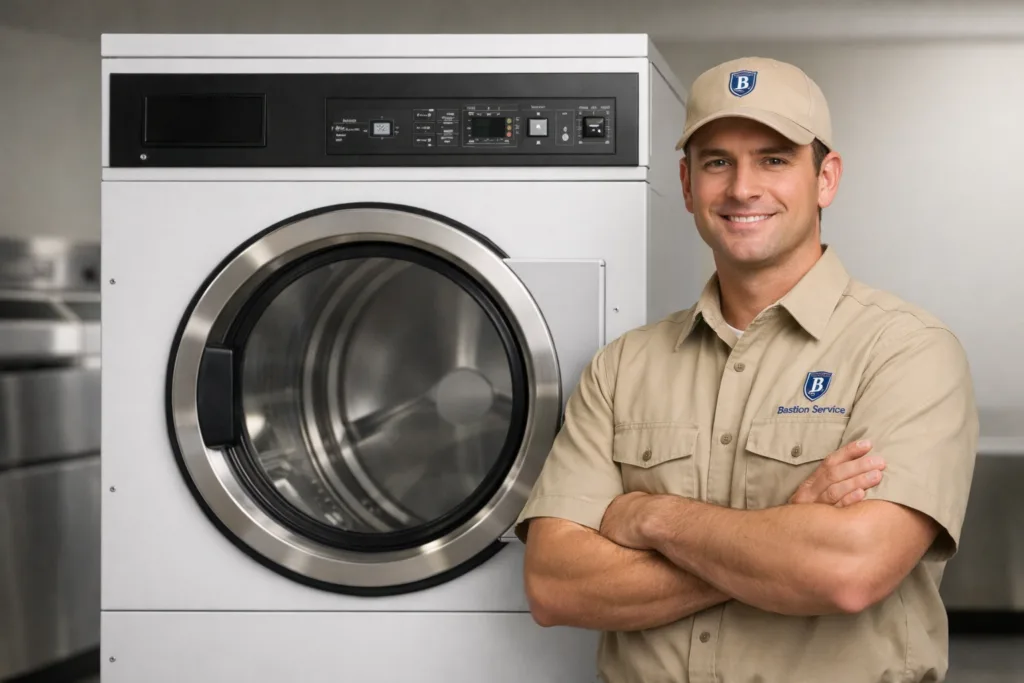




Dryer problems can disrupt laundry flow fast when loads need to be turned over on schedule. For businesses in Westwood, the most useful next step is service built around the exact symptom, how the unit is used, and whether the issue points to heat failure, airflow restriction, drive wear, controls, or utility-related trouble. Bastion Service works on Speed Queen dryer issues with that service-first approach so repair decisions are based on operating conditions, downtime impact, and what it will take to return the machine to reliable use.
Related commercial service paths in Westwood include Speed Queen Commercial Repair in Westwood, Commercial Dryer Repair in Westwood, and Speed Queen Washer Repair in Westwood.
What Speed Queen dryer problems usually mean in day-to-day operation
A dryer does not have to be fully down to create a serious workflow issue. Reduced heat, longer dry times, intermittent starts, shutdowns during the cycle, and new mechanical noise all affect labor, turnaround, and how staff plan loads. In many cases, the symptom seen by staff is only part of the problem. A unit that seems to have a heating issue may actually be tripping on restricted airflow, while a dryer that starts slowly may be dealing with both drive-system wear and electrical faults.
That is why symptom-based diagnosis matters before approving parts or deciding whether the machine should stay in service. The goal is to identify the actual failure, check for related wear, and determine whether continued use risks more damage.
Common symptom groups and what they can indicate
No heat or poor heat output
If the drum turns but the load is still damp, possible causes can include failed heating components, thermostats, thermal cutoffs, igniters, gas-valve related issues, relays, sensor faults, or control problems. Airflow restriction is also a common reason a Speed Queen dryer appears to heat poorly. When exhaust flow is limited, drying performance drops and cycle results become inconsistent.
In a business setting, poor heat is rarely just an inconvenience. It often means extra cycle time, rework, and staff checking loads repeatedly instead of moving on to the next task.
Long dry times or incomplete cycles
When loads eventually dry but take too long, the issue may be connected to weak heat, lint buildup, vent restriction, moisture-sensing problems, cycling faults, or improper air movement through the machine. A dryer that is technically running can still be underperforming enough to reduce usable capacity across the day.
If staff have started extending every cycle, splitting loads, or running items through twice, that usually signals a repair issue rather than a normal variation in load type.
Overheating or stopping mid-cycle
A dryer that becomes excessively hot, shuts itself down, or trips protective devices should be evaluated quickly. Common causes include blocked airflow, failing temperature controls, motor strain, internal lint accumulation, or control-side faults. Overheating can increase wear on several components at once, which is one reason delayed service often leads to a larger repair than expected.
Repeated mid-cycle shutdowns can also create uncertainty for staff because the machine may appear usable for one load and fail on the next.
Drum not turning or inconsistent starting
If the machine powers on but the drum does not rotate, likely causes include belt failure, worn rollers, idler issues, motor problems, door-switch faults, or board and wiring interruptions. An intermittent no-start condition can be harder to track because the dryer may work during one test and fail again during regular use.
These symptoms are important to address early. A slipping or stressed drive system can lead to added wear on related parts if the machine keeps being restarted and pushed through loads.
Noise, vibration, or burning smell
Squealing, scraping, thumping, rattling, or grinding often points to wear in rollers, supports, bearings, belt components, or the motor system. Vibration may come from loose mounting, internal wear, or installation-related issues. A burning smell should be treated as a warning sign, especially if it appears along with overheating, poor airflow, or unusual noise.
In busy laundry operation, it is easy for new noise to be ignored if the unit is still producing some output. That can be costly when the underlying problem is mechanical wear that is worsening with each cycle.
Control, timing, or sensor issues
When cycle lengths are inconsistent, settings do not respond correctly, displays behave erratically, or moisture sensing seems inaccurate, the problem may involve the control board, user interface, wiring, sensors, or calibration-related faults. These issues can waste labor because staff end up restarting loads, guessing at settings, or avoiding certain programs entirely.
Why service decisions should be based on diagnosis, not just the visible symptom
Dryers often present overlapping symptoms. A unit with no heat may also have restricted exhaust. A noisy machine may also be drawing the motor down. A dryer that stops mid-cycle may have temperature-related protection responding to another issue rather than a failed timer alone. Approving repair without sorting out the primary cause can lead to repeat breakdowns and unnecessary parts replacement.
For businesses in Westwood, diagnosis also helps answer practical questions: whether the unit can remain in operation until repair, whether the issue is isolated to one machine, and whether airflow or usage conditions may be contributing to repeated failures.
When to schedule repair service
Service should be scheduled when a Speed Queen dryer is not heating, taking too long to dry, shutting off during the cycle, failing to start, making new mechanical noise, overheating, showing inconsistent control behavior, or producing results that staff can no longer rely on. These symptoms usually worsen instead of resolving on their own.
- Loads are leaving the machine damp on normal settings
- Dry times have steadily increased
- The unit needs repeated restarts to finish a load
- The drum hesitates, drags, or stops turning
- There is a hot smell, scraping sound, or heavy vibration
- Controls are unresponsive or cycles do not complete normally
If staff have begun adjusting workflow around one dryer rather than using it normally, that is usually a sign that repair should move from optional to timely.
When continued use can make the problem worse
Some dryers remain partially operational even while components are failing. That can create the impression that repair can wait. In reality, continued use under the wrong conditions can increase damage to belts, rollers, motors, heat components, controls, and safety devices. Restricted airflow and overheating are especially important because they can affect both performance and safe operation.
A machine should not simply be kept in rotation because it still runs. If it smells hot, stops unpredictably, struggles to turn, or requires repeated workarounds, limiting use until the cause is identified is often the better business decision.
Repair or replacement: what usually guides the decision
Many Speed Queen dryer issues are repairable when the core structure of the machine is still in good condition and the failure is limited to serviceable components. Repair is often the sensible choice when the symptom is well defined, the correction is targeted, and the unit still supports the facility’s daily workload.
Replacement becomes a more serious consideration when the dryer has a pattern of repeat failures, several worn systems at once, chronic overheating history, or repair needs that no longer make sense for the machine’s age and condition. For some businesses in Westwood, the decision comes down to uptime and labor impact as much as parts cost.
How to prepare for a service visit
It helps to note what the dryer is doing and when the problem occurs. Useful details include whether the drum turns, whether heat is present at the start of the cycle, whether the issue appears on every load, what sounds have changed, and whether staff have noticed shutdowns, long dry times, or control irregularities. If multiple dryers are in use, it is also helpful to know whether one machine is affected or several are showing similar symptoms.
That information can make the appointment more efficient and help narrow down whether the problem is tied to the unit itself, venting conditions, or a broader wear pattern.
Service-focused next steps for Westwood businesses
When a Speed Queen dryer begins affecting throughput, the right next move is to schedule repair based on the symptom pattern instead of waiting for a full breakdown. A service visit should lead to fault identification, an explanation of what is causing the performance issue, and straightforward guidance on repair timing, continued-use risk, and the best path to restore dependable laundry operation in Westwood.


