
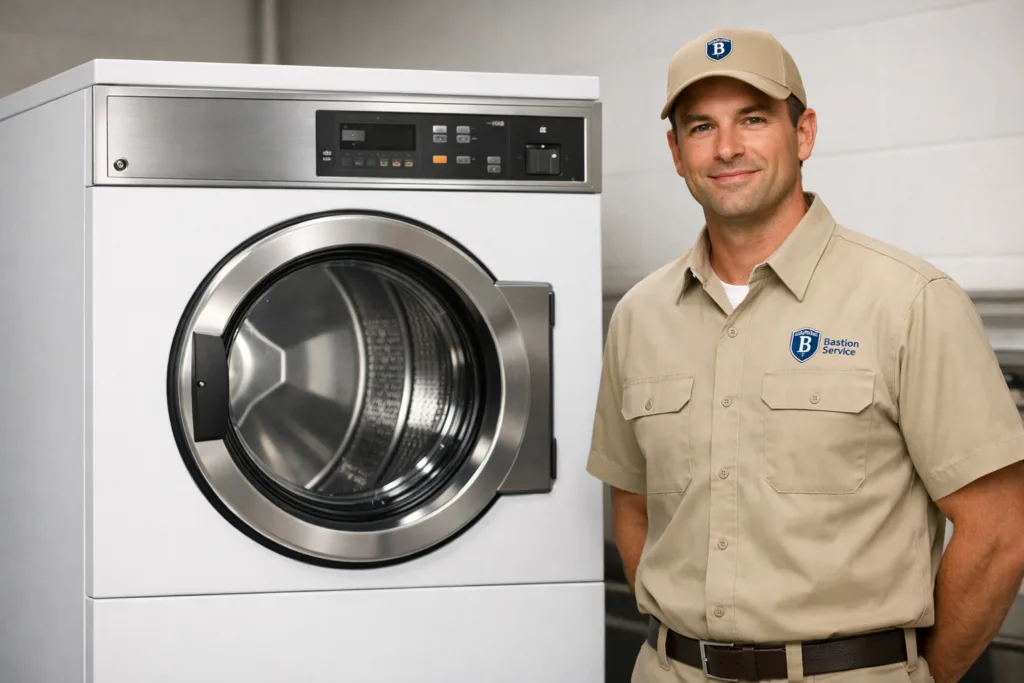




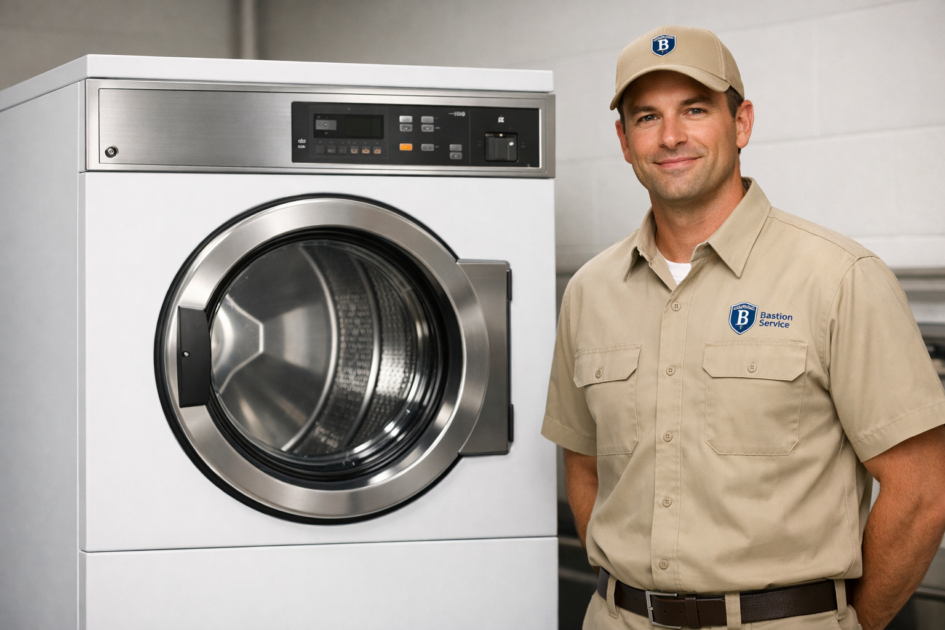
Dryer problems can quickly disrupt linen turnover, resident service, staff routines, and daily workflow. For businesses in West Los Angeles, the right next step is to schedule service based on the exact symptom pattern rather than guessing at parts. Bastion Service handles Speed Queen dryer repair by testing heat, airflow, drum movement, controls, and safety circuits so the repair decision matches the failure instead of the most obvious symptom.
Related commercial service paths in West Los Angeles include Speed Queen Repair in West Los Angeles, Commercial Dryer Repair in West Los Angeles, and Speed Queen Washer Repair in West Los Angeles.
A dryer that tumbles but leaves loads damp needs a different repair path than a unit that will not start, shuts down during operation, overheats, or develops scraping noise. Early service can help limit downtime, reduce repeat failures, and prevent extra wear on motors, belts, rollers, heating components, and control parts.
Common Speed Queen dryer problems
No heat or poor drying performance
If the drum turns but fabrics stay damp, the issue may involve a failed heating component, ignition problem, restricted airflow, thermostat fault, sensor issue, or control failure. In business settings, this often shows up first as longer dry times, repeated cycle restarts, or loads that feel warm but not fully dry. Running the dryer in this condition can reduce throughput and add strain to other components.
Dryer starts but does not finish the cycle
Mid-cycle shutdowns can point to overheating protection, airflow restriction, motor trouble, control board faults, or intermittent electrical issues. If the machine stops at different points with no consistent pattern, testing is usually needed to separate a heat-related shutdown from a timer, sensor, or power problem.
Dryer will not start
A no-start complaint may come from a door switch failure, start circuit issue, blown thermal device, control problem, wiring fault, or motor failure. On Speed Queen units, several different faults can produce the same no-start symptom, which is why proper testing matters before any part is replaced.
Long dry times with normal drum movement
When the drum turns normally but drying time keeps increasing, airflow is often a major suspect. Lint buildup, vent restriction, weak blower performance, heat cycling problems, or moisture sensing issues can all reduce efficiency. This is especially important in higher-volume laundry use where a small airflow problem can create a major scheduling problem.
Noise, vibration, or scraping
Thumping, squealing, grinding, or scraping usually points to worn rollers, belt issues, idler problems, drum support wear, bearing damage, or motor-related strain. Mechanical noise rarely stays minor for long. Continued use can cause secondary damage if moving parts wear unevenly or begin to bind.
Overheating or burning odor
A dryer that feels unusually hot, produces a burning smell, or shows signs of overheating should be inspected promptly. Possible causes include lint accumulation in critical areas, airflow restriction, failing thermostats, slipping drive parts, damaged wiring, or control faults. This is a stop-and-schedule-service symptom, not one to monitor for later.
Why symptom-based diagnosis matters
Many dryer complaints sound simple from the outside but have several possible causes. “Not heating” can mean a failed element or igniter, but it can also come from airflow problems, safety cutoffs, control issues, or voltage problems. “Not drying” may actually be a venting issue rather than a heating failure. “Shuts off early” can be tied to overheating, sensing, or motor protection.
Because similar symptoms can come from different failures, targeted testing helps avoid replacing parts that do not solve the real problem. It also helps determine whether the repair is isolated to one system or whether multiple wear issues are affecting performance at the same time.
Warning signs that service should be scheduled soon
- Loads are taking noticeably longer to dry than usual
- The dryer has heat sometimes but not on every cycle
- The machine stops before the load is finished
- Starting the dryer requires repeated attempts
- The cabinet becomes hotter than normal during operation
- There is new squealing, scraping, grinding, or heavy vibration
- A burning smell appears during or after a cycle
- Output drops enough to affect staffing or load scheduling
Waiting too long can turn a contained repair into a larger one, especially when the original problem involves restricted airflow, heat stress, or worn rotating parts.
Why is my Speed Queen dryer not heating or finishing the cycle?
This combination usually points to one of a few core issues: failed heating components, restricted venting, tripped safety devices, faulty thermostats, sensor problems, control failure, or electrical supply trouble. In some cases, the dryer still tumbles normally, which makes the problem look minor even though the machine is no longer reaching or maintaining the proper drying temperature.
If the dryer begins the cycle but shuts down before completion, overheating protection or motor-related shutdown can also be involved. When a unit both struggles to heat and fails to complete cycles consistently, the most efficient path is to test the airflow and heat system together rather than treating them as separate complaints.
Repair or replacement decision points
Repair is often the sensible option when the machine is structurally sound and the failure is limited to serviceable components such as heating parts, controls, switches, rollers, belts, sensors, or motors. Replacement becomes a more serious consideration when the dryer has repeated breakdowns, multiple systems showing wear, severe heat damage, or a repair scope that no longer fits the machine’s remaining value.
For businesses in West Los Angeles, the best decision usually depends on three factors: the confirmed fault, the overall condition of the dryer, and how much future downtime the operation can realistically absorb. A focused repair can restore reliable performance, but a machine with a long pattern of recurring issues may justify replacement planning instead.
How to prepare for a dryer repair visit
Before service is scheduled, it helps to note the exact symptom and when it appears. Useful details include whether the drum turns, whether heat is present at all, whether the problem affects every cycle, whether shutdown happens at a certain point, and whether any unusual noise or smell appeared before the failure. If multiple dryers are in use, identifying whether the issue is isolated to one unit or showing up across several loads can also help narrow the cause.
Practical preparation can speed up diagnosis and make the visit more productive:
- Note whether the unit has no heat, weak heat, or excessive heat
- Track if the problem is constant or intermittent
- Listen for new sounds such as squealing, thumping, or scraping
- Stop using the dryer if there is a burning odor or overheating concern
- Keep the area around the machine accessible for inspection
Service that supports day-to-day operations
Dryer repair should do more than restore basic operation for one cycle. It should identify the failed system, explain whether continued use could cause more damage, and give the business a realistic path forward. For Speed Queen dryer issues in West Los Angeles, that means matching the repair to the actual workload, symptom history, and downtime impact so scheduling and equipment decisions stay grounded in how the machine is used. If your dryer is not heating, taking too long to dry, shutting down, or making new mechanical noise, scheduling service promptly is the best way to reduce disruption and restore consistent operation.


