
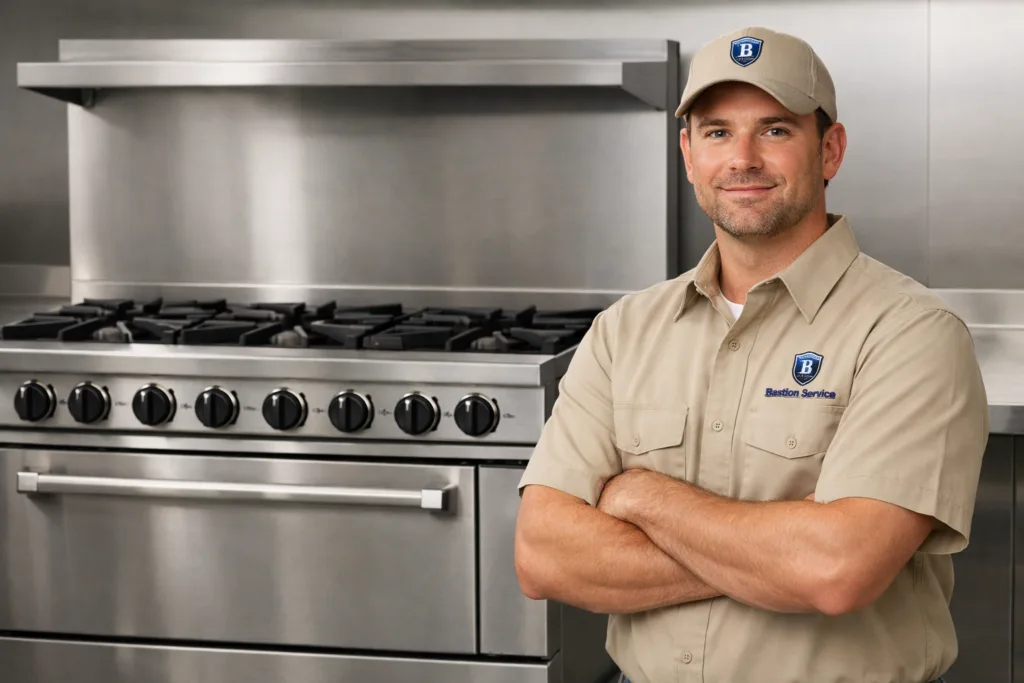




Range problems can disrupt prep, slow ticket times, and force staff to work around equipment that no longer responds the way it should. For businesses in West Los Angeles, service is most effective when the symptom pattern is evaluated first, the likely cause is narrowed down, and repair scheduling is based on how the failure is affecting daily output. Bastion Service works on Southbend range issues with that service-focused approach so businesses can make informed decisions about repair timing, parts, and operational impact.
Related commercial service paths in West Los Angeles include Southbend Commercial Repair in West Los Angeles, Southbend Oven Repair in West Los Angeles, and Vulcan Range Repair in West Los Angeles.
Why is my Southbend range not lighting, heating, or holding temperature?
These symptoms often trace back to a limited set of systems, but the exact cause is not always obvious from the surface complaint. A burner that will not light may involve ignition components, clogged ports, gas-flow problems, switches, or wiring. Weak heat may come from burner restriction, pressure issues, or failing control parts. Temperature instability can point to sensing, calibration, burner performance, or intermittent control faults.
That is why symptom-based diagnosis matters. The same range can show one problem during startup, another during a long cook cycle, and a third when multiple burners are being used at once. A proper inspection helps determine whether the issue is isolated or whether several worn components are contributing to the breakdown.
Common Southbend range symptoms and what they can mean
Burners that do not ignite reliably
If a burner clicks without lighting, lights only after several attempts, or fails intermittently, the problem may involve the igniter, burner buildup, wiring faults, moisture intrusion, or irregular fuel delivery. In a busy kitchen, unreliable ignition quickly becomes more than an inconvenience because staff begin losing time on repeated start attempts and may shift work to other stations.
Flame that looks weak, uneven, or abnormal
Low flame, patchy flame spread, or noticeable color changes usually indicate that the burner is not operating the way it should. Restricted burner paths, pressure problems, adjustment issues, or worn fuel-control parts can all affect heat output. When flame quality changes, cooking speed and consistency usually change with it.
Oven or range heat that drifts during use
When the unit seems to run hot, then cool, or struggles to maintain a stable set temperature, the cause may be tied to controls, sensing components, calibration problems, or inconsistent burner performance. This kind of issue often shows up first as uneven results rather than a complete failure, which makes it easy to overlook until production quality starts slipping.
Clicking, cycling, or repeated attempts to start
Persistent clicking or repeated startup behavior may mean the ignition system is trying to compensate for a fault it cannot overcome. That can include worn ignition parts, contaminated burner components, switch problems, or electrical issues. Continued use under those conditions can add wear to related parts and increase the chance of a no-start condition during a shift.
Intermittent shutdowns or inconsistent controls
If the range works for a period of time and then cuts out, loses heat, or responds unpredictably to settings, the problem may involve switches, thermostatic components, connections, wiring, or heat-damaged controls. Intermittent issues are especially important to address early because they often worsen gradually and are easy to mistake for operator inconsistency.
What a diagnosis should confirm before repair begins
Before parts are replaced, the service visit should establish which system is actually failing, whether the problem has affected neighboring components, and whether the range can remain in use safely until repair is completed. That process is important because visible symptoms do not always identify the failed part correctly.
- Whether the complaint is tied to ignition, burner performance, controls, or fuel delivery
- Whether wear is isolated or part of a larger pattern across the unit
- Whether the range is causing workflow slowdowns or quality issues during production
- Whether continued operation risks added damage or a full outage
- Whether a targeted repair is reasonable based on age and condition
For West Los Angeles businesses, that information helps managers decide how urgently to schedule repair, whether to restrict use temporarily, and how to plan around downtime.
When range trouble starts affecting daily operations
Many range failures begin as small disruptions. A burner starts slower than usual. Heat recovery drops. One section cooks differently from another. Staff compensate at first, but those workarounds usually signal that the unit is no longer operating normally. Once the kitchen begins adjusting production around the equipment, service should move higher on the priority list.
Scheduling repair makes sense when you notice:
- Burners that fail to light consistently
- Heat output that feels weaker than normal
- Temperature swings that affect cooking results
- Repeated clicking or startup issues
- Controls that respond inconsistently
- Staff shifting work to other equipment to compensate
Repair decisions should account for downtime, not just the failed part
A Southbend range is often central to line performance, so the repair decision should consider more than whether one component can be replaced. If the unit has a solid structure and the failure is isolated, repair is often the sensible path. If the range has multiple overlapping problems, repeated service history, or wear severe enough to make reliability uncertain, the conversation may need to include whether another repair cycle is worth the operational risk.
Useful repair planning should consider the condition of burners, controls, ignition-related parts, and the overall service history of the unit. For many businesses in West Los Angeles, the larger cost is not the component itself but the disruption caused by unstable cooking performance and unplanned outages.
How to prepare for a Southbend range service visit
Good preparation can speed up diagnosis and reduce back-and-forth during service. If possible, note whether the issue affects all burners or only one area, whether it happens at startup or after the unit has been running, and whether the symptom is constant or intermittent. Details about clicking, delayed ignition, weak heat, shutdown timing, or temperature drift can help narrow the cause faster.
It also helps to identify when the issue started, whether performance changed gradually or suddenly, and whether staff have noticed any unusual sounds, smells, or operating behavior. That kind of information supports a more efficient repair plan and helps separate a single part failure from a broader operating problem.
Service focused on restoring reliable kitchen performance
Southbend range repair in West Los Angeles should be approached with the realities of business operations in mind: diagnosing the actual source of the problem, determining whether the unit can remain in service, and scheduling repair based on the impact to production. When a range is not lighting, not heating properly, or no longer holding temperature, the right next step is prompt evaluation and a repair recommendation that fits the equipment condition, the urgency of the failure, and the practical needs of the kitchen.


