
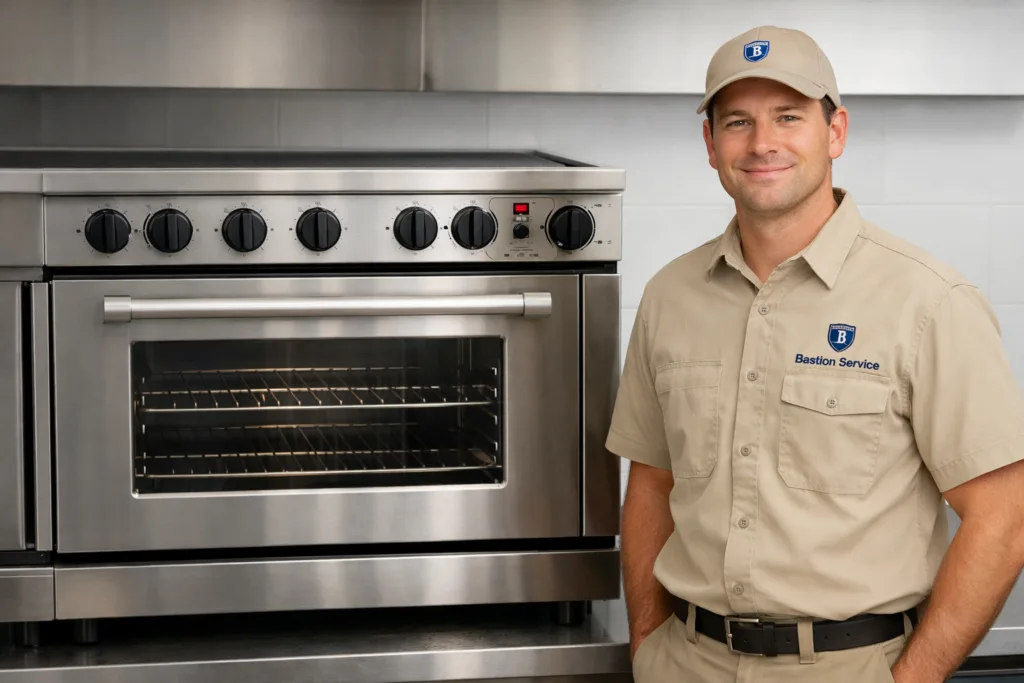




Busy kitchens in Mid-City usually notice Southbend oven trouble before the unit fully fails. Preheat takes longer, pans bake differently from one rack to another, the burner does not light cleanly, or the control begins acting inconsistently during production. Those symptoms matter because they affect output, food quality, labor timing, and the ability to keep service moving. Bastion Service works with businesses in Mid-City to inspect the exact failure pattern, narrow down the cause, and schedule repair based on how the oven is actually performing on the job.
Related commercial service paths in Mid-City include Southbend Commercial Repair in Mid-City, Commercial Oven Repair in Mid-City, and Southbend Range Repair in Mid-City.
Common Southbend Oven Problems That Disrupt Daily Operations
Not heating or struggling to reach the set temperature
When an oven powers on but does not build heat properly, the problem can come from several different points in the system. Gas models may have ignition weakness, burner problems, flame-sensing issues, or valve-related faults. Electric units may have failed heating elements, relays, wiring problems, or control failures. In both cases, a temperature complaint should be tested instead of assumed, because a unit that seems underpowered may actually be misreading temperature or cycling incorrectly.
Uneven baking, hot spots, or poor temperature recovery
If one side cooks faster than the other, top racks finish early, or batches need constant rotation, the oven may have airflow issues, convection component wear, calibration drift, seal problems, or internal heat loss. These problems often show up gradually. Staff compensate by changing cook times or repositioning trays, but that workaround usually means the equipment is no longer performing as intended.
Ignition delays and intermittent burner operation
An oven that clicks repeatedly, lights late, drops flame, or shuts down partway through a cycle often needs prompt attention. Intermittent faults are especially disruptive because the unit may appear normal during one shift and fail the next. Heat-related electrical issues, ignition wear, sensor problems, and control faults can all create inconsistent operation that is difficult to catch without direct testing.
Control problems and unexplained shutdowns
When the display behaves erratically, settings do not hold, or the oven resets unexpectedly, the issue may involve the controller, thermostat function, sensor feedback, wiring, or incoming power conditions. These failures are more than a convenience problem. Once controls stop responding consistently, the oven becomes harder to trust during production, and food results often become less predictable.
Door, hinge, and gasket wear
Heat retention matters. A worn gasket, loose hinge, or door that no longer closes evenly can cause slow preheat, unstable chamber temperature, and longer cook times. This kind of mechanical wear is easy to underestimate, but it can place extra strain on heating components and make other performance complaints seem worse than they would be with a proper seal.
Why a Southbend Oven May Not Heat Evenly or Reach Set Temperature
Uneven heat or failure to reach the selected temperature is one of the most common reasons businesses in Mid-City schedule service. The cause is not always a single failed part. A weak igniter can delay proper burner performance. A drifting sensor can send inaccurate temperature information to the control. A damaged door seal can let heat escape fast enough to affect recovery. Convection-related issues can also make the chamber feel hot in some areas and weak in others.
This is why symptom-based diagnosis matters. If the complaint is only treated as “not heating enough,” the actual source can be missed. A proper service visit compares the reported symptom to how the unit ignites, cycles, holds temperature, and recovers under real operating conditions. That helps determine whether the issue is isolated, developing, or tied to multiple worn components.
Symptoms That Usually Mean Service Should Be Scheduled Soon
Some oven problems are obvious, while others build slowly and start costing time before anyone labels them a repair issue. It is usually time to schedule service when the oven’s behavior is changing enough that staff must work around it.
- Preheat is taking noticeably longer than before
- The oven does not maintain a stable temperature during use
- Food quality varies from batch to batch
- Burners fail to light reliably or light late
- The unit shuts off during a cook cycle
- The controller shows inconsistent response or errors
- The door does not seal tightly
- Staff are adjusting recipes or timing just to compensate for the oven
Once operators are changing process to work around the equipment, the oven is already affecting workflow. That usually means the issue is worth inspecting before it leads to a full outage.
Why Delaying Repair Often Increases Downtime
It is common to keep a struggling oven in use during busy periods, especially if it still works part of the time. The risk is that partial failure often becomes full failure under load. An ignition problem can turn into no heat. A temperature-control issue can affect entire batches. A worn gasket can force longer run times and added strain on other components.
Delaying service also makes troubleshooting harder when symptoms become layered. What began as a single ignition or sensor issue may later involve damaged wiring, overheated parts, or broader control problems. For businesses in Mid-City, earlier repair planning usually means better scheduling decisions and fewer surprises during active service periods.
What Technicians Typically Check on a Southbend Oven Service Call
A useful oven repair visit is focused on how the unit fails, not just on replacing the most common part. The inspection may include:
- Ignition sequence and burner performance
- Temperature accuracy and cycling behavior
- Sensor and thermostat response
- Control operation and electrical checks
- Convection fan and airflow function, where applicable
- Door alignment, gasket condition, and heat retention
- Safety-related shutdown behavior
- Visible wear on serviceable components
That process helps determine whether the repair is a straightforward correction, a multi-part issue, or a sign the oven has broader wear affecting reliability.
Repair or Replacement: How Businesses Usually Decide
Many Southbend oven problems can be repaired effectively when the unit is otherwise in solid condition. Igniters, sensors, switches, controls, contactors, gaskets, fan-related parts, and similar components are common service items. If the structure of the oven is sound and the failure is limited to repairable assemblies, repair is often the more practical path.
Replacement becomes a more serious consideration when there are repeated breakdowns, several major systems showing wear at the same time, or repair costs that no longer support stable operation. The key question is not only whether the oven can run again, but whether it can return to dependable use without creating ongoing disruption for the business.
How to Prepare for a Southbend Oven Repair Visit
A few details from the site can make service more efficient. It helps to note when the problem happens, whether it appears during preheat or under load, how long the issue has been present, and whether the oven is failing all the time or only intermittently. If staff have noticed unusual sounds, delayed ignition, temperature drift, or shutdowns after reaching heat, that information can help narrow the test process.
If possible, businesses should also be ready with the model information and a short summary of how the issue affects production. That allows repair decisions to stay centered on uptime, scheduling, and the most practical next step for the equipment.
Service-Focused Support for Mid-City Businesses
Southbend oven issues rarely stay isolated for long once they begin affecting consistency, heat output, or startup reliability. For businesses in Mid-City, the most useful next step is to have the symptom verified, the failure point identified, and the repair path explained in plain terms so downtime can be managed with less guesswork. When the oven is slowing production, creating uneven results, or showing signs of ignition or control trouble, timely service helps restore safer, steadier operation and makes scheduling decisions easier.


