
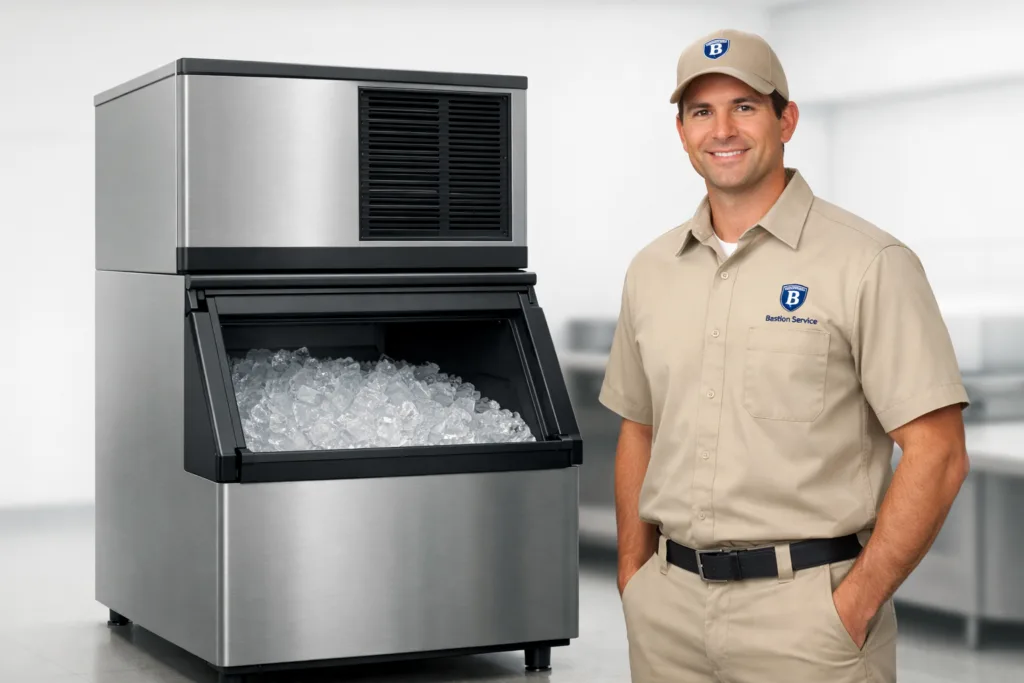




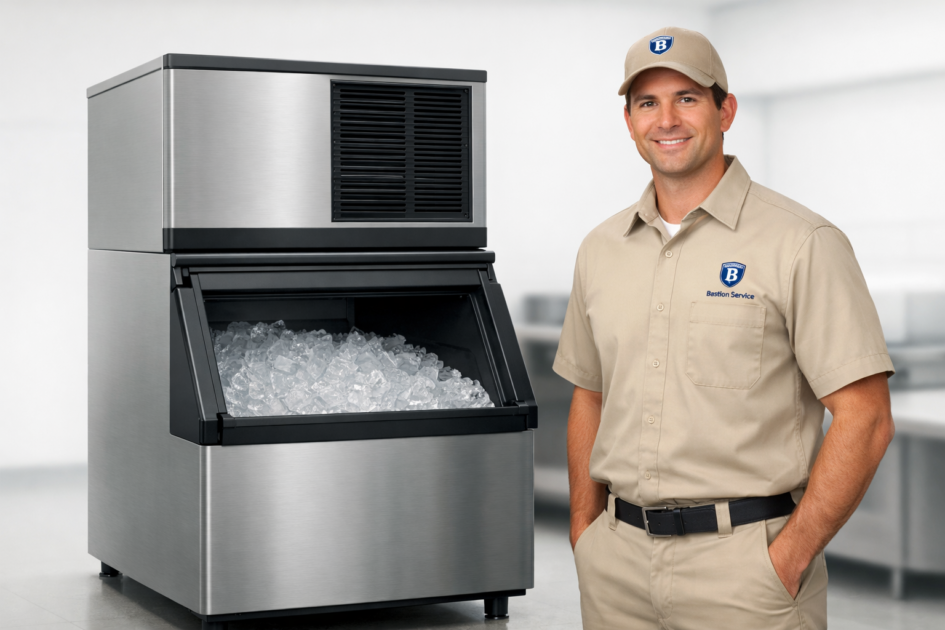
Ice machine problems can disrupt service quickly when bins do not refill, water starts showing up around the unit, or production drops below daily demand. For businesses in Santa Monica, repair service is most useful when it moves beyond guesswork and identifies whether the issue involves water flow, scale buildup, harvest components, sensors, drainage, refrigeration performance, or an electrical fault. Bastion Service helps business owners and managers evaluate symptom patterns, schedule repair at the right time, and decide whether the machine can stay in use while service is arranged.
For specific equipment paths in Santa Monica, review Scotsman Ice Machine Repair in Santa Monica and Commercial Appliance Repair in Santa Monica.
Common Scotsman Ice Machine Symptoms and What They May Indicate
Scotsman ice machine equipment often gives early warning signs before a full shutdown. A machine may still run while producing less ice, making inconsistent cubes, taking too long to complete cycles, or stopping intermittently. Those symptoms matter because several different failures can look similar from the outside, and the right repair depends on what is happening inside the machine.
Low Ice Production or Slow Refill
When output drops, the cause may be restricted incoming water, mineral accumulation on internal components, a dirty condenser, weak refrigeration performance, sensor issues, or controls that are no longer cycling properly. Low production is not only an inconvenience; it can create service delays and force staff to work around a machine that is no longer meeting demand. If the bin is not recovering on schedule, it usually makes sense to inspect the machine before the problem develops into a complete stop.
Thin, Small, Cloudy, or Misshapen Ice
Changes in ice quality often point to water distribution problems, scale, inlet valve issues, freeze inconsistencies, or sensor-related errors. Ice that looks different than normal can be one of the earliest signs that the machine is no longer operating efficiently. Because appearance and size changes may happen before a full production failure, these symptoms are worth addressing early rather than waiting until the machine stops harvesting or shuts down.
Leaks, Overflow, or Water Around the Unit
Water on the floor or inside the cabinet can result from blocked drains, cracked lines, drain pump problems, loose connections, poor water regulation, or abnormal freeze and harvest behavior. Persistent leaking should not be treated as a minor nuisance. It can lead to cleanup issues, interfere with nearby equipment, and increase the chance that a smaller problem turns into a more involved repair.
Harvest Problems and Ice Not Releasing Properly
If ice sticks to the evaporator, forms into a slab, breaks irregularly, or fails to release during harvest, the machine may be dealing with scale buildup, probe or sensor problems, control timing faults, or issues in the harvest circuit. Repeated restart attempts rarely solve this kind of problem for long. When harvest problems start repeating, service should focus on why the machine is failing to transition normally from freeze to release.
Unexpected Shutdowns or Intermittent Operation
A machine that starts and stops unpredictably may be entering a protective shutdown or reacting to a sensor error, overheating condition, control board issue, power problem, or failing component. Intermittent operation can be especially frustrating because the unit may appear to recover for a short period and then fail again during a busy part of the day. That pattern usually means the issue is progressing, not resolving.
Why Water Flow and Scale Problems Matter So Much
Many recurring Scotsman issues begin with water-side problems. Reduced flow, mineral deposits, clogged distribution paths, and drainage restrictions can interfere with freeze times, harvest performance, cube quality, and overall production. Scale does more than affect appearance. It can alter how the machine senses conditions, reduce efficiency, and contribute to repeated faults that look electrical or mechanical at first.
When buildup is part of the failure pattern, repair may involve both corrective work and cleaning so the machine can return to more stable operation. If scale is ignored too long, parts that might have functioned normally with earlier attention can begin to fail under added strain.
Signs the Machine Should Not Be Left Alone Much Longer
Some symptoms justify prompt scheduling because continued operation can make the repair more expensive or create avoidable downtime. Watch for these warning signs:
- production that keeps falling week after week
- repeated need to reset the machine
- water leaks that return after cleanup
- ice that looks inconsistent from batch to batch
- harvest failures that interrupt normal cycling
- shutdowns that happen during heavy use
- visible mineral accumulation inside key ice-making areas
If more than one of these symptoms is happening at the same time, the machine usually needs a service visit sooner rather than later.
How Repair Decisions Are Usually Made
Once the symptom pattern is inspected, the next step is deciding whether the issue is isolated or part of a broader condition affecting the machine. That decision often comes down to a few practical questions:
- Is the problem tied to one failed component or several systems?
- Does the machine need cleaning and repair together?
- Can the unit stay in limited use without increasing risk?
- How urgently does output need to be restored for daily operations?
- Is the current issue part of a recurring service history?
For businesses in Santa Monica, these decisions are not just technical. They affect staffing, drink service, food holding, customer flow, and whether temporary workarounds are realistic. A targeted repair is often the right move when the machine is otherwise in solid condition. If breakdowns have become frequent and multiple issues are stacking up, it may be time to compare further repair costs with replacement planning.
What a Service Visit Can Clarify
A repair visit should help answer the questions that matter most operationally: what is causing the production or shutdown issue, whether the machine can continue running safely, what parts or cleaning steps may be needed, and how quickly service should be completed to reduce disruption. That kind of evaluation is especially important when symptoms overlap, such as low output combined with poor ice quality or leaks combined with harvest faults.
If your Scotsman ice machine in Santa Monica is producing less ice, leaking, shutting down, or showing harvest and water flow problems, the best next step is to schedule service before the disruption spreads further into daily operations. Early repair attention can help protect uptime, reduce unnecessary strain on the machine, and give you a workable plan for restoring reliable ice production.


