
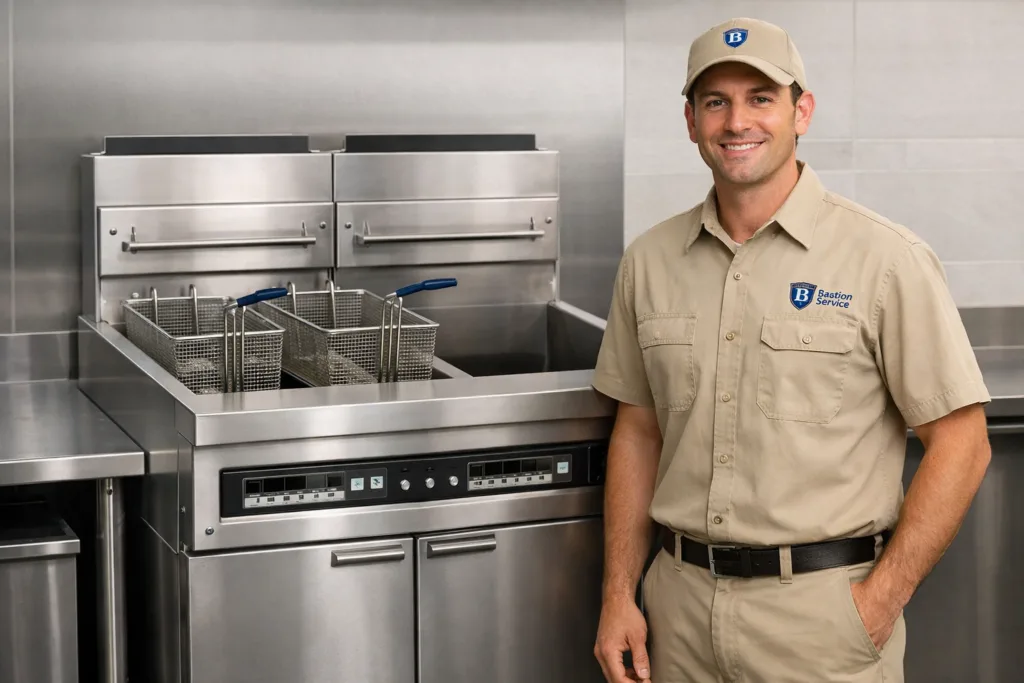




When Pitco cooking equipment begins missing heat targets, recovering too slowly, or shutting down during a busy shift, the effect shows up immediately in ticket times, food quality, and kitchen flow. Similar symptoms can come from very different failures, so repair decisions are best made after the equipment is tested for the actual cause. Bastion Service works with businesses in Santa Monica to identify what is affecting operation, determine whether the unit should stay in use, and schedule repair based on urgency, parts needs, and production impact.
For specific equipment paths in Santa Monica, review Pitco Fryer Repair in Santa Monica and Commercial Appliance Repair in Santa Monica.
What Pitco cooking equipment problems do you troubleshoot?
Pitco equipment issues are often first noticed as inconsistent performance rather than a complete outage. A fryer may still turn on but struggle to maintain temperature. A burner may light, then drop out. Controls may appear functional while the unit cooks unevenly or falls behind during peak demand. In most cases, troubleshooting focuses on the heating system, ignition sequence, temperature control components, safety devices, gas flow, wiring, and operating responses under load.
Common symptom patterns include:
- Equipment not heating or heating too slowly
- Oil temperature that runs too high or too low
- Slow recovery between batches
- Ignition failure or repeated startup attempts
- Burners that cycle irregularly or produce weak heat
- Unexpected shutdowns during use
- Error conditions or visible control problems
- Performance changes that interrupt production
These problems can point to failed controls, probes, thermostatic parts, ignition components, high-limit devices, burner issues, or electrical faults. A symptom-based inspection helps separate a single failed part from a broader wear pattern that may keep causing downtime if only the most obvious issue is addressed.
Fryer symptoms that often need repair attention
Because fryer performance is closely tied to output, even a modest change can become an operating problem. Businesses in Santa Monica often call for service when a unit still runs but no longer keeps pace with normal kitchen demand.
Temperature drift and unstable heat
If food is cooking too fast, too slowly, or inconsistently from batch to batch, the fryer may not be reading or responding to temperature correctly. Possible causes include sensor faults, thermostat problems, control board issues, high-limit concerns, or irregular burner operation. This type of problem affects product consistency and can also place extra strain on other components if the unit keeps cycling abnormally.
Slow recovery during rush periods
Recovery issues are especially disruptive when the fryer falls behind after each basket drop. Kitchens may notice longer cook times, reduced capacity, or a backlog that forces staff to adjust workflow. Slow recovery can be linked to burner weakness, gas delivery issues, scale or buildup affecting heat transfer, or control faults that prevent the unit from operating at full performance.
Ignition failures and startup trouble
If the fryer does not light reliably, clicks repeatedly, or starts and then shuts off, the fault may involve the ignition module, flame sensing, pilot-related parts, wiring, or safety controls. Repeated restart attempts can waste time and make the underlying issue harder to isolate, especially when the failure is intermittent.
Unexpected shutdowns
A fryer that turns off during operation should be evaluated quickly. Shutdowns can be tied to overheating protection, ignition loss, control failure, electrical interruptions, or a condition that is triggering a safety response. For kitchens that depend on steady fryer output, this is usually a sign to move from observation to scheduled repair as soon as possible.
How repair decisions are made in a working kitchen
Not every equipment issue calls for the same response. Some problems can be resolved with a focused repair after testing confirms the failed component. Others reveal multiple worn parts, repeated heat-related damage, or control-system issues that change the repair scope. The goal is not just to identify one bad symptom but to understand how the equipment is performing overall and what the next step should be.
That usually means answering a few practical questions:
- Is the equipment safe and reasonable to keep using until repair is completed?
- Is the problem isolated, or does it suggest broader wear?
- Will continued operation risk a larger failure?
- Does the repair support current production needs, or is replacement becoming the better business decision?
For kitchen managers and operators, those answers matter because downtime affects staffing, prep timing, menu execution, and the ability to maintain service standards.
Signs it is time to schedule Pitco repair in Santa Monica
Service is worth scheduling when the equipment shows repeat symptoms rather than a one-time irregularity. If a fryer is holding the wrong temperature, taking longer to recover, failing to ignite, shutting down mid-shift, or causing quality issues, waiting often increases the chance of a more disruptive outage.
It is also smart to schedule service when the unit still runs but staff have started working around it. Examples include extending cook times, avoiding one fryer during busy periods, restarting the unit several times a day, or limiting production because the heat is no longer dependable. Those workarounds usually mean the equipment is already affecting operations, even if it has not failed completely.
What a service visit should clarify
A productive repair visit should narrow the fault to the system actually causing the trouble and explain what that means for operation. That includes identifying whether the problem is related to heating, controls, ignition, burner performance, or safety shutdown behavior, along with whether the unit can remain in use and what parts or follow-up work may be required.
For businesses in Santa Monica, the most useful outcome is a service path that matches real operating needs: what is failing, how urgent the repair is, whether temporary use is realistic, and how to address the issue before it creates broader production delays. If your Pitco cooking equipment is no longer heating reliably, struggling with ignition, losing temperature, or interrupting kitchen output, the next step is to schedule repair and get a diagnosis that supports a practical plan.


