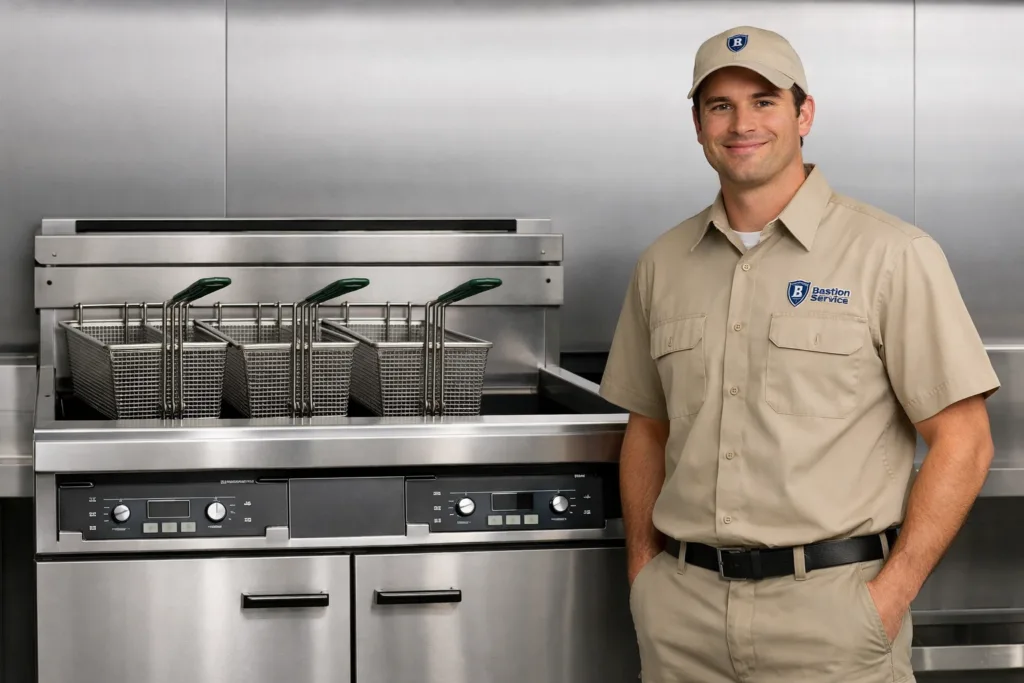




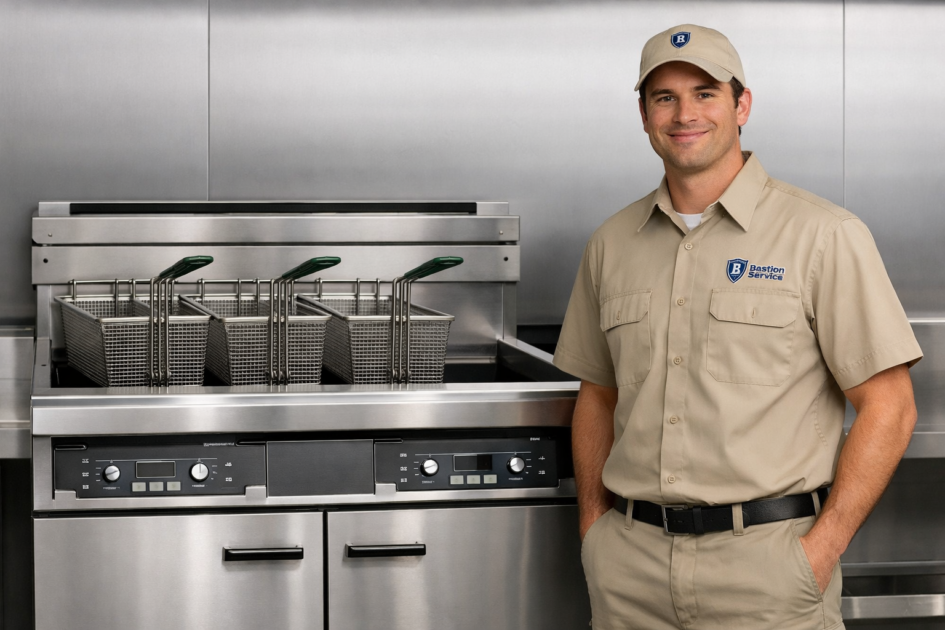
When Pitco cooking equipment starts missing temperature targets, recovering too slowly, or shutting down during service, the problem quickly affects ticket times, food quality, and line capacity. In Century City, the most useful repair visit is one that connects the symptom to the actual failed component so managers can decide whether the unit should stay in rotation, be repaired immediately, or be taken offline before it causes a larger interruption. Bastion Service works with local businesses to diagnose these issues, explain the repair path, and help schedule service around operating demands when possible.
For specific equipment paths in Century City, review Pitco Fryer Repair in Century City and Commercial Appliance Repair in Century City.
How Pitco cooking equipment problems show up in daily kitchen operations
Most operators notice equipment trouble first through workflow changes rather than technical warning signs. A fryer may take longer to recover between batches, product may come out darker or lighter than expected, or a unit may begin cycling unpredictably during a busy period. In some cases, staff start adjusting cook times or changing batch sizes just to keep output moving. Those workarounds are often early signs that the equipment needs attention.
Because Pitco cooking equipment is tied directly to production, even a symptom that seems minor can create wider disruption. A single heating fault can affect prep timing, holding capacity, menu consistency, and staffing decisions across the kitchen. That is why symptom-based diagnosis matters: similar performance issues can come from very different causes in ignition, burners, controls, sensors, safety limits, gas flow, or electrical components.
Common Pitco fryer problems that disrupt service
No heat or failure to start heating
If the fryer does not heat at all, the problem may involve ignition components, a tripped high-limit, control failure, wiring faults, or gas-related issues. From an operations standpoint, this is usually an immediate production loss. A proper repair evaluation helps determine whether the issue is isolated to a single part or tied to a broader control or safety problem.
Slow heat recovery
Slow recovery often shows up when the oil temperature drops during normal use and takes too long to return to target. That can lead to longer cook cycles, inconsistent results, and reduced output during rush periods. Common causes include burner performance problems, sensor drift, scaling or buildup affecting heat transfer, or control-related faults that keep the fryer from responding correctly under load.
Unstable or inaccurate temperature control
When a fryer overheats, underheats, or swings between temperatures, product consistency suffers first. Operators may also notice that staff begin compensating manually because the displayed settings no longer match actual cooking results. These symptoms can point to thermostat, probe, control, calibration, or safety-related issues, and they should be addressed before they create avoidable food waste or operational risk.
Ignition problems and burner irregularities
Delayed ignition, inconsistent flame, burner dropout, or repeated failed starts often indicate trouble in the ignition sequence, gas delivery, burner assembly, or control circuit. These faults can become progressively more disruptive because the fryer may appear to work intermittently before failing altogether. Intermittent operation is especially hard on service flow because the station cannot be trusted during peak demand.
Unexpected shutdowns
If the fryer begins heating normally and then powers down or stops maintaining heat, the issue may be related to overheating protection, intermittent electrical faults, failing controls, or an unstable sensor input. Shutdowns during active production usually justify prompt service because they create uncertainty for the line and can be difficult to predict without testing under real operating conditions.
What Pitco cooking equipment problems do you troubleshoot?
For Pitco cooking equipment used in restaurants and other food-service businesses, troubleshooting typically includes:
- Units that will not heat or will not stay hot
- Slow recovery between batches
- Temperature overshoot, underheating, or unstable control
- Ignition failures or delayed burner start
- Burner dropout or inconsistent flame performance
- High-limit trips and repeated shutdown behavior
- Error symptoms tied to controls, probes, or electrical faults
- Performance decline that causes production delays
Even when the equipment category is clear, the failure point is not always obvious from the symptom alone. For example, a fryer that seems to have a temperature problem may actually be dealing with a sensing issue, a control issue, or a burner problem that only shows up under load. That is why repair decisions should be based on testing and inspection rather than guesswork.
Why diagnosis matters before ordering parts
Kitchen equipment symptoms often overlap. A unit that fails to recover properly can look like a simple burner issue, but the root cause may be a control fault or a sensor that is reading inaccurately. A fryer that shuts down might have a safety-limit issue, but it could also be reacting to overheating caused by another failing component. Starting with diagnosis reduces the chance of replacing parts that do not solve the underlying problem.
It also helps management plan around downtime. Once the failure point is identified, it becomes easier to decide whether the equipment can remain in limited use, whether repair should be prioritized before the next busy period, and whether the unit is still a practical candidate for repair based on age, condition, and reliability history.
Signs it is time to schedule repair instead of working around the problem
It usually makes sense to schedule service when any of the following are happening:
- Staff are adjusting cook times because the equipment is no longer consistent
- The fryer is technically running but output has dropped noticeably
- The unit loses heat during normal service
- Shutdowns are becoming more frequent or harder to predict
- Ignition takes multiple tries or fails intermittently
- Temperature performance is affecting product quality
- The equipment can no longer be trusted during peak volume
Intermittent problems are often the most disruptive because they create uncertainty rather than a clean failure. Managers may delay service because the unit still works part of the time, but that pattern often leads to more expensive downtime when the problem worsens in the middle of a rush.
Repair versus replacement considerations for Pitco equipment
Many Pitco cooking equipment issues can be addressed with targeted repair, especially when the fault is limited to ignition components, sensors, controls, burner-related parts, or other heating-system failures. Replacement becomes a more serious consideration when the equipment has a pattern of repeated breakdowns, poor overall condition, extensive wear, or a history of repair costs that no longer makes sense for the kitchen.
The right decision depends on more than the current symptom. Operators should also consider how critical the unit is to daily volume, whether backup capacity exists, and how much downtime the kitchen can realistically absorb. A service diagnosis provides the information needed to make that call based on actual condition rather than assumptions.
Service-focused support for Century City kitchens
For restaurants and other food-service operations in Century City, Pitco cooking equipment repair should lead to a practical next step, not just a description of the symptom. If a fryer is down, running inconsistently, or showing signs of ignition, burner, or temperature-control trouble, scheduling repair is the best way to confirm the cause, reduce unnecessary production loss, and move forward with a repair plan that fits the needs of the kitchen.