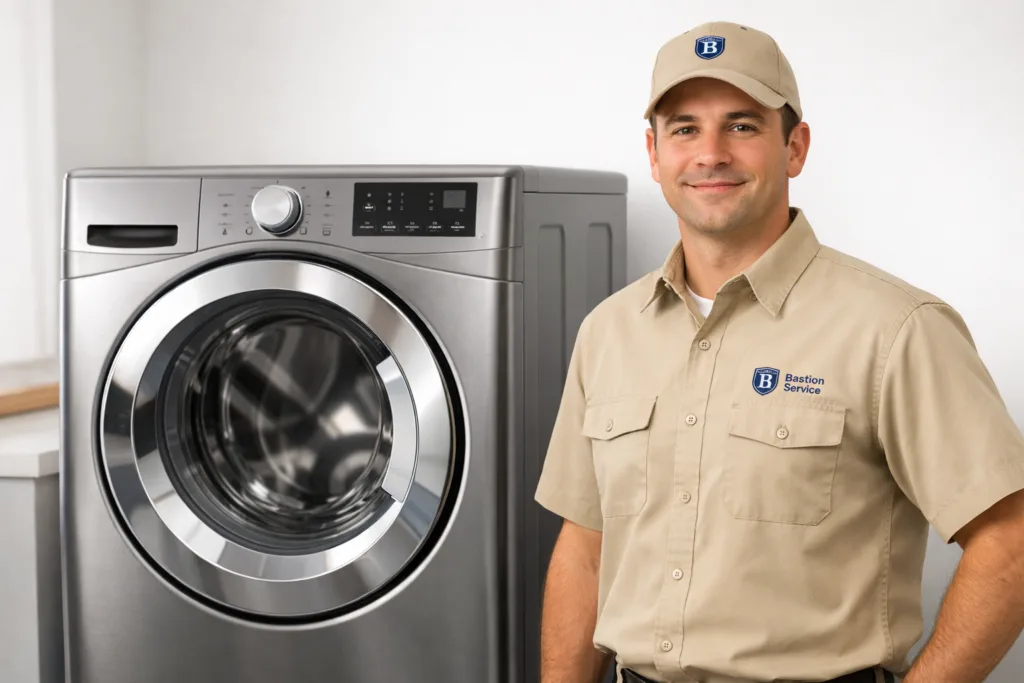
Common Maytag washer problems and what they can mean

Maytag washers can show the same symptom for several different reasons, which is why the pattern of the failure matters. A unit that will not start might have a lid or door lock issue, a control problem, a damaged user interface, or a power-related fault. If it fills with water but does not agitate or spin, the cause may involve the drive system, motor, actuator, belt, or a safety lock that is not engaging correctly.
Drain problems are especially disruptive in a home laundry routine. When the tub stays full or the washer stops before spin, the cause may be a clogged drain path, failing pump, water-level sensing issue, or a cycle control problem. If clothes come out unusually wet, the machine may be draining poorly, refusing to reach full spin speed, or stopping because it detects a condition that prevents the cycle from advancing.
Leaks also need closer inspection rather than guesswork. Water at the front can point to a door boot or overflow issue on some models, while water underneath or toward the rear may be related to hoses, the pump, internal seals, or fill connections. Even a small recurring leak can lead to cabinet damage, flooring problems, or hidden moisture in the laundry area.
Noise, shaking, and off-balance performance
A Maytag washer that suddenly gets loud should not be dismissed as normal wear. Grinding, roaring, scraping, banging, or repeated thumping during spin can indicate worn bearings, suspension problems, loose internal components, basket movement issues, or drive-related wear. Some machines will also pause repeatedly or fail to complete the spin cycle when they detect an unbalanced load condition.
Heavy vibration can become more than an annoyance. If the washer shifts during operation or slams the cabinet during spin, it can put additional stress on the tub assembly, mounting points, and surrounding parts. In Palos Verdes Estates homes, that often turns a repairable issue into a broader one if the machine keeps being used the same way.
When unusual sound matters most
A new sound that becomes more frequent from load to load is usually a stronger warning sign than a one-time rattle from a loose item in the drum. A deep rumble during high spin, a sharp knock as the basket speeds up, or a scraping sound that repeats each cycle generally points to a mechanical issue that should be inspected before further use.
Drain, spin, and cycle completion issues
Some washers appear to run normally at first but fail near the end of the cycle. The tub may remain full, the lid may stay locked, or the load may finish with clothing much wetter than expected. These symptoms often involve the drain system, lid or door sensing, water-level feedback, or control timing.
Because several parts can create similar results, replacing one item based only on the symptom can lead to unnecessary expense. A pump may still run but be partially obstructed. A washer may refuse to spin not because the motor has failed, but because it is not reading the lid position, load balance, or water level correctly. The right repair depends on which part of the sequence is actually breaking down.
Fill problems, poor wash results, and heating-related complaints
If a Maytag washer fills too slowly, overfills, or does not seem to bring in enough water for the load, the issue may involve the inlet valve, supply screens, pressure sensing system, or control response. Low fill complaints can also be confused with normal high-efficiency operation, so it helps to compare the current behavior with how the washer previously handled similar loads.
Poor wash results can show up as detergent residue, clothing that still looks dingy, or loads that come out with an odor even after a full cycle. In some cases, the problem is tied to water temperature, drain performance, load size, oversudsing, or a wash action problem rather than a single failed part.
On models where temperature performance affects results, heating-related complaints may point to thermistor, heater, wiring, or control issues depending on the design. If cycles run unusually long, stop midstream, or fail to reach the expected temperature behavior, that can also affect how well the washer rinses and finishes.
When to stop using the washer
It is usually best to stop using the washer if it is leaking onto the floor, tripping a breaker, giving off a burning smell, making severe mechanical noise, or leaving standing water in the tub. The same applies when the basket does not spin properly, the door or lid will not secure as it should, or the machine shakes violently enough to move during operation.
Even if the problem seems intermittent, repeated use can make diagnosis harder and increase the chance of secondary damage. A minor drain issue can strain the pump. A vibration problem can wear out surrounding components faster. A small leak can spread beyond the area you see right away.
Repair versus replacement for a Maytag washer
Whether repair makes sense depends on the washer’s age, overall condition, service history, and the exact component that has failed. Many repairs are worthwhile when the machine is otherwise in solid condition and the issue is limited to a serviceable part such as a pump, hose, inlet valve, latch, suspension component, or confirmed control-related failure.
Replacement starts to make more sense when there are multiple active problems, major tub or bearing failure, structural wear, significant rust, or recurring electronic faults that reduce confidence in long-term use. The goal is not simply to get one more load through the machine, but to make a choice that is sensible for the household.
Useful factors in the decision
- Whether the washer has needed repeated repairs recently
- Whether the current failure is isolated or part of a larger pattern
- Whether continued use risks damage to other parts
- Whether the repair is likely to restore normal, reliable operation
What homeowners in Palos Verdes Estates can expect from a focused service visit
A productive appointment should do more than identify a general category of failure. It should narrow the problem to the likely cause, test the parts involved in that symptom chain, and explain whether the repair is practical based on the machine’s actual condition. That is especially important with issues like no drain, no spin, leaks, cycle errors, poor wash performance, or a washer that will not start at all.
For Maytag washer repair in Palos Verdes Estates, the most useful outcome is a straightforward explanation of what failed, what needs to be repaired, and whether the machine is a good candidate for service. That helps homeowners avoid trial-and-error part swapping and make a confident decision about the next step.