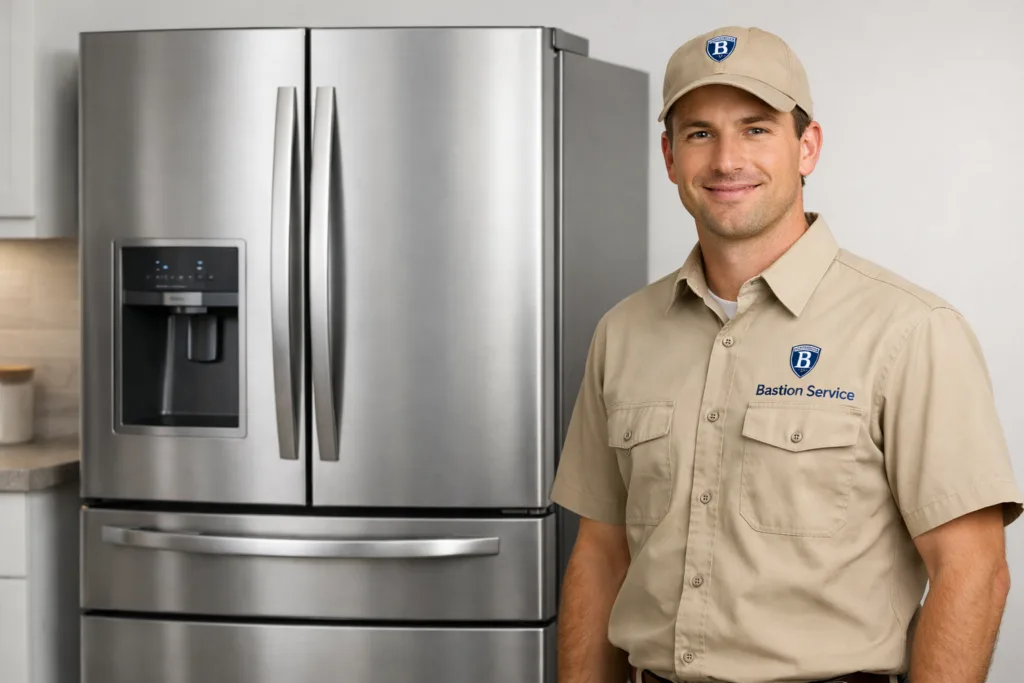
A Maytag refrigerator that starts warming up, leaking, or making unusual sounds usually gives warning signs before it fails completely. Paying attention to the exact pattern matters, because a refrigerator that runs constantly calls for a different repair path than one that cycles off too soon, frosts over, or cools unevenly from shelf to shelf.
What the symptom pattern usually tells you
Many refrigerator complaints sound similar at first, but the underlying cause can be very different. A fresh-food section that feels warm may be dealing with blocked airflow, a weak evaporator fan, a defrost problem, a control issue, or poor door sealing. Frost on the back wall of the freezer may point to a defrost failure, while water under the crisper drawers may be related to drainage or condensation management.
Instead of focusing only on the final symptom, it helps to notice when the issue happens, whether both compartments are affected, and whether performance changes during the day. Those details often make diagnosis faster and help determine whether repair is likely to be straightforward or more involved.
Refrigerator not cooling or not cold enough
If the refrigerator section is warming while the freezer still seems partly cold, airflow is often part of the story. Cold air has to move correctly from the freezer side through the system, and when that circulation is disrupted, the refrigerator compartment usually shows the problem first. Homeowners may notice milk spoiling early, soft produce, or temperatures that seem to improve briefly and then rise again.
Other clues include:
- The compressor or fans running longer than normal
- Items near vents freezing while other shelves stay warm
- Cabinet temperatures changing after the doors are opened
- A freezer that no longer keeps ice fully solid
These symptoms can be related to fans, sensors, controls, frost blockage, condenser issues, or more serious cooling-system trouble. If food safety is becoming a concern, service should not wait long.
Temperature swings and inconsistent performance
Some Maytag refrigerators do not fail all at once. Instead, they drift in and out of normal operation. One day everything seems fine, and the next day the refrigerator is too warm or the freezer is frosting over. Intermittent symptoms like this can come from a control problem, sensor inaccuracy, a fan that cuts in and out, or a defrost issue that builds slowly over time.
Temperature inconsistency is also one of the main reasons homeowners feel unsure about whether the problem is serious. In most cases, recurring swings mean the appliance is no longer managing cooling the way it should, even if it still appears to be running.
Frost buildup in the freezer
Frost is more than a cosmetic issue when it keeps returning. Heavy frost can restrict airflow, interfere with temperature balance, and eventually reduce cooling in both compartments. In some units, the first sign is ice collecting around the back panel. In others, the freezer door becomes harder to close properly, or frozen packages start sticking together because moisture is building where it should not.
Common causes include:
- Defrost heater or defrost control problems
- Door gasket leaks allowing humid air inside
- Airflow issues that keep moisture from clearing properly
- Doors being slightly misaligned or not sealing fully
If frost returns quickly after being cleared, the issue usually needs more than simple cleanup.
Water leaks and interior moisture
Water on the floor in front of the refrigerator is easy to spot, but moisture problems often begin inside first. You may see droplets on shelves, water collecting under drawers, or a sheet of ice forming where it should not. A clogged defrost drain is a frequent cause, though water line problems, freezing in the wrong area, and door seal issues can create similar results.
Leaks should be taken seriously because they can affect flooring, baseboards, and nearby cabinetry. If the same water problem keeps coming back, wiping it up is only a temporary fix.
Noisy operation, clicking, or constant running
Refrigerators make normal operating sounds, but new noise patterns are worth noticing. Buzzing, rattling, repeated clicking, fan noise that grows louder, or a machine that seems to run almost nonstop can all signal developing trouble. In some cases the noise is tied to a fan blade hitting ice buildup. In others, it may point to a failing motor, start component, or cooling-system strain.
A refrigerator that gets louder at the same time cooling becomes less reliable should usually be checked sooner rather than later.
Ice maker or dispenser issues
When the ice maker slows down, stops producing, or begins making unusually small cubes, the issue is not always limited to the ice maker itself. Water supply restrictions, inlet valve problems, freezer temperature issues, and airflow-related cooling problems can all reduce production. A dispenser that becomes weak or inconsistent may also indicate a broader temperature or water-delivery issue inside the unit.
If ice production drops at the same time food temperatures seem off, it is smart to treat it as a refrigerator performance problem, not just an accessory issue.
Basic checks homeowners can make first
Before scheduling service, a few simple checks can help rule out easy causes:
- Confirm the refrigerator has steady power
- Check that temperature settings were not accidentally changed
- Make sure interior vents are not blocked by large items
- See whether the doors are closing fully every time
- Look for obvious gasket gaps, torn seals, or heavy frost
- Verify that the condenser area is not heavily dust-loaded if accessible
If these basics do not change the symptom, further trial and error usually does not help much. At that point, the best next step is a clear diagnosis and a practical repair plan based on the exact symptom pattern.
When to stop using the refrigerator normally
Some refrigerator problems can be watched briefly, but others can get worse quickly with continued use. If the unit is warming rapidly, tripping a breaker, clicking without starting properly, or developing heavy frost that blocks airflow, normal use may add stress to major components. Repeated overheating or nonstop running can be especially hard on the compressor.
It also makes sense to act quickly when:
- Food is spoiling ahead of its normal shelf life
- The freezer is no longer holding a stable temperature
- Water leaks are recurring on the floor
- Condensation keeps returning inside the cabinet
- The refrigerator is much louder than usual
Repair or replacement: how the decision is usually made
For many households in Westwood, the decision is less about one symptom and more about the overall condition of the appliance. Age, prior repair history, the state of major components, and the cost of the current repair all matter. A drain issue, fan motor problem, gasket failure, or control-related fault may make good sense to repair if the refrigerator is otherwise in solid shape.
If the unit has repeat cooling problems, signs of sealed-system trouble, or a major component failure in an older appliance, replacement may be the better long-term option. The goal of service is not to push one outcome, but to provide enough information for a smart household decision.
What to expect from Maytag refrigerator repair in Westwood
A useful service visit should identify which system is actually failing rather than treating every cooling complaint as the same problem. That includes evaluating airflow, defrost operation, drainage, control response, fan performance, and the condition of the cooling system itself. Once the cause is narrowed down, it becomes easier to understand whether the problem is urgent, whether repair is practical, and what steps help prevent the same issue from repeating.
For homeowners in Westwood, the most helpful repair experience is one that explains the symptom in plain terms, connects it to the likely failing part or system, and helps protect both food storage and the life of the appliance.