
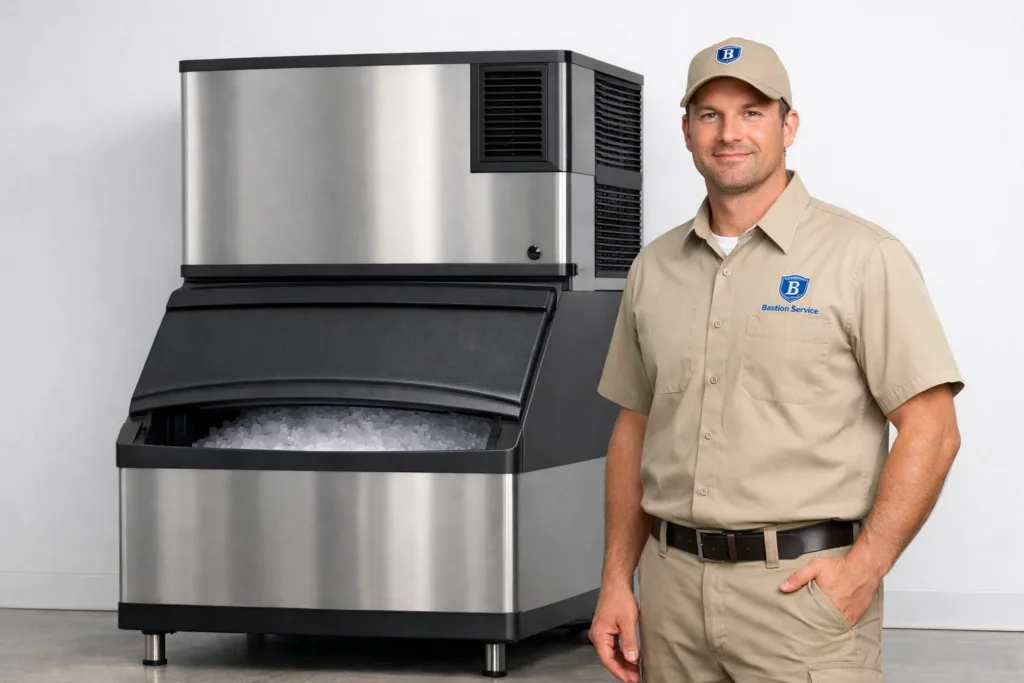




Ice machine problems rarely stay small for long. When a Manitowoc unit starts missing output, leaking, stopping mid-cycle, or producing unusable ice, the most important step is getting the symptom evaluated in a service context so repair timing, downtime exposure, and operating risk are all clear. For businesses in Torrance, that means looking beyond the surface complaint and identifying what is actually interrupting production.
For specific equipment paths in Torrance, review Manitowoc Ice Machine Repair in Torrance and Commercial Appliance Repair in Torrance.
Bastion Service helps businesses in Torrance troubleshoot Manitowoc ice machine issues with repair scheduling built around real operating impact. Whether the concern is low production, unstable water flow, repeated shutdowns, harvest trouble, or scale-related performance loss, the goal is to determine what failed, whether the machine should stay in use, and what repair path makes sense next.
Common Manitowoc ice machine symptoms that need repair attention
Many ice machine issues start with one visible symptom, but the cause may involve more than one system. Water supply, drainage, controls, sensing, freezing performance, scale accumulation, and component wear can all affect output and consistency. A service visit helps separate a cleaning-related issue from a fault that needs parts, further testing, or immediate shutdown.
Low ice production or no ice at all
If the bin is not filling as expected, or the machine has stopped making ice entirely, likely causes can include restricted incoming water, inlet valve problems, long freeze cycles, temperature-related performance loss, sensor faults, or a control issue that is interrupting production. In a busy setting, reduced output often becomes a larger problem quickly because the machine cannot recover once demand increases.
This is one of the clearest signs to schedule repair because low production is often treated as a minor slowdown until it becomes a full outage. If the machine is already lagging behind normal demand, waiting usually increases disruption.
Poor ice quality
Cloudy cubes, thin ice, hollow ice, irregular shape, slow-melting ice, or inconsistent batch size can all point to underlying operating problems. Water distribution issues, scale buildup, unstable freezing conditions, or harvest problems are common contributors. Even when the machine is technically still running, poor ice quality usually means performance is already off-track.
For businesses that rely on consistent beverage service or food handling workflow, poor ice quality is more than a cosmetic issue. It often signals a machine that is no longer cycling correctly and may soon begin shutting down or underproducing.
Water leaks, overflow, or drainage problems
Visible water around the unit, water collecting where it should not, or repeated overflow should be treated as a repair concern right away. Common causes include drain restrictions, water inlet trouble, internal hose or routing issues, cracked components, or cycle faults that leave too much water in the system.
Leaks can damage surrounding areas, interrupt use of the machine, and create safety concerns. They also make it harder to judge whether the machine can remain on while waiting for service. In many cases, a leaking unit needs prompt evaluation before continued use causes added problems.
Freeze cycle or harvest cycle problems
If ice forms but does not release correctly, batches stick, cycle times run too long, or the machine stops during harvest, the issue may involve sensing, control response, scale interference, or declining system performance. Harvest-related complaints are especially important because the machine may appear close to normal while steadily losing capacity.
Repeated harvest trouble usually does not correct itself. It tends to lead to inconsistent output, longer run times, and more frequent shutdowns, especially during heavier use periods.
Scale buildup and recurring shutdowns
Heavy mineral accumulation can reduce water flow, affect sensing, interfere with freezing and release, and contribute to repeat fault conditions. If the machine has visible scale or keeps stopping after resets, there may be a larger performance issue than routine cleaning alone can solve.
Shutdowns that come and go are often misread as temporary glitches. In practice, they are a warning sign that the machine is struggling to complete normal operation consistently. If resets are becoming part of daily use, repair should be scheduled before the unit becomes unreliable at the worst time.
Why symptom-based diagnosis matters before repair approval
Two machines can show the same symptom and need very different repairs. Low production might be tied to water flow in one case and to cycle control or performance loss in another. A machine that appears to have one failure may actually have multiple contributing issues, especially if it has been underperforming for some time.
That is why diagnosis matters before deciding whether to keep running the unit, shut it down, or move ahead with parts and repair scheduling. The value is not only identifying the failed component. It is also understanding what related issues should be checked, whether the machine is likely to worsen if left in operation, and how to plan service with the least disruption possible.
Signs the machine should not stay in use without service
Some symptom patterns point to a higher risk of additional damage or more severe downtime if the machine continues running. Businesses in Torrance should prioritize service if they notice:
- Active leaking or repeated overflow
- Very low production during normal demand
- Frequent shutdowns or repeated reset needs
- Ice that is unsafe-looking, inconsistent, or clearly abnormal
- Cycles that run unusually long or fail to complete
- Recurring problems soon after cleaning or routine attention
These symptoms do not always mean the machine is beyond repair, but they do mean continued use may increase the chance of a more disruptive failure.
What a service visit helps clarify
When an ice machine problem affects daily operations, the key questions are practical ones. Is the issue isolated or part of a larger pattern? Can the machine stay in use temporarily? Is the current problem likely to damage other components? Does the repair make sense now, or should replacement planning be part of the discussion?
A service assessment helps answer those questions by connecting the visible symptom to the actual operating condition of the equipment. That gives managers a better basis for scheduling repairs, planning downtime, and avoiding repeated stopgap decisions.
When repair becomes urgent for businesses in Torrance
Urgency usually depends less on the age of the machine and more on how the current symptom affects output and reliability. A newer unit with unstable production may need immediate attention if it supports daily service flow. An older unit may still justify repair if the issue is limited and the machine otherwise fits operational needs.
In most cases, service should be scheduled promptly when ice demand is no longer being met, leaks are present, shutdowns are recurring, or quality has become inconsistent enough to affect daily use. Waiting for a complete stop often turns a manageable repair into a harder scheduling problem.
Repair versus replacement considerations
Not every Manitowoc issue points toward replacement, and not every repeat problem should automatically get another repair without review. The better decision usually depends on several factors:
- How severe the current fault is
- Whether the machine has a pattern of repeat service needs
- How much downtime the business can absorb
- Whether one component failed or multiple systems are underperforming
- How strongly the machine’s condition affects daily operations
For many businesses, the most useful outcome is a realistic picture of present condition and near-term risk. That makes it easier to decide whether to repair the current problem, monitor the machine after service, or start planning for replacement before reliability declines further.
Scheduling the next step
If a Manitowoc ice machine is leaking, underproducing, stopping during normal cycles, or making inconsistent ice, the next step is to schedule service before the problem spreads into a longer outage. A repair visit can confirm the source of the issue, help determine whether the unit should remain in operation, and provide a clearer plan for restoring dependable ice production in Torrance.


