
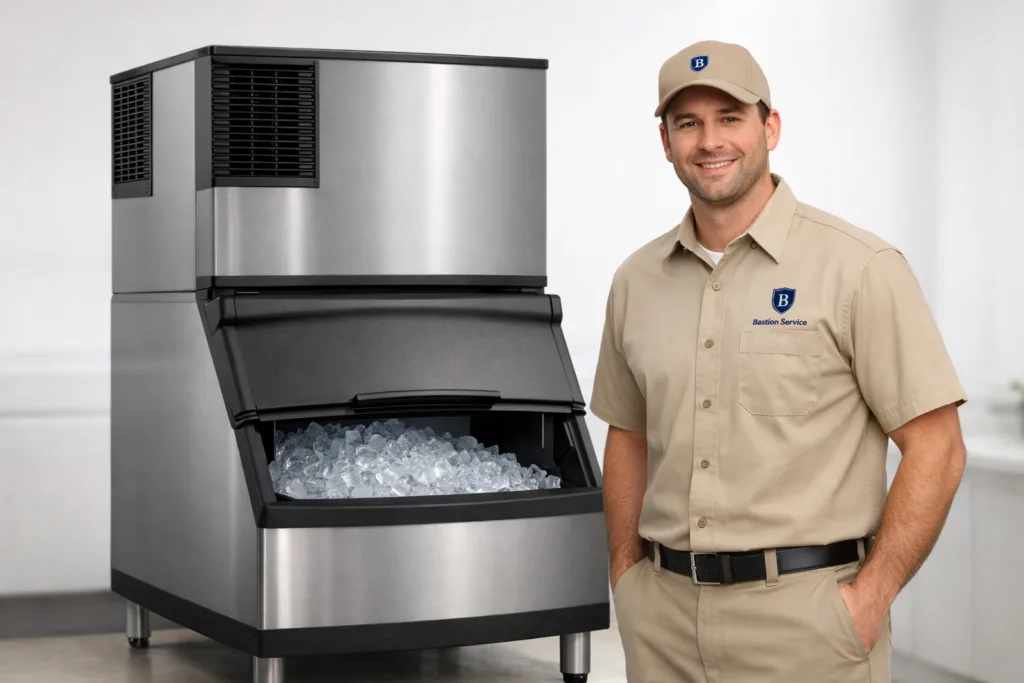





When a Manitowoc ice machine starts falling behind on output, leaking, dropping inconsistent cubes, or stopping mid-cycle, the priority is to find the cause quickly and decide how to restore reliable operation without unnecessary downtime. For businesses in Mid-Wilshire, ice problems can disrupt beverage service, prep routines, sanitation workflows, and staff efficiency. Bastion Service helps identify the fault, confirm whether the machine can keep running safely, and schedule repair based on the urgency of the symptom and the needs of the operation.
For specific equipment paths in Mid-Wilshire, review Manitowoc Ice Machine Repair in Mid-Wilshire and Commercial Appliance Repair in Mid-Wilshire.
Common Manitowoc ice machine symptoms that point to repair needs
Ice machine issues rarely stay limited to one simple complaint. Low production can trace back to water flow restrictions, scale buildup, freeze-cycle problems, failing components, or control issues. A machine that appears to run normally may still be building toward a shutdown if harvest timing, water fill, or sensing is off. That is why service decisions are best made from the full symptom pattern rather than from one visible problem alone.
Low ice production or no ice at all
If the machine is making less ice than usual, taking too long to recover, or stopping production entirely, several systems may be involved. Common causes include restricted incoming water, clogged filtration, mineral buildup, weak water distribution, sensor faults, or issues within the freeze and harvest sequence. In many cases, output drops before the unit stops completely, which gives businesses a window to schedule service before they face a full production loss.
This symptom matters because a machine that is still producing some ice can create the impression that the problem is minor. In reality, weak output often means the machine is already underperforming enough to affect daily operations.
Harvest problems and incomplete ice release
When ice will not release properly, drops unevenly, or stays attached longer than it should, the issue may involve scale, temperature imbalance, sensor errors, water system irregularities, or wear affecting the harvest cycle. Harvest problems can lead to smaller batches, erratic timing, or repeated shutdown behavior if the machine cannot complete its cycle the way it is designed to.
If staff notice longer cycle times, partial slab release, or unusual pauses between batches, that is usually a sign that the machine needs more than observation. Delayed harvest often becomes a production problem long before the unit fully stops.
Leaks, overflow, and drainage issues
Water around the machine, moisture in the bin area, overflow during operation, or repeated drainage problems should be addressed promptly. These issues can be tied to drain restrictions, water line faults, valve problems, internal buildup, or ice formation where it should not occur. Leaks are more than an inconvenience. They can affect sanitation, create floor hazards, and contribute to surrounding equipment-area damage if the machine keeps running in that condition.
Poor ice quality, cloudy cubes, or inconsistent shape
Ice that looks cloudy, soft, hollow, undersized, slow to freeze, or inconsistent from batch to batch can point to water quality issues, scale accumulation, poor water flow, freeze-cycle irregularities, or harvest-related faults. These symptoms often appear before customers or staff notice a total production problem, which makes them useful early warnings.
Ice quality concerns also matter because they affect how the machine is performing overall. Cosmetic changes in ice can reflect deeper operating issues that will eventually impact volume, reliability, or shutdown frequency.
Unexpected shutdowns or intermittent operation
If the unit starts, stops, resets, or goes offline without warning, the machine may be reacting to protective controls, sensor failures, electrical faults, overheating conditions, or water-related errors. Intermittent operation is especially disruptive because the machine may appear recovered for a short time, then fail again during a busier period.
Repeated restarts, temporary recoveries, or on-and-off production usually mean the problem is progressing. Waiting for a complete outage often leads to more difficult scheduling and greater disruption.
Why water flow problems often affect more than one function
Water flow issues do not just reduce fill. They can affect freeze times, ice formation, slab thickness, harvest release, and overall cycle consistency. A restriction in supply, filtration, internal distribution, or drainage can create symptoms that seem unrelated at first, such as low output, poor cube appearance, extended run times, and shutdowns.
Because water flow problems can present in different ways, diagnosis should account for the entire operating sequence. Treating only the most obvious symptom may leave the underlying cause unresolved.
Scale buildup can look like a minor issue until performance drops
Mineral accumulation is one of the most common reasons a Manitowoc ice machine starts losing consistency. Scale can interfere with water movement, sensor response, ice release, and timing through the production cycle. In some machines, buildup causes a gradual decline that becomes easy to ignore until output can no longer keep up with demand.
Not every scaled machine only needs routine cleaning. Heavy buildup may be paired with worn parts, restricted components, or recurring performance faults that continue after surface cleaning. If scale-related symptoms keep returning, a repair-focused evaluation helps determine whether the machine needs descaling alone or a broader corrective plan.
Signs the machine should not be pushed through another shift
Some issues allow limited operation while service is being arranged, but others should be treated as urgent. It is usually wise to stop relying on the unit if you notice:
- Active leaking or recurring overflow
- Repeated shutdowns during normal use
- Ice that looks contaminated, unusually soft, or consistently misshapen
- Loud or unfamiliar operating noise
- Very slow recovery that no longer supports normal demand
- Staff repeatedly restarting the machine to keep it going
These conditions can lead to added component stress, more cleanup, and a larger interruption if the machine fails completely at a critical time.
Repair or replace: how businesses usually make the decision
Many Manitowoc ice machine issues can be resolved with targeted repair, especially when the machine still matches the site’s production needs and the problem is isolated. Replacement becomes a more serious consideration when failures are frequent, major components are stacking up, downtime is recurring, or the current unit no longer supports the volume the business needs.
The key question is not only whether the current symptom can be fixed, but whether the machine is still a sensible fit for ongoing operation. A service visit should help clarify the condition of the equipment, the likely repair path, and whether the expected result justifies the investment.
What to have ready before scheduling service
Helpful details can make the appointment more efficient and speed up diagnosis. Before scheduling, it helps to note:
- Whether the machine is making some ice, no ice, or inconsistent batches
- How long the problem has been happening
- Whether leaks, overflow, or drainage issues are present
- If the ice looks cloudy, hollow, soft, or unusually small
- Whether the machine is shutting down, restarting, or showing intermittent behavior
- Any recent cleaning, filtration, or maintenance history related to the problem
These details can help connect the reported symptom to the most likely operating fault and support faster repair planning.
Scheduling Manitowoc ice machine repair in Mid-Wilshire
If your Manitowoc ice machine is struggling with production, water flow, scale buildup, leaks, shutdowns, harvest problems, or declining ice quality, scheduling service early usually prevents a more disruptive outage later. For businesses in Mid-Wilshire, the most useful next step is to have the machine evaluated based on current output, operating condition, and downtime risk so repair can be planned around the demands of the site rather than after the unit stops completely.


