





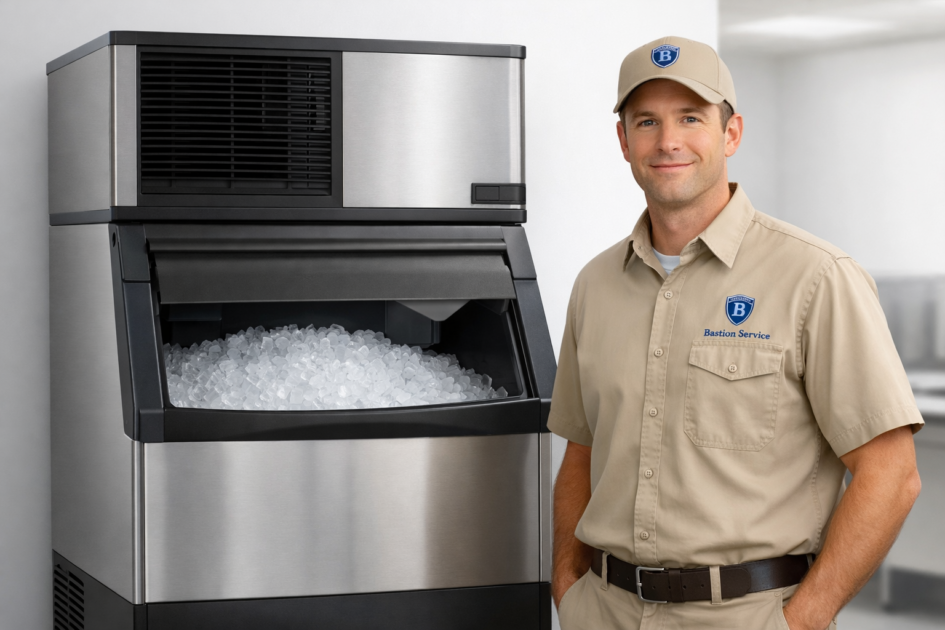
When a Manitowoc ice machine starts missing production targets, dropping poor-quality ice, or shutting down during operating hours, quick service matters before staff have to make stopgap decisions. In Fairfax, ice equipment problems can disrupt beverage service, food holding, prep flow, and sanitation routines, so the first priority is to identify the actual fault, assess any scale or wear, and decide whether the unit should stay in operation until repair is completed.
For specific equipment paths in Fairfax, review Manitowoc Ice Machine Repair in Fairfax and Commercial Appliance Repair in Fairfax.
For many businesses, this is not just a maintenance issue. It affects timing, staffing, and customer service. Bastion Service helps Fairfax businesses evaluate Manitowoc ice machine problems based on symptom pattern, operating impact, and the urgency of the repair so scheduling decisions are based on what the machine is doing now, not guesswork.
Common Manitowoc Ice Machine Problems That Need Repair
Ice machine equipment often gives warning signs before it fully stops. A service call helps determine whether the issue is tied to water supply, drain flow, freezing performance, harvest timing, controls, scale buildup, or refrigeration components. Because one symptom can have several causes, a proper diagnosis is the fastest way to avoid unnecessary downtime and avoid replacing the wrong part.
Low Ice Production or No Ice
If the machine is producing less ice than normal or has stopped making ice entirely, the problem may involve restricted water flow, a failing inlet valve, sensor problems, dirty internal components, airflow restriction, or a refrigeration fault. Low production is easy to overlook when the machine still runs, but it often points to a developing issue that gets worse under heavy demand. When production no longer matches daily use, repair should be scheduled before a slow machine turns into a no-ice outage.
This symptom is especially important when output has dropped gradually. A gradual decline can suggest scale buildup, water distribution issues, or reduced cooling performance. A sudden stop may indicate a control, electrical, or safety-related shutdown. That difference helps shape the repair plan.
Water Flow Problems
Manitowoc units depend on stable water delivery during the freeze and harvest process. If water flow becomes restricted, inconsistent, or excessive, the machine may produce thin cubes, incomplete batches, or uneven ice formation. In some cases, the unit may fill incorrectly and trigger additional cycle problems that look like unrelated failures.
Water flow issues can stem from inlet components, floats, distribution parts, scale accumulation, filtration concerns, or pressure-related problems. Because these issues can also affect sanitation and ice quality, they should be addressed promptly rather than treated as minor performance changes.
Leaks and Drain Problems
Water around the machine cabinet or on the floor should be treated seriously. A leak may come from damaged tubing, a loose connection, drain restriction, overflow condition, or an internal operating problem that causes water to move where it should not. Even a small leak can create slip hazards, affect nearby equipment, and point to a larger fault inside the machine.
If staff notice water only during certain parts of the cycle, that timing is useful during diagnosis. Leaks that appear mainly during harvest can indicate a different issue than leaks that are present constantly. Noting that pattern can shorten troubleshooting time during the visit.
Harvest Issues and Ice Release Problems
When ice hangs up on the plate, releases unevenly, drops in broken sections, or causes the machine to pause, the harvest cycle needs attention. Harvest problems are often connected to scale on the evaporator, water distribution irregularities, sensor readings, or cooling conditions that interfere with normal release timing.
These issues often begin as intermittent slowdowns before they become repeated shutdowns. A machine may appear to recover between batches, but that does not mean the problem is resolved. If release timing is no longer consistent, the equipment is already outside normal operation and should be evaluated before peak demand exposes the problem fully.
Scale Buildup and Performance Loss
Scale is one of the most common reasons ice machine equipment starts behaving unpredictably. Mineral buildup can affect water flow, freeze timing, sensor response, and ice release. It can also contribute to poor cube shape, irregular batch sizes, and nuisance shutdowns that seem electrical at first but actually begin with restricted internal movement of water.
In business settings, scale matters because it can cause several symptoms at once. A machine with buildup may still make ice, but not at the right volume or quality. If scale is present, the service decision may involve both corrective cleaning and repair of any parts that were affected by the buildup.
Ice Quality Concerns
Cloudy ice, soft cubes, hollow formation, inconsistent size, or misshapen batches usually point to operating conditions that are no longer stable. Water quality, scale, fill problems, temperature-related performance loss, and control issues can all affect the final ice product. For food-service businesses, poor ice quality is more than an appearance issue; it can signal that the machine is no longer producing reliably enough for daily use.
When ice appearance changes at the same time as output drops or cycle times increase, those symptoms should be evaluated together. Looking at quality and production as a pair often helps isolate the underlying problem faster.
Shutdowns, Error Conditions, and Intermittent Operation
A machine that stops unexpectedly, restarts on its own, enters safety shutdown, or runs inconsistently during busy periods may have a control fault, sensor issue, fan problem, electrical concern, pressure-related condition, or compressor-related failure. Intermittent problems are easy to postpone because the machine sometimes comes back online, but they are often the most disruptive because they create uncertainty during service hours.
If the unit is showing status lights, repeating the same lockout pattern, or failing at the same point in the cycle, that information can help narrow the cause before parts are approved. Repeated shutdowns are a strong sign that repair should not be delayed.
When Continued Use Can Make the Problem Worse
Some problems allow limited operation until a scheduled appointment, while others should be treated as immediate risks. If the machine is leaking, making unusual noises, short-cycling, repeatedly locking out, or producing much less ice than normal, continued use may increase wear on related components. A manageable repair can become more expensive when the machine is forced to keep running through a fault.
This is especially true when multiple symptoms appear together, such as low output plus poor ice quality, or leaks plus irregular harvest. Those combinations often mean the issue has moved beyond a single minor part and is now affecting the overall cycle. A service visit helps determine whether temporary operation is reasonable or whether the unit should be taken offline to limit further damage.
How Repair Decisions Are Made for Fairfax Businesses
Repair planning usually comes down to three things: what the machine is doing, how badly it affects daily operations, and whether the issue appears isolated or part of broader wear. During diagnosis, it helps to review the age of the unit, recent service history, cleaning frequency, the timing of the symptom, and whether production demand leaves any margin for downtime.
That information helps determine whether the repair is likely to be a focused correction or part of a larger reliability problem. In many cases, a well-defined repair is the right move when the machine is otherwise in solid condition. In others, repeated failures, major sealed-system trouble, or ongoing control issues may point to a broader decision. What matters most is understanding the actual condition of the equipment before committing to the next step.
What to Check Before Scheduling Service
Before the visit, it helps to gather a few details so the symptom pattern is easier to evaluate:
- When the problem started and whether it appeared suddenly or gradually
- Whether ice production dropped, stopped, or became inconsistent
- If there are visible leaks, drain backups, or water around the machine
- Whether the issue happens during freeze, harvest, or throughout the full cycle
- Any changes in cube shape, clarity, hardness, or batch size
- Status lights, shutdown patterns, or repeated restart behavior
- Recent cleaning, filter changes, or other maintenance activity
It also helps to make sure the machine is accessible and that someone on site can describe what staff have been seeing. Small details often matter when the problem is intermittent.
Scheduling Manitowoc Ice Machine Repair in Fairfax
If your Manitowoc unit is leaking, slowing down, failing to harvest properly, showing water flow problems, building up scale, or shutting down during operating hours, the next step is to schedule a repair visit based on the actual symptom pattern. Prompt service in Fairfax helps you decide whether the machine can remain in use, what repair path makes sense, and how to reduce downtime before the issue affects the rest of your operation.


