
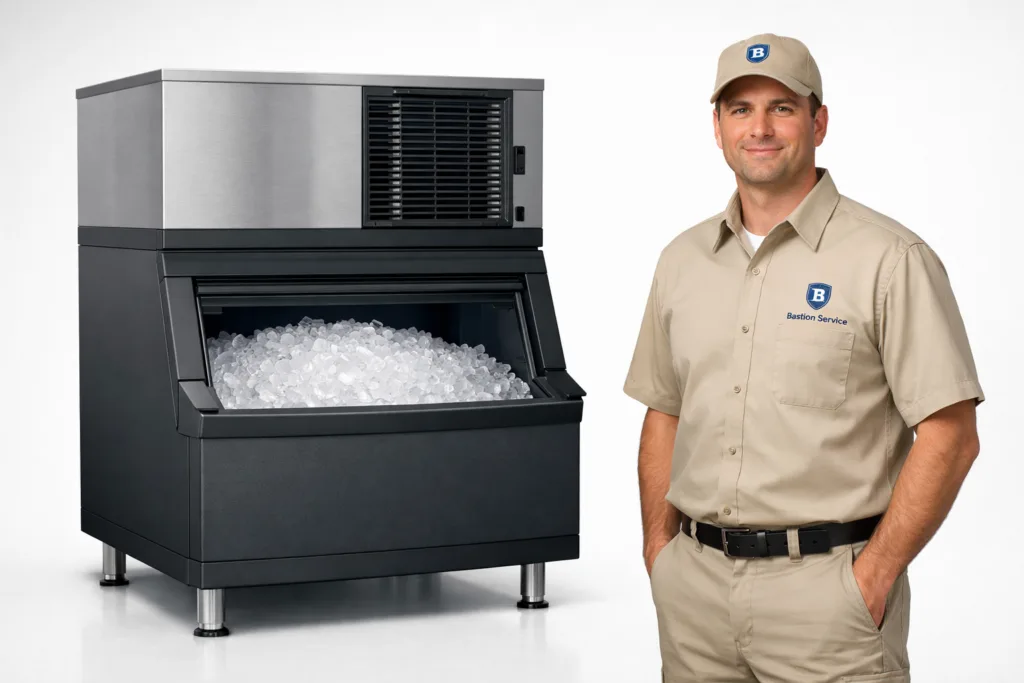




Ice machine problems can disrupt beverage service, food holding, prep timing, and front-of-house operations faster than many managers expect. When a Manitowoc unit starts underproducing, leaking, locking out, or making poor-quality ice, the most useful next step is service that identifies the failed system and explains what should be repaired now versus what can wait. In Brentwood, businesses often need that answer quickly so managers can protect inventory, maintain sanitation standards, and avoid avoidable downtime during operating hours.
For specific equipment paths in Brentwood, review Manitowoc Ice Machine Repair in Brentwood and Commercial Appliance Repair in Brentwood.
Bastion Service provides Manitowoc ice machine repair for local businesses that need symptom-based diagnosis, repair scheduling, and a realistic plan for restoring stable ice production. Whether the issue appears to be water related, drainage related, electrical, control based, or tied to freeze and harvest performance, the goal is to connect the complaint to the actual cause before the machine is pushed into a larger failure.
Common Manitowoc Ice Machine Problems That Often Need Repair
Many units show warning signs before a full outage. Production changes, unusual ice shape, delayed harvest, or repeated shutdowns usually indicate that one or more systems are no longer operating correctly. A service visit helps determine whether the problem is tied to scale buildup, water flow, refrigeration performance, controls, sensors, or a worn component.
Low ice production or no ice at all
If the bin is not filling as expected, the machine may be dealing with restricted incoming water, a faulty inlet valve, an issue in the freeze cycle, condenser performance problems, or sensor errors that interrupt normal operation. Sometimes the unit still runs, but it produces less ice per cycle or takes much longer to complete a batch. In a business setting, reduced output can become just as disruptive as a complete shutdown because staff may not notice the full impact until demand increases.
Low production should also be evaluated in the context of recent changes. A machine that suddenly slows down after operating normally may point to a part failure, while a gradual decline can suggest scaling, water distribution issues, or developing wear that is affecting efficiency.
Harvest problems and ice not releasing correctly
When cubes stick to the plate, release unevenly, or harvest takes too long, the machine may have mineral buildup, a control problem, temperature-related faults, or water distribution issues affecting normal ice formation. Harvest complaints often show up as low production first, but they can also create inconsistent cube shape, partial batches, or repeated cycling that never returns the unit to normal output.
This is one of the areas where resetting the machine rarely solves the real problem. If the harvest stage is no longer consistent, repair decisions should be based on what is interrupting release rather than on symptoms alone.
Water leaks, overflow, and drainage issues
Water appearing around the unit can come from drain restrictions, loose or damaged water lines, pump problems, overflow conditions, internal ice formation in the wrong area, or components that are no longer moving water through the machine properly. Leaks matter not only because of the machine itself, but because they can affect floors, nearby equipment, and day-to-day safety in the work area.
A leak that seems minor can still point to a more significant operating problem. If water is not following the intended path through the unit, the machine may also be struggling with ice formation, sanitation concerns, or repeated interruptions that reduce reliability over time.
Scale buildup and declining ice quality
Cloudy ice, odd taste, inconsistent cube size, broken ice patterns, or residue inside the unit can all point to mineral accumulation and water-path issues. Scale does more than affect appearance. It can interfere with sensors, reduce water flow, alter freeze and harvest timing, and increase strain on parts that rely on normal water movement and heat transfer.
Businesses often notice this category of problem after customers or staff comment on the ice itself. Even when the machine is still making ice, quality changes are often an early sign that service is needed before production drops further or shutdowns begin.
Unexpected shutdowns and recurring error conditions
If a Manitowoc machine powers down, enters lockout, or repeatedly restarts, the problem may involve controls, thermistors, float components, bin sensing, fan operation, electrical supply, or compressor protection. Repeated shutdowns usually mean the machine is trying to protect itself from operating under a fault condition.
When staff are repeatedly resetting a unit just to keep ice available, the underlying failure is usually getting more expensive to ignore. A machine that cannot complete normal cycles without intervention should be evaluated before it stops during a busy service period.
How Symptom Patterns Help Narrow the Cause
Not every complaint points to a single obvious failure. A business may report low output, wet ice, delayed harvest, and occasional shutdowns at the same time. Those symptoms can overlap across several systems, which is why repair decisions are better when they are based on operating behavior rather than assumptions.
- Low production with normal-looking ice can suggest long cycle times, condenser issues, or partial water supply problems.
- Low production with poor cube formation often points toward water distribution, scale, or freeze-cycle abnormalities.
- Leaks combined with shutdowns may indicate drainage or overflow issues that are triggering protective responses.
- Ice sticking during harvest commonly overlaps with scaling, plate conditions, or control-related timing problems.
- Cloudy or irregular ice with inconsistent operation can suggest water quality concerns affecting multiple parts of the machine.
Looking at the full symptom pattern helps determine whether the repair is likely to involve cleaning-related correction, a failed component, multiple worn parts, or a larger reliability issue that should influence approval and scheduling decisions.
When It Makes Sense to Stop Using the Machine
Some issues allow for limited short-term operation, but others should be addressed before the equipment is used again. Continued use may worsen the problem when the machine is leaking onto the floor, producing abnormal ice formations, running hot, short cycling, or repeatedly shutting down and restarting. In those cases, the machine may be placing stress on electrical or refrigeration components while still failing to provide dependable output.
It is also wise to move quickly when sanitation is becoming a concern. Drain issues, stagnant water, heavy scale, and inconsistent ice production are not just performance problems. They can create conditions that are harder to manage if service is delayed too long.
Repair Decisions That Matter for Business Operations
For many businesses, the main question is not simply whether the machine can be repaired. The more important question is whether the repair will restore steady production in a way that supports daily operations. A useful evaluation considers the current complaint, the age and condition of the unit, recent history of repeat failures, and whether the equipment is showing isolated problems or broader wear.
Many Manitowoc issues are repairable, including problems involving valves, pumps, sensors, controls, fans, drain components, and water-system restrictions. In other situations, especially where there are repeated breakdowns or multiple stacked problems, the better decision may be to compare repair investment against future reliability. That is particularly important for businesses that depend on consistent ice availability throughout the day.
What Businesses in Brentwood Can Expect From a Service Visit
A service visit should do more than confirm that the machine is not working correctly. It should identify where the operating failure is occurring, how that failure affects ice production, and whether the unit should remain in use while repair plans are being made. That often includes reviewing water flow, checking drainage behavior, evaluating freeze and harvest performance, and looking for conditions such as scale, sensor faults, or component failure that explain the complaint.
For managers and facility teams, that information helps with timing, approvals, and staffing decisions. It can also clarify whether the problem is likely to stay contained or whether continued operation increases the chance of a larger outage. If your Manitowoc ice machine in Brentwood is producing less ice, leaking, shutting down, taking too long to harvest, or making poor-quality ice, the best next step is to schedule repair service before the issue affects more of your operation.


