
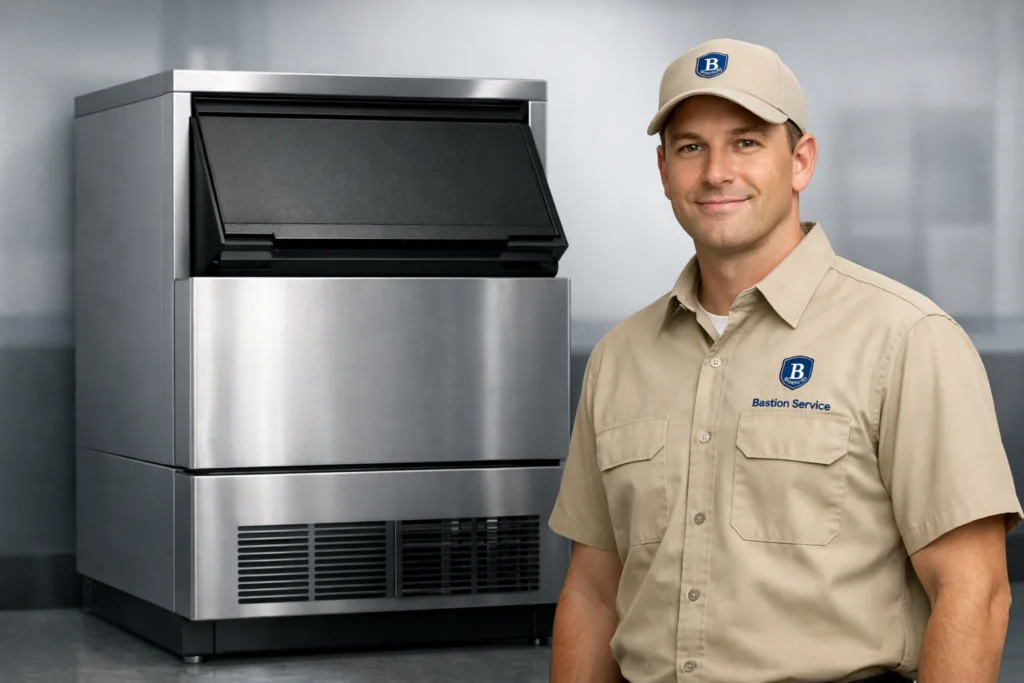




Ice machine downtime can interrupt beverage service, prep routines, and customer-facing operations quickly, especially when the problem starts as “less ice than usual” and then turns into leaks, shutdowns, or failed harvest cycles. For businesses in West Los Angeles, the best next step is service that identifies the exact fault before parts are replaced or the machine is pushed harder than it should be. Bastion Service handles Hoshizaki ice machine repair with attention to symptom patterns, operating sequence, and whether the unit can continue running safely until repair is completed.
Related commercial service paths in West Los Angeles include Hoshizaki Commercial Repair in West Los Angeles, Commercial Ice Machine Repair in West Los Angeles, and Hoshizaki Fridge Repair in West Los Angeles.
Common Hoshizaki Ice Machine Problems
Low ice production or slow recovery
If the bin is not filling as expected, the cause may be restricted water flow, mineral buildup, condenser airflow issues, weak harvest performance, or a refrigeration problem that is lengthening the freeze cycle. In a busy operation, slow output often gets noticed only after staff begin rationing ice or bringing in backup supply. That is usually the point when a service visit makes sense, because partial operation can hide a developing failure.
No ice at all
A complete no-ice condition can be tied to fill issues, control faults, shutdown protections, pump or circulation problems, or a system that is not entering or finishing the freeze and harvest sequence correctly. When the machine is powered on but not producing usable ice, the important question is not just whether it runs, but where the cycle is stopping and why.
Leaks, overflow, or water on the floor
Water around the unit may come from drain restrictions, blocked internal passages, failed overflow control, or a machine that is not clearing water correctly during operation. This type of problem should be addressed promptly because it can create cleanup issues, slip hazards, and additional internal damage if the machine keeps running in the same condition.
Clumped, cloudy, or incomplete ice
Poor ice quality often points to uneven water distribution, scale buildup, temperature inconsistency, or harvest issues that affect cube formation. If the machine is producing ice that is fused together, soft, hollow, or misshapen, the problem is usually bigger than appearance alone. It can mean the unit is no longer cycling within normal operating conditions.
Unusual sounds or repeated restarting
Buzzing, rattling, grinding, or repeated start-stop behavior can indicate fan motor wear, pump trouble, loose components, control issues, or system stress. Noise changes are worth taking seriously because they often appear before a full failure. If the machine keeps trying to restart or shuts off before a normal cycle completes, continued use may increase repair scope.
What These Symptoms Usually Mean During Diagnosis
One symptom can have several possible causes. Low production might come from water restriction, scale, a valve problem, poor heat rejection, or a refrigeration fault. Leaking might be a drain issue, but it can also be related to a failed cycle or overflow condition. That is why repair decisions should be based on what the machine is doing during fill, freeze, harvest, and drain rather than on symptoms alone.
A useful service visit typically checks water delivery, drainage behavior, freeze time, harvest response, visible scale, airflow condition, and component performance. That helps separate maintenance-related loss of performance from part failure, and it reduces the chance of solving only part of the problem.
Why Hoshizaki Ice Machines Start Falling Behind
Water flow problems
If the unit is not getting the right amount of water at the right time, ice production can drop fast. Restricted inlet flow, valve issues, or internal buildup can all affect fill consistency. In many cases, the machine still appears to operate, but output and cube quality begin to decline first.
Scale and mineral buildup
Mineral accumulation can interfere with water movement, sensor response, heat transfer, and normal cycling. That can lead to long freeze times, weak harvest, inconsistent cube shape, and eventually shutdowns. When a Hoshizaki machine has not been cleaned or serviced on schedule, scale is often part of the diagnosis even if it is not the only issue.
Airflow and heat rejection issues
A dirty condenser or blocked airflow path can make it harder for the machine to reject heat efficiently. The result may be slower production, higher stress on components, and irregular cycling. This is especially important when a unit is technically still running but no longer keeping pace with demand.
Harvest and control faults
If ice forms but does not release properly, or if the cycle does not transition when it should, the machine may stall, short cycle, or stop making ice altogether. Problems in this area can look inconsistent from the outside, which is why observing the sequence matters during diagnosis.
When to Stop Using the Machine and Schedule Repair
Service should be scheduled as soon as the machine shows a meaningful drop in output, repeated shutdowns, visible leaking, major ice quality changes, or sounds that were not present before. It also makes sense to stop normal use if the unit is overflowing, failing to harvest, or producing ice that raises sanitation concerns.
Continuing to run a machine in those conditions can turn a manageable repair into a more expensive one. A drain problem can lead to standing water. A unit struggling through long cycles can place extra stress on motors and controls. A machine with poor ice quality can create service disruptions and force staff into workarounds that do not solve the underlying fault.
Repair or Replacement: How Businesses Usually Decide
Many Hoshizaki ice machine issues are repairable, particularly when they involve water supply, drainage, cleaning-related performance loss, sensors, pumps, fan motors, or isolated control problems. Replacement becomes a more serious consideration when the machine has repeated major failures, advanced wear, or a repair history that suggests unstable operation will continue even after the current issue is fixed.
The decision usually comes down to condition, repair scope, expected reliability after service, and the cost of continued downtime. For businesses in West Los Angeles, the practical question is whether the machine can return to stable daily production without repeated interruptions.
How to Prepare for a Service Visit
Before repair is scheduled, it helps to note whether the machine is making no ice, making some ice slowly, leaking, shutting off, or producing poor-quality cubes. It is also useful to know whether the problem is constant or intermittent, whether staff have been resetting the unit, and whether the change happened suddenly or gradually.
Those details help narrow down the likely failure path and speed up diagnosis. If possible, keep the area around the machine accessible and avoid restarting the unit repeatedly if it is already showing abnormal cycling or water-related issues.
Service Focus for Hoshizaki Ice Machine Repair in West Los Angeles
The most effective repair approach is centered on restoring dependable ice production, not just getting the machine to run for the moment. That means identifying where the cycle is failing, checking whether cleaning and operating conditions have contributed to the problem, and determining whether the repair addresses the root cause or only the visible symptom.
For businesses in West Los Angeles, timely scheduling is often the best way to limit downtime, protect workflow, and avoid a minor ice machine issue becoming a larger interruption. If your Hoshizaki unit is leaking, underproducing, shutting down, or struggling through harvest, a symptom-based service visit is the right next step.


