
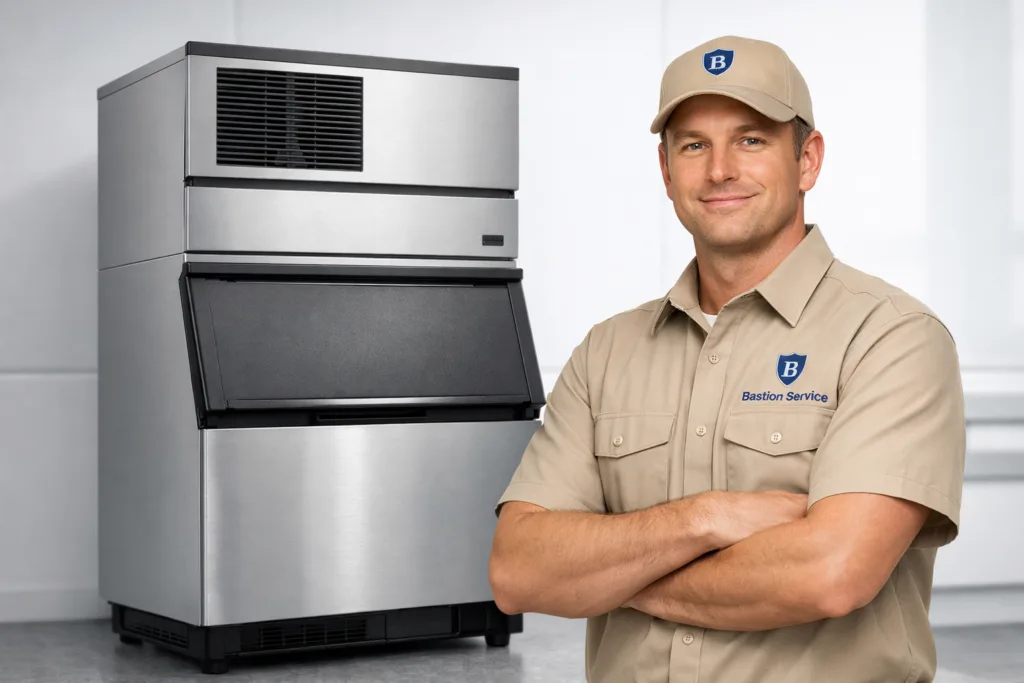





When a Hoshizaki ice machine starts producing thin cubes, slowing down, leaking, or shutting off during operating hours, the priority is to identify the failure pattern before it turns into a full outage. For businesses in Pico-Robertson, service decisions are usually more effective when they are based on what the machine is doing in real time: struggling to fill, freezing unevenly, failing to harvest, draining poorly, or running hot while output drops. Bastion Service handles these calls with a service-first approach focused on diagnosis, repair planning, and reducing avoidable downtime.
Related commercial service paths in Pico-Robertson include Hoshizaki Commercial Repair in Pico-Robertson, Commercial Ice Machine Repair in Pico-Robertson, and Hoshizaki Refrigerator Repair in Pico-Robertson.
Ice machine problems rarely stay isolated for long. A unit that still makes some ice can still be heading toward a more disruptive failure, especially when water flow, scale buildup, airflow restriction, controls, or refrigeration performance are involved. That is why symptom-based repair is often the fastest way to understand whether the issue is minor, whether cleaning and parts replacement need to happen together, or whether the machine is developing multiple problems at once.
Common Hoshizaki Ice Machine Problems in Pico-Robertson
Low ice production or slow recovery
If the bin is not filling like it used to, the cause may be restricted water supply, scale inside the water system, a weak inlet valve, condenser blockage, or a refrigeration issue that lengthens freeze times. Some machines continue operating without showing a full shutdown, which can make the problem seem less urgent than it is. In a busy kitchen, beverage station, or hospitality setting, slow recovery often becomes noticeable only when demand spikes.
Misshaped, cloudy, or incomplete ice
Changes in ice appearance usually point to a problem with water distribution, mineral buildup, freezing consistency, or harvest timing. If cubes are smaller than normal, hollow, cloudy, or clumping together, the machine may not be completing its cycle correctly. These symptoms matter because they often show up before a total no-ice condition.
Leaks, overflow, or water around the unit
Water on the floor can come from blocked drains, poor drainage slope, cracked lines, bin-related issues, or freeze-up conditions that interfere with harvest and melt-off. Even a small leak can become a larger operating problem if it leads to repeated overflow, slip hazards, or moisture around nearby equipment. A leak complaint is often more than a plumbing issue; it may be part of a broader cycle or defrost problem.
Machine starts and stops unexpectedly
Intermittent shutdowns can be tied to float switches, thermistors, control boards, high-pressure safety conditions, electrical faults, or overheating caused by restricted airflow. Repeatedly resetting the machine may get it running again for a short time, but that does not address why the stop occurred. When the machine cycles off unpredictably, the goal is to find the trigger before the shutdown becomes constant.
Noisy operation, vibration, or excess heat
Buzzing, grinding, rattling, or unusually hot operation can indicate fan problems, compressor strain, loose mounting, or airflow issues around the condenser section. These warning signs are easy to miss in active work areas, but they often line up with lower production and longer cycle times. Catching them early can prevent a serviceable issue from becoming a more expensive repair.
What the Symptom Pattern Can Tell You
A Hoshizaki machine that is making no ice at all is diagnosed differently from one that makes some ice but cannot keep up. The symptom pattern helps narrow the repair path:
- No water entering the machine: possible inlet valve, float, supply, or control issue
- Water enters but ice is thin or incomplete: possible scale, distribution, freeze-cycle, or refrigeration concern
- Ice forms but does not release correctly: possible harvest issue, sensor problem, or scale affecting the evaporator surface
- Machine shuts down after running briefly: possible safety trip, overheating, or control fault
- Bin fills with poor-quality ice: possible water quality, filtration, or cycle consistency problem
This kind of symptom-based review helps determine whether the repair is likely to involve water system correction, component replacement, cleaning-related service, or a deeper refrigeration diagnosis.
Why Diagnosis Matters Before Replacing Parts
The same complaint can come from very different causes. Low production, for example, might point to mineral buildup, reduced water flow, dirty condenser conditions, a failing sensor, or inefficient refrigeration performance. Replacing one part based on the symptom alone can leave the actual cause untouched and create repeat service calls.
A more effective repair process checks how the machine fills, freezes, harvests, drains, and cycles under load. It also helps clarify whether the issue is isolated or whether multiple conditions are stacking together. That matters for businesses trying to decide whether to approve repair now, plan for additional corrective work, or start evaluating equipment replacement.
Signs It Is Time to Schedule Service
Service should be scheduled when staff notice any clear change in how the machine performs, especially if that change affects output or reliability. Common signs include:
- Production is noticeably lower than normal
- Ice quality has changed
- Water is leaking or draining poorly
- The machine shuts off or needs frequent resets
- Freeze or harvest cycles seem longer than usual
- The unit is louder, hotter, or less stable during operation
These symptoms often appear before a complete failure. Scheduling repair at this stage can help avoid a no-ice situation that interrupts service, staff workflow, or customer-facing operations in Pico-Robertson.
When Continued Use Can Make the Problem Worse
Running an ice machine through obvious performance problems can increase wear on major components and add avoidable stress to the system. A restricted condenser can raise operating temperatures. Poor water flow can interfere with freeze consistency. Ongoing drainage problems can lead to overflow, sanitation concerns, or repeated ice quality complaints. If the machine is running but behaving abnormally, continued use should be evaluated carefully rather than treated as acceptable until it fully stops.
Repair or Replacement: How Businesses Usually Decide
Some Hoshizaki units are good candidates for repair because the issue is limited and the overall condition is still solid. Others may have multiple active faults, a heavy scale history, recurring shutdowns, or declining performance that makes each new repair less worthwhile. The right direction depends on the machine’s age, condition, service history, the parts involved, and whether the proposed repair is likely to restore stable production.
That decision is easier when the problem is clearly identified. Businesses generally want to know whether they are solving one specific failure or stepping into a pattern of repeat interruptions. A well-documented diagnosis gives that answer more clearly than trial-and-error parts replacement.
Service Support for Hoshizaki Ice Machines in Pico-Robertson
For businesses in Pico-Robertson, Hoshizaki ice machine service is most useful when it leads quickly from symptom review to repair action. Whether the issue is no ice, low output, leaks, fill problems, poor harvest, or intermittent shutdowns, the next step should be based on how the machine is actually failing and what is needed to restore dependable operation. If your unit is affecting workflow, product service, or daily uptime, scheduling repair early is usually the best way to limit disruption and make the repair decision with better information.


