
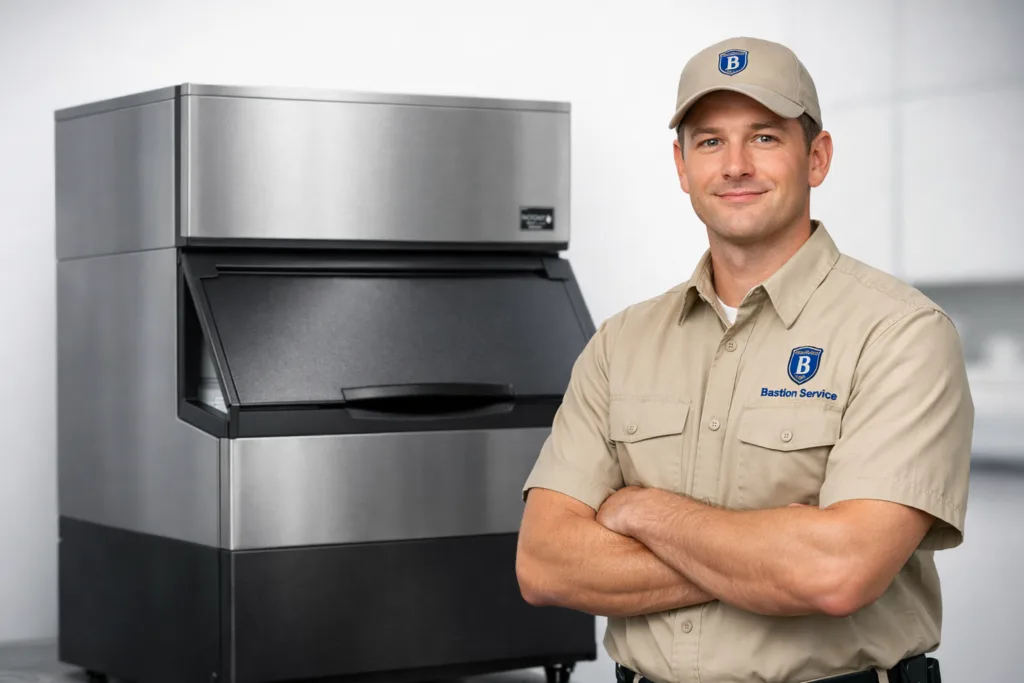





Ice machine problems rarely stay minor for long when daily operations depend on steady production. If a Hoshizaki unit is slowing down, leaking, stopping mid-cycle, or making poor-quality ice, the next step should be service built around the exact symptom pattern, not trial-and-error part replacement. Bastion Service helps businesses in Marina del Rey evaluate what the machine is doing, what changed, and whether the issue involves water flow, harvest function, refrigeration performance, controls, or a condition that could lead to a larger shutdown.
Related commercial service paths in Marina del Rey include Hoshizaki Commercial Repair in Marina del Rey, Commercial Ice Machine Repair in Marina del Rey, and Hoshizaki Refrigerator Repair in Marina del Rey.
Common Hoshizaki Ice Machine Symptoms and What They Can Mean
Low ice production or slow recovery
When the machine still runs but cannot keep up with normal demand, the cause may be more than one issue. Scale buildup, restricted incoming water, a dirty condenser, poor airflow, weak refrigeration performance, or a harvest problem can all reduce output. In many cases, low production is the early warning sign that the machine is working harder than it should and needs attention before it stops completely.
No ice production
A machine that has stopped making ice altogether may be dealing with a fill problem, a control fault, a failed pump or motor, a safety shutoff, or a problem in the freeze and harvest sequence. Repeatedly resetting the unit might get it running briefly, but it can also hide the real failure and extend downtime when the machine finally stops for good.
Water leaking around the unit
Leaks can start with a restricted drain, overflow in the water circuit, poor leveling, cracked lines, reservoir issues, or ice forming where it should not. Even a small leak matters because it can create floor hazards, sanitation concerns, and damage around the machine. If water is showing up during production or after shutdown, the leak source should be identified before the machine is pushed through another shift.
Ice clumping, odd shape, or poor clarity
Changes in cube shape, cloudy ice, thin ice, slabbing, or clumping usually point to water quality issues, scale, distribution problems, timing errors, or a component that is no longer controlling the cycle correctly. When the ice itself changes, the problem is often already affecting consistency inside the machine.
Unusual noise or inconsistent cycling
Buzzing, rattling, short cycling, delayed harvest, or repeated start attempts can point to fan motor trouble, pump issues, electrical faults, compressor stress, or freeze-up conditions. These noises and cycle changes are important because they often show up before a more expensive failure interrupts production completely.
Why Symptom-Based Diagnosis Matters on Hoshizaki Units
Two machines can show the same visible problem and need very different repairs. A Hoshizaki ice machine with low output might have a water supply restriction, heavy scale, a sensor issue, or a refrigeration problem. A unit that seems to be leaking might actually be dealing with drainage, internal ice formation, or an overflow condition tied to another failing component.
That is why repair decisions should be based on how the machine fills, freezes, harvests, drains, and recovers during normal operation. Looking at only the end symptom can lead to unnecessary parts replacement and repeat service calls. A proper evaluation should connect the complaint to actual machine behavior so the repair addresses the cause instead of the aftermath.
Issues That Often Affect Hoshizaki Ice Production
- Restricted or inconsistent water supply
- Scale buildup in the water circuit
- Dirty condenser surfaces or blocked airflow
- Drain restrictions causing backup or overflow
- Pump, fan motor, or valve problems
- Control board or sensor faults affecting cycle timing
- Freeze or harvest failures that leave the machine out of sequence
- Wear from prolonged operation under poor conditions
Some of these problems reduce output gradually, while others cause sudden shutdowns. Either way, the repair approach should account for both the immediate failure and any wear created by running the machine in that condition.
When to Schedule Repair Instead of Waiting
Waiting for a complete outage often turns a manageable service visit into a more disruptive interruption. If the machine is still operating but doing so inconsistently, that usually means the failure is already developing. Scheduling repair earlier can help avoid spoilage of workflow, unexpected shutdowns, and added strain on major components.
It makes sense to schedule service when:
- Bin levels are no longer keeping up with normal use
- Staff notice slower batch production or delayed refill
- The machine leaks during operation or after harvest
- Ice quality changes in size, clarity, or consistency
- The unit stops and restarts on its own
- New noises appear during freeze, harvest, or drain cycles
- The machine needs manual resets to stay in service
When Continued Operation Can Make the Repair Bigger
Some conditions do more than affect ice output. A machine running with scale, blocked airflow, unstable electrical components, drainage problems, or repeated freeze-ups may place extra stress on pumps, motors, controls, and refrigeration parts. What starts as an ice quality complaint can become a broader equipment problem if the machine is kept in service without addressing the source of the issue.
If the unit is shutting off on safety conditions, leaking consistently, or struggling through normal cycles, it is usually better to have it evaluated before relying on it for another busy period. That helps protect both the machine and the surrounding work area.
Repair or Replace?
Many Hoshizaki ice machine problems are repairable when the unit is otherwise in sound condition and still matches the business’s production needs. The more useful question is whether the repair is likely to restore stable operation without creating repeated interruptions in the near future.
Replacement becomes more likely when the machine has a pattern of major failures, significant internal wear, chronic production issues, or repair needs that no longer make sense for its age and workload. A service evaluation can help separate an isolated repair from a machine that is becoming unreliable overall.
Service Planning for Businesses in Marina del Rey
For businesses in Marina del Rey, the priority is usually simple: determine what is wrong, understand how urgently it affects operation, and move forward with the most sensible repair path. Whether the complaint is no ice, slow output, leaking, clumped ice, or an incomplete harvest cycle, the right service call should clarify the fault, the effect on uptime, and the next step needed to get the machine back into dependable use.
If your Hoshizaki ice machine is showing clear performance changes, repair should be scheduled before a partial problem becomes a full interruption. Early attention is often the difference between a targeted fix and a longer outage that affects service, workflow, and daily production.


