
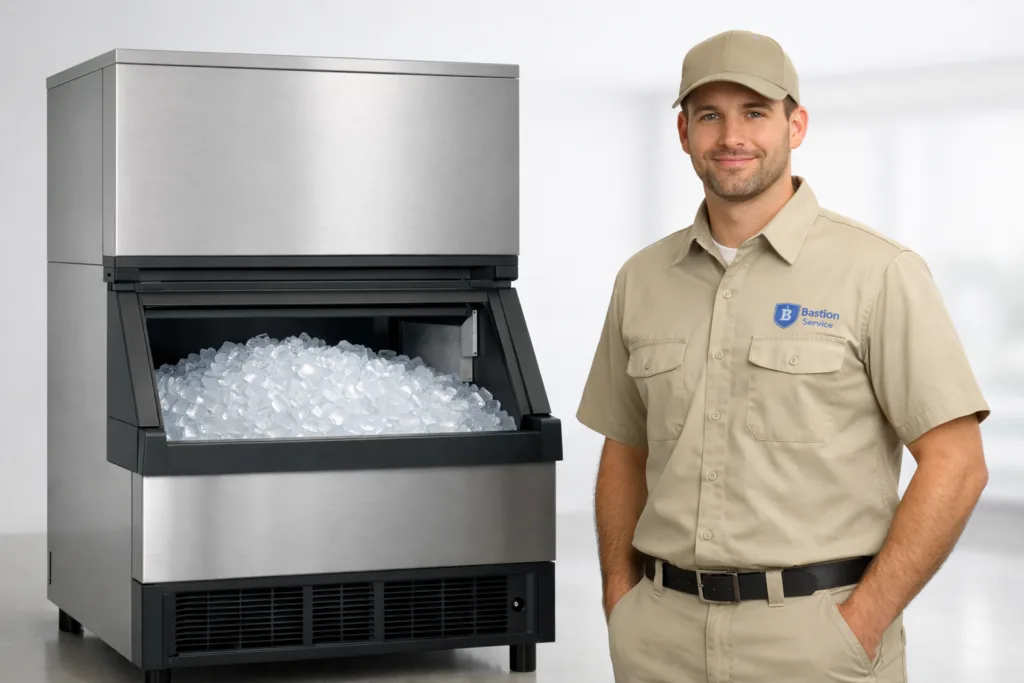




When a Hoshizaki ice machine starts falling behind, leaking, shutting down, or turning out inconsistent ice, the right next step is service that focuses on the actual operating pattern rather than guesswork. For businesses in Palms, that means looking at how the unit is filling, freezing, harvesting, draining, and responding under daily demand so repairs can be scheduled before a shortfall turns into a larger interruption.
For specific equipment paths in Palms, review Hoshizaki Refrigerator Repair in Palms, Hoshizaki Freezer Repair in Palms, and Hoshizaki Ice Machine Repair in Palms.
Bastion Service works with businesses in Palms that need help identifying whether the issue is tied to scale buildup, water flow restrictions, controls, refrigeration performance, drainage, or a component that is beginning to fail under load. That service-oriented approach helps owners and managers decide whether the machine can keep running safely until repair, whether same-day attention is the better move, and what to expect from the repair path.
How Ice Machine Problems Affect Daily Operations
Ice shortages do not stay isolated to the machine. They can slow beverage service, disrupt prep routines, force staff into workarounds, and create sanitation or safety concerns when water begins pooling around the unit. A machine that still produces some ice can be especially misleading because partial operation often masks a worsening condition.
In many cases, early service is less about reacting to a total shutdown and more about preventing one. If output is trending down, cycles are taking longer, or the machine needs repeated resets, those are service signals worth addressing before the next busy period.
Common Hoshizaki Ice Machine Symptoms and What They Often Mean
Low ice production or no ice at all
When output drops, the problem may involve a restricted water supply, inlet valve trouble, scale on water-contact surfaces, sensor faults, refrigeration inefficiency, or a control issue that interrupts the normal freeze-and-harvest sequence. Some units continue operating with reduced volume for a while, which can delay action until the machine finally stops.
From a repair standpoint, low production matters because the cause is not always obvious from the outside. A machine may appear to be making ice, yet still be cycling inefficiently, starving for water, or struggling to complete harvest properly. Diagnosis helps separate a correctable maintenance-related issue from a failing part or a deeper system problem.
Ice is small, cloudy, thin, hollow, or misshapen
Changes in cube quality usually point to something affecting water delivery, freezing consistency, mineral buildup, or cycle timing. Poor ice quality can also show up before a larger production failure, making it an important early warning sign rather than a minor nuisance.
For businesses, this issue affects more than appearance. It can change how quickly ice melts, alter beverage presentation, and signal conditions that may worsen if the machine stays in service without inspection. If cube quality changes at the same time as slower production or unusual cycling, repair evaluation is usually the smarter move.
Leaks, overflow, or water around the machine
Visible water can come from drain restrictions, internal overflow, loose connections, hose issues, freezing irregularities, or bin-related problems. Even a small leak deserves prompt attention because it can create slip hazards, affect nearby equipment, and turn a repair visit that could have been straightforward into a cleanup and damage-control issue.
If the source is not obvious, it is worth having the machine checked before continued use. What looks like a simple drain issue can sometimes be tied to broader operating problems that interfere with normal cycling.
Freeze-ups, harvest failures, or ice not releasing properly
When the machine forms ice but cannot release it correctly, production becomes unpredictable fast. This symptom can be related to scale, sensor problems, water system irregularities, control timing, or refrigeration conditions that push the machine out of its normal cycle.
Harvest issues are important because they often lead to repeated interruptions rather than one clean failure. Staff may notice long cycle times, partial drops, odd noises, or a machine that seems to stall before starting again. Those are all strong reasons to schedule service before the unit moves from inconsistent to fully down.
Shutdowns, alarms, or repeated resets
A Hoshizaki unit that stops unexpectedly may be responding to protective controls, abnormal temperatures, water issues, pressure conditions, or electrical faults. If restarting the machine only brings temporary improvement, the underlying problem is still there, and repeated resets can make the timing of the next failure harder to predict.
Intermittent shutdowns are often some of the most disruptive problems for businesses in Palms because the machine may work just long enough to create false confidence. Service becomes more efficient when recent alarm behavior, production changes, and any visible leak or freeze pattern are noted before the visit.
Scale Buildup and Water Flow Problems
Scale is one of the most common reasons ice machines drift away from normal performance. Mineral buildup can interfere with fill patterns, reduce heat transfer, affect sensors, and disrupt harvest. Over time, a machine that once produced consistently may begin making less ice, forming irregular cubes, or developing longer cycles without any single dramatic failure at first.
Water flow issues can have a similar effect. If the unit is not receiving or moving water the way it should, the entire ice-making process becomes unstable. That is why service for low production and poor ice quality often includes checking both the water side of the machine and the parts responsible for timing and control.
- Reduced output despite the machine still running
- Inconsistent cube size or clarity
- Longer-than-normal freeze cycles
- Incomplete harvest or ice sticking where it should release
- Recurring issues after a simple restart
When to Stop Using the Machine Until Repair
Not every symptom means immediate shutdown, but some conditions should be taken seriously. Continued operation may worsen the problem when the machine is leaking steadily, producing questionable ice, freezing up repeatedly, or tripping off over and over. In those situations, trying to push through another shift can increase wear and lead to a longer outage.
It is usually wise to move quickly on service when:
- Ice production has dropped enough to affect daily service
- The machine needs frequent resetting
- Water is collecting around the unit
- Harvest problems are repeating
- Ice quality has changed noticeably
- The machine is shutting down without a clear reason
What a Repair Visit Helps Clarify
Service is not only about identifying a failed part. It also helps determine whether the machine can remain in operation until repair is completed, whether the issue is isolated or part of broader wear, and whether the current symptoms point to a repair that is still relatively contained or one that risks additional downtime if delayed.
That matters for equipment planning. Some machines need a focused repair and can return to stable production once the underlying fault is corrected. Others show a mix of scale history, repeat interruptions, control issues, or cooling-related problems that make the repair decision more time-sensitive. Getting the unit assessed based on its actual symptoms helps management make a better call.
Scheduling Hoshizaki Ice Machine Service in Palms
If your machine is making less ice, leaking, failing to harvest, shutting down, or producing inconsistent cubes, scheduling service in Palms is the most practical next step. A repair visit can help determine what is causing the disruption, whether continued use is reasonable in the short term, and how to plan the repair around business hours to limit downtime and restore more reliable ice production.


