
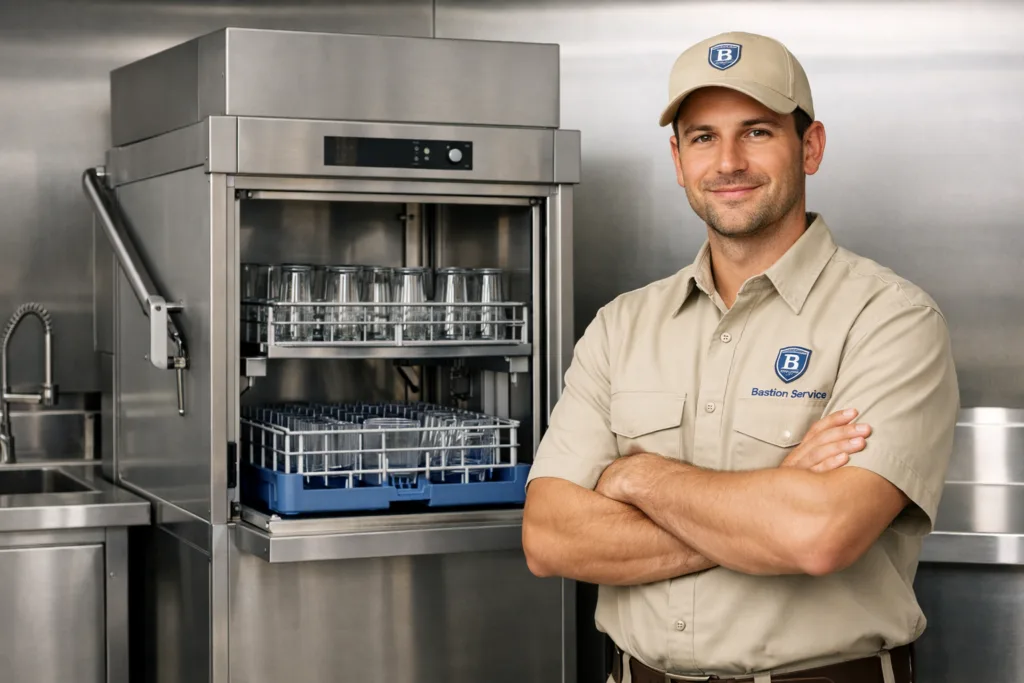




Dishwasher problems can disrupt prep flow, slow rack turnaround, and create sanitation concerns fast, so the next step should be service that identifies the actual fault before more time is lost. Bastion Service works with businesses in El Segundo to diagnose Hobart dishwasher issues, explain what is failing, and schedule repair based on the machine’s condition, urgency, and role in daily operations.
Related commercial service paths in El Segundo include Hobart Commercial Repair in El Segundo and Commercial Dishwasher Repair in El Segundo.
Instead of treating every symptom as the same type of breakdown, it helps to look at what the unit is doing during fill, wash, rinse, heat, and drain. That makes it easier to separate a simple obstruction or wear item from a pump, heater, control, or water-level problem that needs more involved repair.
Common Hobart dishwasher symptoms and what they can mean
Poor wash results, spotting, or residue
If racks come out dirty, glassware looks cloudy, or food soil remains after a completed cycle, the issue may not be limited to one part. Poor results can come from weak wash pressure, blocked spray components, scaling, incorrect rinse temperature, chemical-feed problems, or pump wear. A dishwasher that appears to be running normally can still be underperforming if water movement or temperature is not reaching the level needed for consistent results.
For businesses in El Segundo, this type of complaint usually matters long before the machine fully stops. Ongoing wash-quality problems can force rewashing, slow output, and add unnecessary labor during busy periods.
Standing water or slow draining
When water remains in the machine after a cycle, drains slowly, or backs up during use, the fault may involve the drain path, pump, check components, obstructions, or a control issue that prevents proper drain operation. Continued use can strain the machine further, especially if staff are restarting cycles to compensate for incomplete draining.
A drain issue is also one of the more misleading symptoms because the visible problem is water left behind, while the root cause may be elsewhere in the system. That is why testing is more useful than replacing parts based on guesswork.
Low rinse temperature or failure to heat
If the dishwasher is not reaching rinse temperature, takes too long to heat, or shows signs of inconsistent temperature during operation, the cause may involve the heating system, sensors, water level, relays, limit controls, or incoming supply conditions. On Hobart units, a temperature complaint can overlap with fill or control faults, so it is important to verify what the machine is actually doing at each stage of the cycle.
Temperature-related issues should not be ignored because they affect both performance and confidence in the machine’s ability to support normal kitchen workflow.
Cycle failures or shutdowns mid-operation
A unit that stops mid-cycle, fails to advance, restarts unexpectedly, or needs repeated operator intervention may be dealing with control faults, safety lockout conditions, fill problems, drain problems, or electrical issues. What looks like a random shutdown often follows a pattern once the machine is tested under operating conditions.
When this starts happening more than once, it usually signals a repair issue rather than a one-time glitch. Repeated interruptions can be more damaging to operations than a complete failure because they create uncertainty on every load.
Leaks, overflow, or unstable water level
Leaks around the door, underneath the machine, or during fill and rinse can point to gasket wear, hose damage, loose fittings, valve problems, float issues, or internal component deterioration. Overflow and unstable water levels can also lead to inconsistent wash performance even before visible leaking becomes severe.
Small leaks often get dismissed until they affect floors, nearby equipment, or electrical safety. If a Hobart dishwasher is leaking in El Segundo, it is usually best to stop treating it as a minor nuisance and have it evaluated before the repair becomes broader.
Noise, vibration, or rough running
Grinding, rattling, humming, or sudden changes in sound can indicate foreign material in the wash system, pump wear, motor problems, loose components, or imbalance during operation. A dishwasher that sounds different from normal is often giving early warning before a more serious failure develops.
Noise complaints are especially worth addressing when they appear together with weak cleaning, drain issues, or intermittent cycle failure, since those combinations often point to wear inside core operating systems.
Why symptom-based diagnosis matters
The same complaint can have several possible causes. A no-heat call may involve the heater, but it can also stem from improper fill, a safety condition, or a control problem. Poor cleaning may be tied to chemicals, but it can also come from low wash pressure or bad rinse performance. Symptom-based diagnosis helps narrow the issue to the system that is actually failing.
That matters for repair decisions because it reduces unnecessary parts replacement and helps businesses understand whether the machine has one isolated failure or a wider pattern of wear. It also gives a more realistic picture of downtime, repair scope, and whether the dishwasher is worth continuing to invest in.
When to schedule service instead of waiting
Service should be scheduled when the dishwasher is:
- Leaving ware dirty or inconsistent from load to load
- Not draining fully or leaving standing water
- Running with low rinse temperature or heat-related faults
- Stopping mid-cycle or failing to complete normal operation
- Leaking, overflowing, or showing unstable fill levels
- Making new grinding, rattling, or vibration noises
These issues usually do not correct themselves. In many cases, continued use increases wear on pumps, heating components, controls, and seals, which can turn a targeted repair into a larger service event.
How continued operation can increase downtime
Trying to push through a shift with a dishwasher that is already showing drain, heat, or wash-pressure problems can create more than a performance issue. Staff may start rerunning racks, changing workflow to work around incomplete cycles, or ignoring warning signs just to keep output moving. That often leads to longer interruptions later.
For businesses in El Segundo, the practical concern is not just whether the dishwasher still powers on. The better question is whether it is still operating predictably enough to support daily volume without creating sanitation, labor, or safety problems.
Repair versus replacement considerations
Repair is often the sensible choice when the machine is in otherwise solid condition and the failure is limited to a manageable part or system. Replacement becomes a more serious discussion when the unit has recurring faults, multiple worn assemblies, signs of heavy internal deterioration, or a service history that shows repeated downtime.
The right decision depends on factors such as:
- Age and overall condition of the dishwasher
- Whether the current issue is isolated or part of a pattern
- Condition of pumps, heating components, controls, and seals
- Likelihood of additional repairs in the near future
- How critical the machine is to the business’s daily output
In many situations, the most useful step is to diagnose the present fault first and then decide whether repair is the better investment.
What to have ready before a service visit
If possible, it helps to note the exact symptom pattern before service is scheduled. Useful details include whether the problem happens on every cycle, whether the machine fills and drains normally, whether heat is affected, whether any unusual noise is present, and whether leaks appear only during certain parts of operation. Even basic observations can shorten the path to the right repair.
It is also helpful to know whether the problem is new, intermittent, or getting worse. A dishwasher that has gradually lost wash quality may point toward a different repair path than one that failed suddenly during a shift.
Service focused on keeping operations moving
Hobart dishwasher repair should do more than get the machine to run once and then leave the larger issue unresolved. For businesses in El Segundo, the goal is to identify the failing system, explain the repair path clearly, and restore operation in a way that supports normal workflow. If your Hobart dishwasher is not washing, draining, heating, or completing cycles the way it should, scheduling service promptly is the most practical way to limit downtime and make the next repair decision with confidence.


