
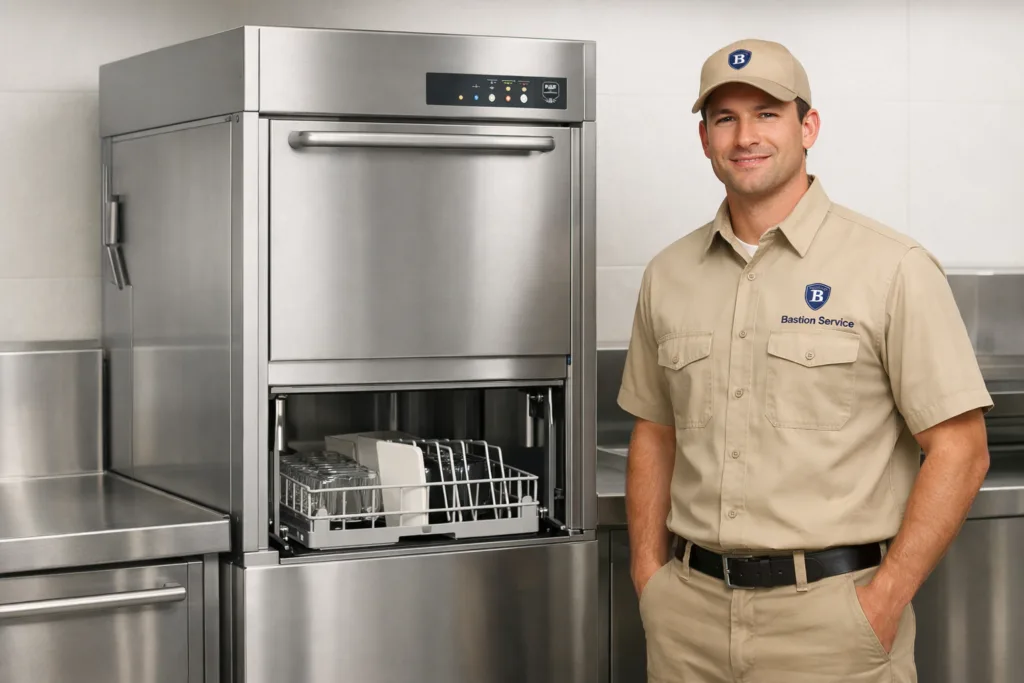




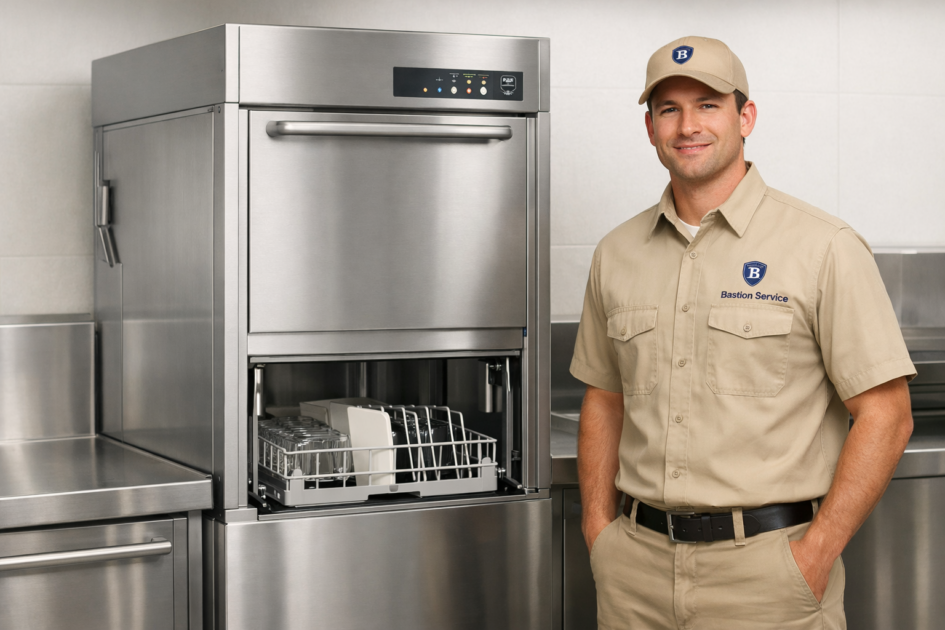
Dishwasher problems rarely stay small for long in a busy kitchen. When a Hobart unit starts leaving soil behind, holding water, leaking, or dropping out of cycle, the most useful next step is service that identifies the fault by symptom pattern and operating behavior, not guesswork. For businesses in Cheviot Hills, that means looking at wash action, drain performance, heat, fill, controls, and wear points together so repair decisions match the actual condition of the machine.
Related commercial service paths in Cheviot Hills include Hobart Commercial Repair in Cheviot Hills and Commercial Dishwasher Repair in Cheviot Hills.
Bastion Service works on Hobart dishwasher issues with a service-first approach built around diagnosis, scheduling, and downtime impact. Whether the unit is still running with weak results or has stopped altogether, the goal is to determine what failed, what else may be affected, and how quickly the machine can be returned to reliable daily use.
Common Hobart Dishwasher Problems
Hobart dishwashers often show warning signs before a full breakdown. Paying attention to those signs can help prevent a minor repair from turning into a larger interruption for the dish area.
Poor wash results and leftover residue
If racks come out with food particles, haze, or uneven cleaning, the issue may be tied to weak wash pressure, blocked wash arms, restricted water flow, low fill, pump problems, or incorrect temperature during the cycle. In practice, these symptoms often show up as some items cleaning normally while others do not, which points to an operational fault rather than simple loading variation.
When poor results continue, staff usually compensate by rewashing loads, slowing turnover and increasing labor time. That is often the point when a repair visit becomes more cost-effective than continuing with workarounds.
Drain problems and standing water
A Hobart dishwasher that finishes a cycle with water left behind may have a clogged drain path, drain pump trouble, obstruction in the tank area, or a control issue that prevents the drain sequence from completing. Sometimes the machine drains slowly rather than failing completely, which can make the problem seem less urgent than it is.
Standing water should be taken seriously because it can affect sanitation flow, contribute to odor and debris buildup, and place extra strain on related components if the machine keeps being used without correction.
Low rinse temperature or heating failure
If the machine is not reaching expected wash or final rinse temperature, the cause may involve the heater circuit, booster components, thermostat or sensor issues, relays, wiring faults, or control problems. Operators may notice this first as inconsistent final results, unusually long recovery time, or cycles that appear normal but do not deliver the same finished outcome.
Temperature complaints are especially important to address quickly because they affect confidence in the machine’s ability to complete its process properly during normal service demand.
Leaks, overflow, and fill issues
Water on the floor, overfilling, or uneven fill levels can point to inlet valve problems, float or level control faults, worn seals, loose connections, cracked hoses, or internal blockage. In some cases the leak appears only during part of the cycle, which helps narrow the problem to fill, wash, or drain activity.
Even a small leak can become a larger operational problem if it spreads to nearby surfaces, creates a slip hazard, or reaches electrical and control components inside the unit.
Cycle failures, no-start problems, and unexpected shutdowns
When a Hobart dishwasher will not start, stops mid-cycle, or needs repeated resetting, the issue may involve door switches, power supply faults, timers, boards, relays, sensors, or wiring failures. These symptoms often overlap, which is why direct testing matters more than replacing parts based on assumption.
Machines that start inconsistently or fail only under heavier use are often showing an underlying electrical or component stress issue that should be evaluated before a complete stoppage occurs.
Why Symptom Patterns Matter During Diagnosis
Two machines can show the same complaint for very different reasons. A dishwasher that is not cleaning well may have a pump problem, but it could also have a fill issue, low temperature condition, blocked spray path, or an incomplete cycle caused by controls. A drain complaint may begin with debris, yet the underlying problem may be pump wear or a control sequence failure.
That is why good service is not only about identifying one failed part. It should clarify whether the issue is isolated, whether continued use is likely to cause more damage, and whether the repair addresses the full reason the machine’s performance changed.
Signs It Is Time to Schedule Service
Some Hobart dishwasher issues are obvious, such as a machine that will not run. Others develop gradually and are easier to overlook until the dish area is already losing time. Scheduling service is usually the right move when the equipment begins requiring operator workarounds or produces inconsistent results from one load to the next.
- Racks are coming out dirty or need frequent rewashing
- Water remains in the unit after the cycle ends
- The machine leaks during fill, wash, or drain
- Final rinse or wash temperature seems too low
- The unit pauses, shuts off, or does not complete cycles
- Starting the machine becomes unreliable
- Noise levels have changed, especially around pumps or motors
- Staff must reset, drain, or adjust the machine to keep it going
Once a dishwasher starts depending on repeated operator intervention, there is usually an underlying fault that should be addressed before it affects more than one system.
How Repair Decisions Are Usually Made
Not every dishwasher problem points to replacement, and not every running machine is in good enough condition to justify a major repair. The right decision often depends on the age and wear of the unit, whether recent issues have been isolated or repeated, what components are involved, and how much interruption the operation can reasonably absorb.
Repair often makes sense when the fault is contained to a specific system and the rest of the machine is performing as expected. A different discussion may be needed when multiple systems are showing wear at the same time, breakdowns are becoming more frequent, or the current failure is part of a larger decline in reliability.
Preparing for a Hobart Dishwasher Service Visit
A little detail from the site can make diagnosis more efficient. Before service is scheduled, it helps to note exactly what the machine is doing and when the problem occurs. For example, does the issue appear at startup, during wash, during drain, only after several loads, or only when the machine is under heavier use? Has the problem been constant, or has it become worse over time?
Useful information may include:
- Whether the dishwasher fails every cycle or only intermittently
- If there are visible leaks, smells, or unusual sounds
- Whether the machine is leaving standing water or failing to heat
- If staff have noticed fault displays or repeated reset needs
- Whether wash quality dropped suddenly or gradually
These details help connect the complaint to the most likely systems involved and can shorten the path from inspection to a workable repair plan.
What Businesses in Cheviot Hills Usually Need From Dishwasher Repair
For kitchens and other fast-paced operations in Cheviot Hills, the main concern is not just whether the dishwasher runs at all. It is whether the machine can maintain steady throughput, acceptable wash results, proper draining, and consistent cycle completion during normal demand. Repair service is most useful when it answers practical questions: can the unit keep operating safely, what needs to be corrected first, and what downtime should the business expect?
When a Hobart dishwasher begins affecting workflow, scheduling service early usually provides the best chance of limiting disruption. A symptom-based repair process helps turn recurring wash, drain, heat, leak, or cycle complaints into a defined next step so the equipment can get back to supporting daily operations in Cheviot Hills.


