
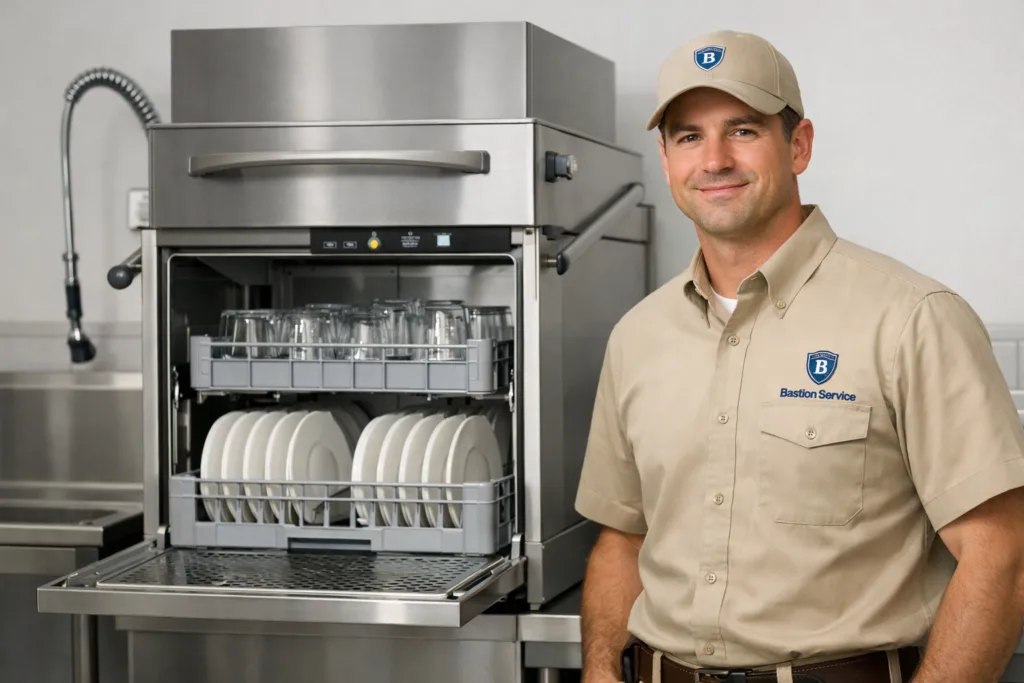




Warewashing problems can disrupt far more than a single machine. In Cheviot Hills, restaurants and other food-service operations often feel the impact immediately through slower turnover, rewash volume, sanitation concerns, and staff workarounds that pull attention away from service. Bastion Service provides Hobart repair support for businesses that need the issue identified, the likely repair path explained, and scheduling that fits the urgency of the equipment failure.
For specific equipment paths in Cheviot Hills, review Hobart Dishwasher Repair in Cheviot Hills and Commercial Appliance Repair in Cheviot Hills.
For Los Angeles operators using Hobart warewashing equipment, the most useful approach is symptom-based service. A machine that leaves residue, fills slowly, fails to drain, leaks, runs at the wrong temperature, or stops with a control fault may have very different causes even when the shutdown looks similar from the outside. Good repair planning starts with what the equipment is doing during normal use, when the problem appears, and whether the symptom is consistent or intermittent.
Warewashing symptoms that usually mean service should be scheduled
Many dishwasher problems build gradually before a full stoppage. A cycle may still start, but wash quality drops, timing becomes inconsistent, or the machine needs repeated resets to finish a load. Those patterns usually point to a mechanical, electrical, water-flow, heating, or control issue that should be inspected before it affects more of the workday.
Poor wash performance and residue on wares
If plates, utensils, pans, or glassware come out with film, debris, grease, or spotting, the problem is not always the same from one machine to the next. Wash-arm blockage, circulation issues, reduced pump performance, filter restrictions, heating problems, and rinse-related faults can all reduce cleaning results. In a busy kitchen, poor wash performance creates immediate rework and raises concerns about whether the next rack will come out usable.
When wash quality declines, it helps to note whether the issue affects every load or only certain cycles, whether the machine sounds normal during wash, and whether heat appears lower than usual. Those details can help narrow the repair direction and reduce trial-and-error part replacement.
Fill problems, low water, or slow cycle start
A dishwasher that takes too long to fill, fills inconsistently, or does not reach the proper water level can struggle throughout the rest of the cycle. Low fill conditions often show up as weak wash action, incomplete cleaning, unusual noises, or repeated interruptions. If the machine starts but never seems to wash with normal force, the issue may begin earlier in the sequence than staff first assume.
These problems are worth addressing quickly because water-level faults can affect multiple functions at once. What looks like a wash complaint may actually begin with intake, sensing, or related control behavior.
Drain issues and standing water after the cycle
Water left in the bottom of the machine after operation is one of the clearest signs that service is needed. Drain restrictions, pump trouble, drain-sequence faults, and related control problems can all leave the unit unable to clear water properly. In daily operations, that can lead to odor, interrupted cycles, repeated error behavior, and a machine that becomes less reliable with each use.
If staff are noticing slow draining, partial draining, or a need to rerun cycles to finish properly, continued operation may increase downtime risk. Drain faults are especially disruptive because they often affect both sanitation flow and the ability to keep racks moving during busy periods.
Leaks, pooling water, and door-area moisture
Not every leak looks dramatic at first. Some begin as occasional pooling under the machine, drips near connection points, or moisture around the door that becomes more noticeable as shifts continue. Leaks may come from worn seals, hose issues, pump-area problems, fittings, or internal components under stress.
Even minor water escape matters in a working kitchen. It can create slip concerns, affect nearby equipment space, and signal wear that will not improve on its own. If the source is unclear, a service visit can determine whether the leak is isolated or part of a larger equipment condition issue.
Rinse temperature and heating concerns
When Hobart warewashing equipment struggles to maintain proper heat, operators may notice longer cycles, inconsistent final results, or concerns about whether the machine is performing as expected during rinse. Heating-related complaints can involve heaters, limit devices, sensors, relays, controls, or related electrical faults. Some units continue running while underperforming, which makes the problem easy to overlook until cleaning quality or service pace drops significantly.
Temperature symptoms deserve prompt attention because they can affect both output quality and confidence in the machine during peak use. If heat recovery seems slow or rinse performance changes from one load to the next, that is usually enough reason to schedule inspection.
Control faults, shutdowns, and interrupted cycles
A dishwasher that stops mid-cycle, flashes an error, fails to respond correctly to commands, or requires repeated restarting often has a control-side issue that needs more than a simple reset. Sometimes the control problem is the primary failure. In other cases, the control system is responding to another fault elsewhere in the machine.
Repeated interruptions should not be treated as normal wear. If staff are working around the same stoppage more than once, the machine is no longer supporting operations reliably, even if it occasionally completes a load.
How these problems affect day-to-day operations
Warewashing equipment supports service flow, labor pacing, and sanitation routines. When the machine underperforms, the cost is not limited to the repair itself. Teams may need to rewash items, hold clean wares longer, shuffle prep timing, or slow dish return across the kitchen. In some cases, one faulty dishwasher changes the work pattern of the entire shift.
- More labor spent checking or rewashing racks
- Slower turnaround for dishes, utensils, and cookware
- Workflow interruptions during meal periods or event service
- Added pressure on staff when cycles become unpredictable
- Greater chance of a full outage if warning signs are ignored
That is why repair decisions are usually time-sensitive. A machine that still powers on is not necessarily a machine that should stay in service through the next rush.
What a service diagnosis helps determine
A proper inspection helps identify whether the problem is isolated to one failed part, related to a broader wear pattern, or connected to more than one operating fault at the same time. With warewashing equipment, symptoms often overlap. A drain complaint can be tied to control behavior. A wash complaint can begin with low fill. A temperature concern can be part of a larger electrical issue.
During diagnosis, businesses typically want answers to a few practical questions:
- Is the machine safe and reasonable to keep using before repair?
- Is the issue likely to worsen quickly if operation continues?
- Does the fault appear isolated or part of broader equipment decline?
- Is repair the sensible next step based on condition and performance?
- How urgent is scheduling based on current downtime risk?
Those answers help owners, managers, and facility teams plan around actual equipment condition instead of guessing from symptoms alone.
When continued operation is usually a bad idea
Some minor issues can be monitored briefly if performance remains stable, but several symptom patterns usually mean the machine should be evaluated as soon as possible. These include repeat standing water, obvious leaking, failure to clean consistently, unreliable heating, frequent cycle interruption, and faults that return after resetting. When the same problem appears across multiple loads, the chance of a larger disruption rises quickly.
Waiting can also complicate the repair. Components under strain may cause secondary damage, and what begins as an intermittent issue can become a complete shutdown at the worst possible time. For kitchens that rely on steady dish turnover, earlier service is often less disruptive than pushing the machine until it stops altogether.
Repair decisions for aging or heavily used equipment
Not every service call ends with the same recommendation. Some Hobart warewashing issues are straightforward once the failed component is identified. Others reveal wear in several areas at once, especially on units that see heavy daily use. In those cases, the goal is not only to restore operation but to understand whether the equipment is likely to return to stable performance after repair.
Useful repair planning considers symptom history, present condition, how often the machine is used, and whether the fault appears isolated or recurring. That gives operators a better basis for deciding whether to proceed with repair now, stage additional work later, or begin planning for replacement if the pattern of failure keeps expanding.
Support for Hobart warewashing equipment in Cheviot Hills
When a Hobart dishwasher is affecting throughput, cleaning results, or staff workflow in Cheviot Hills, the next step is to schedule service based on the actual symptom pattern rather than waiting for a full outage. A focused diagnosis can clarify what is causing the problem, whether continued use makes sense, and what repair timing is most practical for the business.


