
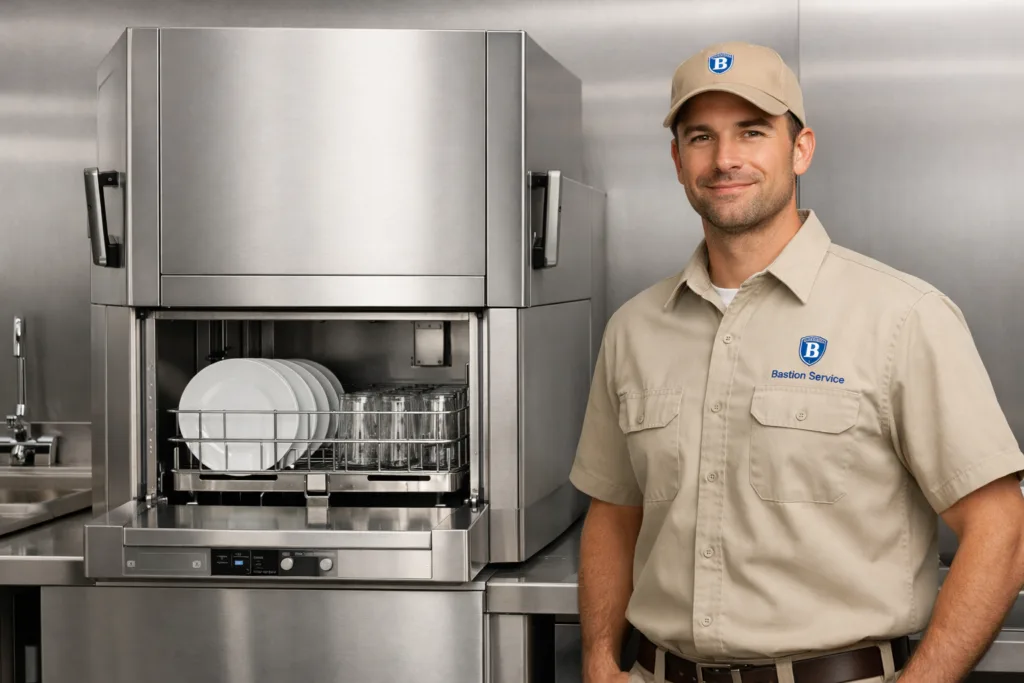





When a Hobart dishwasher starts interrupting kitchen flow in Century City, the most useful next step is service built around the exact symptom the machine is showing. A unit that leaves residue, stops mid-cycle, fails to drain, or never reaches proper rinse temperature may have a very different underlying fault than staff first assume. Bastion Service helps businesses in Century City troubleshoot those symptoms, determine what is actually failing, and schedule repair with downtime and workflow in mind.
Related commercial service paths in Century City include Hobart Commercial Repair in Century City and Commercial Dishwasher Repair in Century City.
That service-focused approach matters because dishwashing problems rarely stay isolated. One issue with heat, circulation, draining, or controls can affect wash quality, turn times, and sanitation consistency across the entire operation. Instead of treating symptoms as separate problems, the goal is to identify where the cycle is breaking down and what repair will return the machine to stable daily use.
Why is my Hobart dishwasher not washing, draining, or reaching temperature?
These three complaints often appear together because Hobart dishwashers rely on several systems working in sequence. If one stage is weak or interrupted, the machine may seem to run while still producing poor results.
- Not washing properly: possible issues include blocked spray arms, low water fill, weak pump performance, chemical-delivery problems, or a heat-related fault that prevents effective cleaning.
- Not draining: standing water can point to drain obstructions, pump trouble, valve failure, or a cycle that is not progressing correctly through the drain stage.
- Not reaching temperature: low rinse temperature may involve a failed heating component, booster-heater problem, sensor issue, scale buildup, or an electrical problem affecting heat production.
Because these symptoms can overlap, a dishwasher that seems to have a wash issue may actually have a heating or drain problem underneath it. That is why diagnosis should follow the full cycle rather than focusing on only the final result seen by staff.
Common Hobart dishwasher symptoms that need repair attention
Poor wash results and recurring residue
If racks come out cloudy, greasy, or spotted, the machine may be circulating weakly, filling incorrectly, or washing at the wrong temperature. In a busy kitchen, this often leads to reruns, hand scrubbing, and delayed turnaround. When poor results start happening more than once, it usually means the problem has moved beyond routine cleaning and into a repair issue.
Water left in the machine after the cycle
Standing water is a sign that the drain stage is not completing as intended. Staff may notice slow draining, interrupted cycles, or the need to manually clear water to keep service moving. Continued use in this condition can put more stress on related components and increase the chance of a more disruptive shutdown.
Low rinse temperature or inconsistent sanitizing performance
A dishwasher can appear operational while still failing to deliver dependable rinse heat. That creates a serious operational problem because the machine is using time, water, and labor without producing consistent end results. If temperature performance varies from cycle to cycle, the cause should be checked before the problem spreads into repeated wash failures or cycle interruptions.
Leaks around the door or underneath the unit
Leaks may come from worn gaskets, hose issues, failed seals, pump-related problems, or overfill conditions. Even a small leak deserves attention because it can affect flooring, create slip risk, and expose nearby equipment areas to moisture. A machine that leaks during normal operation should not be left to “get by” through a busy schedule.
No-start, mid-cycle stoppage, or erratic controls
When the dishwasher will not start, cuts out during a cycle, or behaves unpredictably, the problem may involve switches, boards, relays, door-latch components, sensors, or wiring faults. These symptoms are especially important to diagnose correctly because several electrical and control issues can mimic one another. Guessing at parts often leads to repeat downtime instead of a lasting repair.
How these problems affect business operations
For businesses in Century City, a dishwasher problem is not just an equipment issue. It can slow service, increase labor, create backlog at the dish station, and push staff into temporary workarounds that are not sustainable. A machine that partly works can be just as disruptive as one that is completely down because it still consumes attention while failing to deliver reliable output.
Typical signs that the problem is already affecting operations include:
- staff rerunning racks regularly
- longer wait times between loads
- manual draining or resetting
- avoiding certain cycles because they fail too often
- cleaning around leaks instead of fixing the source
- uncertainty about whether dishes are finishing at proper temperature
Once those patterns appear, repair scheduling becomes less about convenience and more about preventing a larger interruption.
Why symptom-based diagnosis matters on a Hobart dishwasher
Hobart dishwashers depend on fill, wash, rinse, heat, drain, and control systems working together in the right order. A visible complaint at the end of the cycle may start somewhere else entirely. Poor cleaning can begin with heat loss. Mid-cycle shutdown may trace back to a drain-stage fault. Low temperature complaints may involve sensors, booster performance, or electrical supply issues.
Symptom-based diagnosis helps answer the questions that matter most to operators:
- What failed and how is it affecting the cycle?
- Is the problem limited to one repairable component or part of a larger condition issue?
- Can the machine continue operating safely until service is completed?
- Is there evidence of secondary wear caused by the current fault?
That information helps management decide whether to proceed with repair immediately, pause use to avoid added damage, or reassess the machine’s overall condition.
When continued use can make the repair worse
Some dishwasher problems escalate quickly if the unit stays in service. Leaks can spread into surrounding areas. Drain problems can strain pumps and leave the machine cycling improperly. Heat-related faults can produce unreliable results while giving the impression that the dishwasher is still usable. Intermittent electrical issues can become harder to isolate once the machine is repeatedly reset and pushed through extra loads.
It is smart to stop normal use and arrange evaluation if staff notice any of the following:
- water escaping the machine during operation
- burning smell or unusual electrical behavior
- loud mechanical noise from the pump or drive area
- frequent mid-cycle shutdowns
- persistent standing water after draining should be complete
- ongoing low-temperature performance that affects usable output
Repair or replacement: what usually guides the decision
Many Hobart dishwasher failures are repairable when the machine is otherwise in solid condition and the issue is tied to a defined component or system. In those cases, repair is often the most sensible path because it restores function without the disruption of replacing the unit.
Replacement becomes a stronger consideration when the dishwasher has multiple active failures, a history of repeated breakdowns, significant wear across major systems, or repair costs that no longer match the condition of the machine. The decision should be based on the full picture rather than one symptom in isolation.
What to prepare before a service visit
To speed up troubleshooting, it helps to note exactly how the dishwasher is failing in real use. Small details often make diagnosis faster and more accurate.
- Does the problem happen every cycle or only sometimes?
- Is the issue related to washing, draining, heating, filling, or starting?
- Are there unusual noises, odors, or leaks?
- Did staff notice the failure after cleaning, heavy use, or a prior interruption?
- Are there any display alerts, resets, or control irregularities?
Providing those observations helps connect the complaint to the correct stage of operation and makes repair planning more efficient.
Scheduling Hobart dishwasher repair in Century City
If a Hobart dishwasher is affecting wash quality, drainage, temperature, cycle completion, or safe operation, scheduling service early usually limits both downtime and added damage. The most effective repair process starts with the machine’s actual symptoms, confirms how the failure appears under normal use, and identifies the next step based on condition rather than guesswork. For Century City businesses that rely on dishwashing equipment every day, prompt evaluation is the practical move when the machine starts showing signs it can no longer keep up with the workload.


