
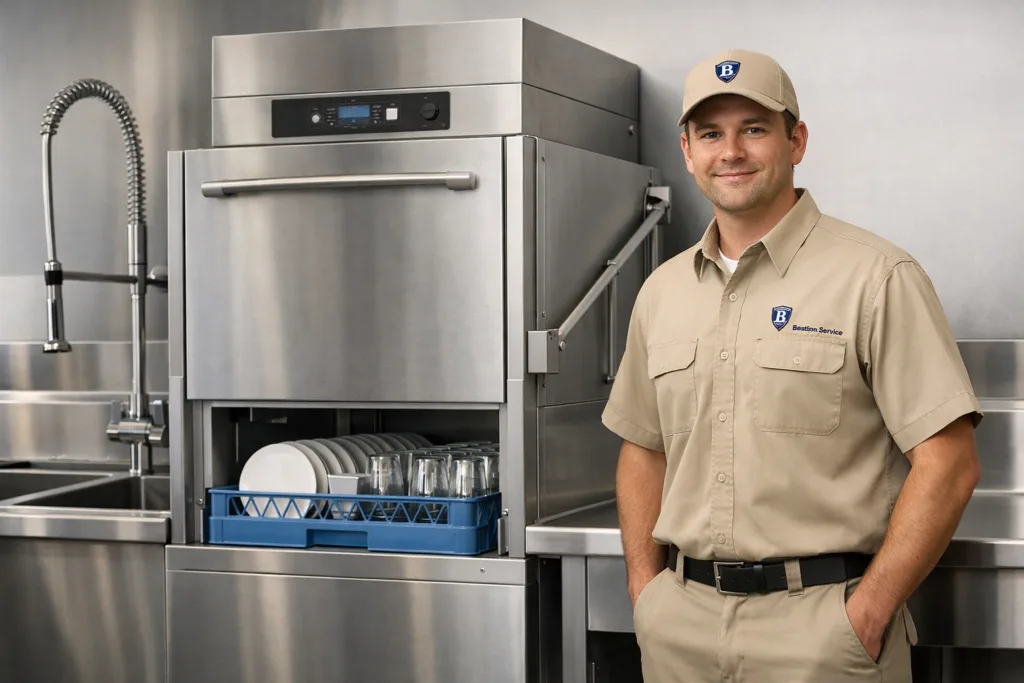




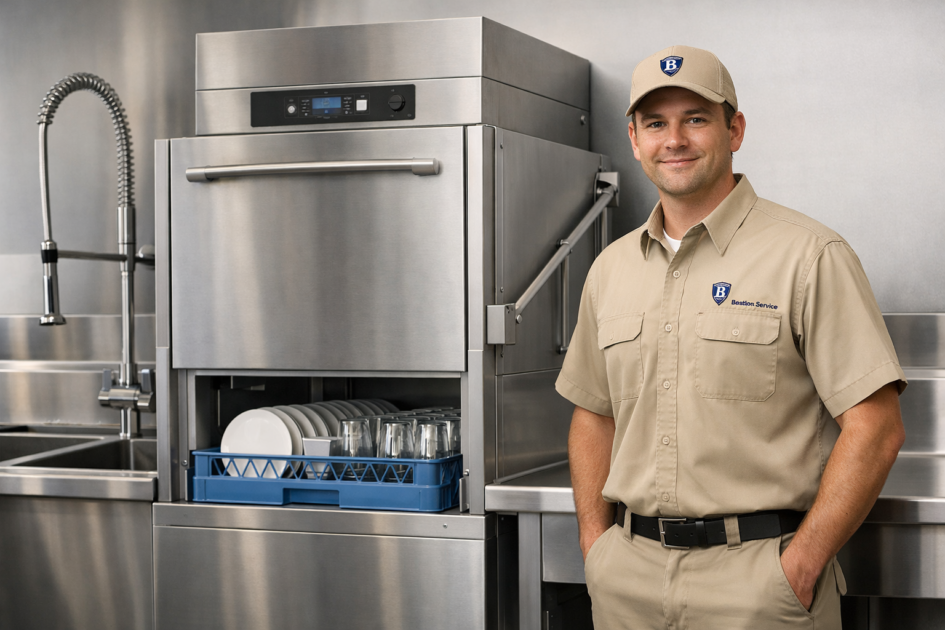
Dishwasher problems can slow service quickly when racks are backing up, items are not coming out clean, or the machine will not finish a full cycle. For businesses in Beverly Hills, the best next step is to schedule service based on the exact symptom pattern, the urgency of the downtime, and whether the unit is still safe to operate. Bastion Service handles Hobart dishwasher repair with an emphasis on finding the actual fault, identifying any related wear, and helping managers decide what needs attention now to restore steady operation.
Related commercial service paths in Beverly Hills include Hobart Commercial Repair in Beverly Hills and Commercial Dishwasher Repair in Beverly Hills.
Service focused on the way the dishwasher is failing
A Hobart dishwasher may show one visible issue while the real cause sits elsewhere in the system. Dirty results can begin with weak wash pressure, poor draining may trace back to a blocked line or pump problem, and low rinse temperature can come from a heating, sensor, or control issue rather than a simple reset. Looking at the machine as a whole helps avoid part swapping based only on guesswork.
For Beverly Hills businesses, repair decisions are usually tied to workflow. If the machine is still running but falling behind, the priority may be to stop a partial failure from turning into a shutdown. If the unit is leaking, not heating, or stopping mid-cycle, the priority is often immediate inspection and a repair plan that addresses both the main fault and any risk to nearby components.
Common Hobart dishwasher symptoms and what they often indicate
Poor wash results or residue left on wares
When dishes, glasses, or utensils come out with soil, film, or inconsistent results, the problem may involve clogged wash arms, blocked filters, scale buildup, pump wear, reduced circulation pressure, or incomplete chemical and rinse action. Some machines continue to run through full cycles even while wash quality is steadily dropping, which can make the issue look smaller than it is.
If the problem appears only during busy periods, that can point to a performance issue under load rather than a complete mechanical failure. That kind of pattern matters during diagnosis because it can change which systems need to be checked first.
Slow draining or standing water after the cycle
Water left in the tank or chamber often points to a drain restriction, pump problem, sensor issue, or a control fault that interrupts the drain sequence. In food-service settings, poor drainage can create sanitation concerns and can also lead to odors, debris buildup, and added strain on internal components.
A drain issue should be addressed early, especially if the machine is also showing longer cycle times, unusual sounds, or intermittent stop-and-start behavior. Those combined symptoms often suggest that the problem is affecting more than one part of the wash process.
Low rinse temperature or no heat
When a Hobart dishwasher is not reaching the needed temperature, businesses may notice wet wares, weaker sanitizing performance, incomplete cycles, or a machine that seems to run without delivering proper final results. Possible causes include failed heating elements, thermostat or sensor problems, contactor issues, wiring faults, or control-related failures.
Heat problems deserve prompt attention because they affect both output and consistency. If staff are rerunning racks or waiting longer between loads, the dishwasher is already affecting labor and service pace even before it stops completely.
Leaks, overflow, or water on the floor
Leaks can come from worn door gaskets, hose damage, loose fittings, drain problems, overfilling conditions, or fill valve issues. A small leak can become a larger repair if moisture reaches electrical areas or if corrosion develops around fittings and metal surfaces.
Overflow conditions are especially important to inspect quickly because the visible water may be only one part of the issue. In some cases, the machine is not regulating fill correctly; in others, a drain restriction is causing water to back up and escape where it should not.
Cycle failures, error codes, or failure to start
If the machine powers on but will not begin, pauses mid-cycle, or repeatedly throws error conditions, the fault may involve door switches, timers, controls, sensors, supply issues, or internal electrical components. Intermittent failures are often early warnings of a larger breakdown, especially when staff have to restart the machine multiple times to finish a normal workload.
These problems should be documented before service if possible. Knowing whether the issue happens at fill, wash, drain, or rinse can shorten the path to an accurate repair.
Why early repair can limit downtime
Many dishwasher failures begin as reduced performance rather than a full stop. A machine that is slower to drain, slightly cooler than normal, louder during operation, or less consistent in wash results is often showing signs of a developing problem. Scheduling service at that stage can help prevent added damage to pumps, heaters, controls, seals, and connected parts.
Continuing to run the unit when it is leaking, tripping power, not reaching temperature, or failing to drain can turn one repair into several. For businesses in Beverly Hills, that usually means more disruption, more staff workarounds, and more pressure on the rest of the kitchen or dish area.
When repair makes sense and when a larger decision may be needed
In many cases, a targeted repair is the right move when the fault is isolated and the rest of the machine is in solid condition. If the dishwasher has been dependable overall and the failure is limited to a specific heating, drain, pump, or control issue, repair often restores usable performance without a broader equipment change.
A bigger decision may be needed when the unit has repeated breakdowns, multiple worn systems, major structural deterioration, or a history of unresolved performance problems. The real question is not only whether the current issue can be fixed, but whether that repair is likely to stabilize the machine or simply postpone another outage.
How to prepare for a Hobart dishwasher service call
A few details can make diagnosis faster and more useful:
- Note whether the problem affects washing, draining, heating, filling, or cycle completion.
- Record any error messages or repeated cycle behavior.
- Identify whether the issue is constant or happens only at certain times of day.
- Check whether leaks appear during fill, wash, drain, or after the machine sits idle.
- Let the technician know if staff have noticed unusual sounds, odors, or longer run times.
These observations help connect the symptom to the system most likely involved, which can make the repair decision more efficient and reduce unnecessary delay.
What businesses in Beverly Hills should expect from dishwasher repair service
A useful service visit should do more than name a failed part. It should show what caused the interruption, whether the machine can be used safely before repair, what component or system has failed, and whether there are related wear issues likely to affect short-term reliability. That gives business owners, kitchen managers, and facility teams a clearer basis for scheduling repair and planning around downtime.
If your Hobart dishwasher is not washing properly, not draining, not reaching temperature, leaking, or failing to complete cycles, timely service can help restore workflow before the problem spreads into a larger operational setback. For businesses in Beverly Hills, the most practical next step is to have the machine inspected based on its current symptoms so the repair can be scheduled around urgency, condition, and the demands of daily operation.


