
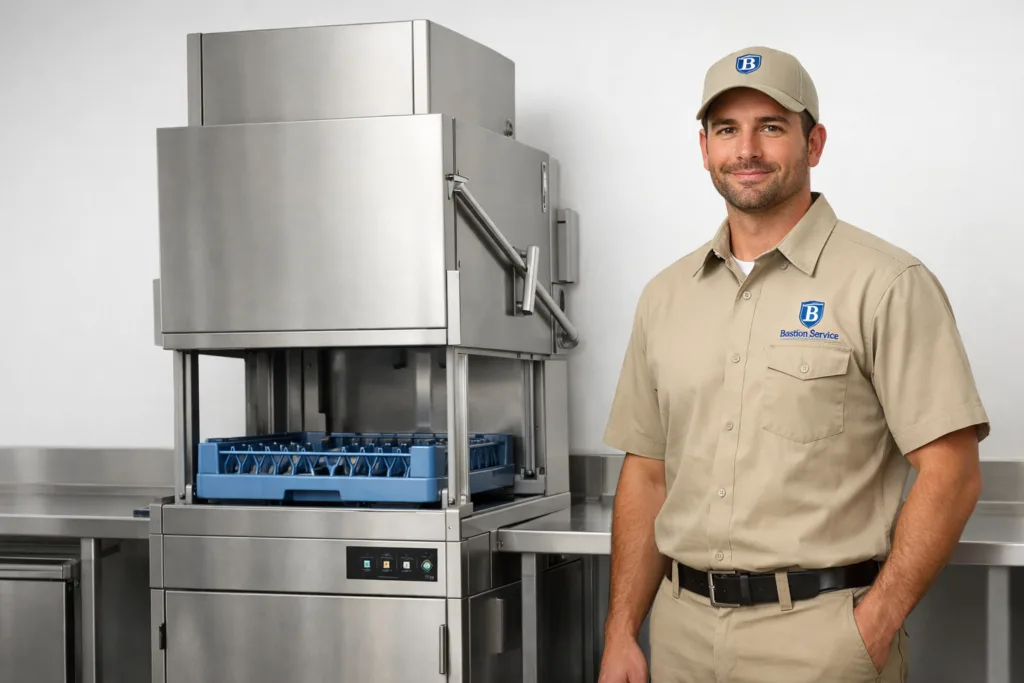




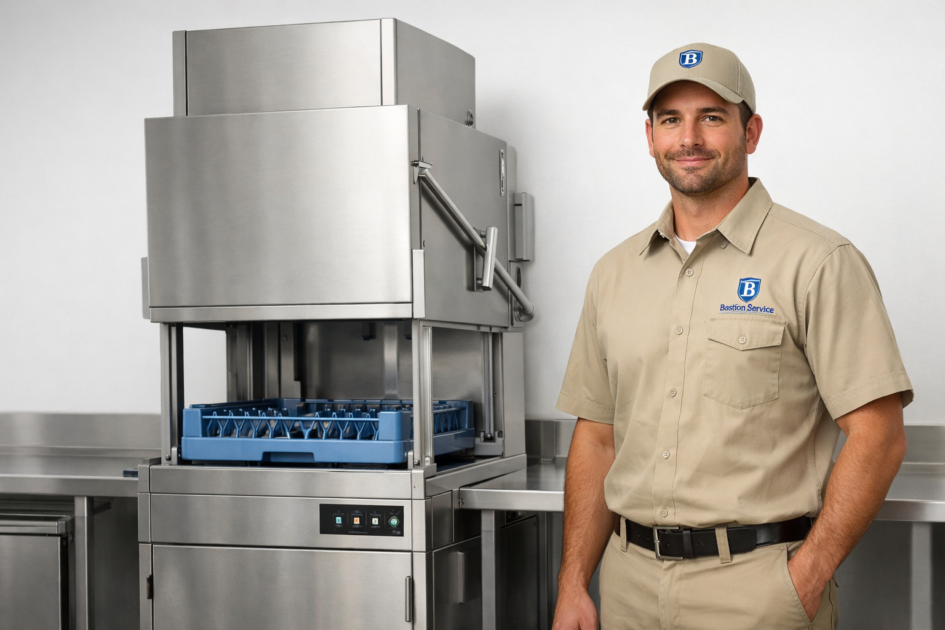
When Hobart warewashing equipment starts missing cycles, washing poorly, leaking, or shutting down during service, the effect on a Beverly Hills operation is immediate. Dish flow slows down, staff begin rerunning racks, and sanitation concerns move from a maintenance issue to an operations issue. In most cases, the next step should be a service visit focused on the actual fault pattern so repair decisions are based on what the machine is doing under load, not just on the most visible symptom.
For specific equipment paths in Beverly Hills, review Hobart Dishwasher Repair in Beverly Hills and Commercial Appliance Repair in Beverly Hills.
For restaurants, hospitality kitchens, and other food-service businesses, warewashing problems are rarely isolated to one bad cycle. A machine that still turns on may still be failing to fill correctly, draining slowly, missing temperature targets, or losing wash pressure. Bastion Service helps businesses in Beverly Hills evaluate Hobart dishwasher problems, confirm what system is failing, and schedule repair based on urgency, downtime risk, and overall equipment condition.
What Hobart warewashing equipment problems usually point to
Poor wash results, residue, or spotting
If racks come out with food particles, film, streaking, or inconsistent cleaning, the cause is not always the same. Low wash pressure, clogged spray components, scale buildup, water distribution problems, rinse issues, and temperature faults can all produce similar results. A machine may appear to be running normally while still falling short where it matters most: wash quality and repeatable results during busy service periods.
When poor performance continues across multiple loads, it often means the issue is no longer procedural. If staff are scraping more, rewashing more, or sorting problem racks by hand, the machine should be evaluated before that extra labor becomes part of the daily routine.
Fill problems, slow fill, or no fill
A Hobart unit that fills too slowly, fails to fill, or starts a cycle and then pauses may be dealing with inlet valve problems, water supply restrictions, level sensing issues, float-related faults, or control interruptions. In some cases the machine fills partially and then stops, creating inconsistent cycle performance that is easy to mistake for operator error.
Fill-related faults matter because they affect the entire cycle. Water level influences wash action, heating performance, and the machine’s ability to complete a sequence without stalling. If the machine needs repeated restarts, that usually signals a repair issue rather than a one-time disruption.
Drain issues and standing water
Water left in the machine after a cycle can indicate a blocked drain path, drain pump trouble, valve problems, or a control issue preventing proper draining. Standing water is more than an inconvenience. It can lead to interrupted cycles, odor concerns, poor rinse results, and extra wear on components that are trying to move water through a restricted system.
Repeated drainage problems can also mask other faults. If a unit is not clearing water correctly, it may be harder to judge whether wash performance problems are caused by chemistry, temperature, or incomplete drainage carrying one cycle’s issues into the next.
Leaks around the machine or under the unit
Leaks may come from door seals, hoses, fittings, pump seals, internal water path failures, or components that only begin leaking once the machine reaches a certain stage in the cycle. Some leaks are obvious and constant. Others show up only during fill, wash circulation, final rinse, or drain.
Even a small leak should be addressed quickly in a working kitchen. Water on the floor creates safety concerns, and hidden leakage can lead to corrosion, electrical damage, and failure of nearby components. A machine that leaks while still completing cycles can give the impression that it is still usable, but continued operation often increases the final repair scope.
Rinse temperature and sanitation concerns
If the machine is not reaching proper wash or rinse temperature, the problem may involve heating elements, boosters, thermostats, contactors, relays, safety limits, sensors, or the control system managing heat demand. Temperature-related issues are especially important because the machine may continue operating while still failing to deliver the conditions needed for reliable cleaning and sanitizing performance.
Common warning signs include extended cycle times, inconsistent results between racks, no noticeable heat during operation, or staff noticing that dishes are not drying or finishing as expected. When those signs appear, the repair decision should be made quickly rather than after a complete shutdown.
Control faults, shutdowns, and interrupted cycles
If a Hobart dishwasher stops mid-cycle, flashes faults, resets unexpectedly, or becomes unresponsive at certain points in operation, the issue may involve wiring, switches, relays, sensors, boards, or safety devices reacting to another mechanical problem. Control issues are often misunderstood because they can look random in day-to-day use.
What seems like an occasional shutdown may actually be a repeatable failure tied to fill time, drain timing, heat demand, or motor load. Tracking when the interruption happens helps determine whether the fault begins in the controls or whether the controls are responding correctly to another system problem.
Symptoms that usually mean service should be scheduled soon
Business operators should move repair higher on the priority list when warewashing equipment shows signs such as:
- cycles stopping before completion
- poor wash results despite normal loading and operating procedures
- slow or incomplete filling
- standing water after the cycle
- visible leaking
- unusual grinding, humming, or vibration
- temperature inconsistency
- repeated resets needed to keep the machine running
These symptoms often start as intermittent disruptions before becoming a full outage. Addressing them during the warning stage can prevent secondary damage to pumps, heaters, seals, electrical components, and water-handling parts.
Why the same symptom can lead to different repairs
Warewashing equipment problems are often symptom clusters rather than single failures. For example, poor cleaning may be caused by weak circulation, but it may also stem from low water level, a heating issue, or a drain problem affecting the next cycle. A leak could be a worn gasket, but it could also come from a pump seal or a cracked internal component that only leaks under pressure.
That is why symptom-based evaluation matters. The useful outcome of a service visit is not simply hearing that the dishwasher is malfunctioning. It is identifying which system is at fault, whether other components have been affected, and whether the machine can be repaired without exposing the business to repeated downtime.
Repair versus replacement for older warewashing equipment
Not every older Hobart unit is nearing the end of its useful life, and not every repair is automatically the right investment. The decision usually comes down to the confirmed failure, overall machine condition, service history, parts availability, and how heavily the equipment is used each day.
Repair often makes sense when the issue is concentrated in one system and the rest of the machine remains structurally sound. Replacement becomes a stronger consideration when there are overlapping failures, recurring shutdowns, heavy wear across multiple assemblies, or repair cost approaching the value of continued operation. A proper diagnosis helps separate a repairable operating problem from a machine that is becoming difficult to justify.
What businesses should expect from a service-oriented repair visit
A productive repair visit should clarify what failed, what symptoms are related to that failure, whether continued operation risks added damage, and what the likely downtime window looks like. For kitchens trying to protect service flow, that information matters as much as the actual parts replacement. The goal is to restore stable warewashing performance without guessing at causes or authorizing broad repairs that do not address the core problem.
If your Hobart warewashing equipment is affecting dish flow, wash quality, drain performance, temperature consistency, or daily reliability in Beverly Hills, scheduling service is the practical next step. A symptom-based diagnosis can show whether the issue is limited, escalating, or affecting multiple systems so repair can be planned around urgency and the demands of your operation.


