
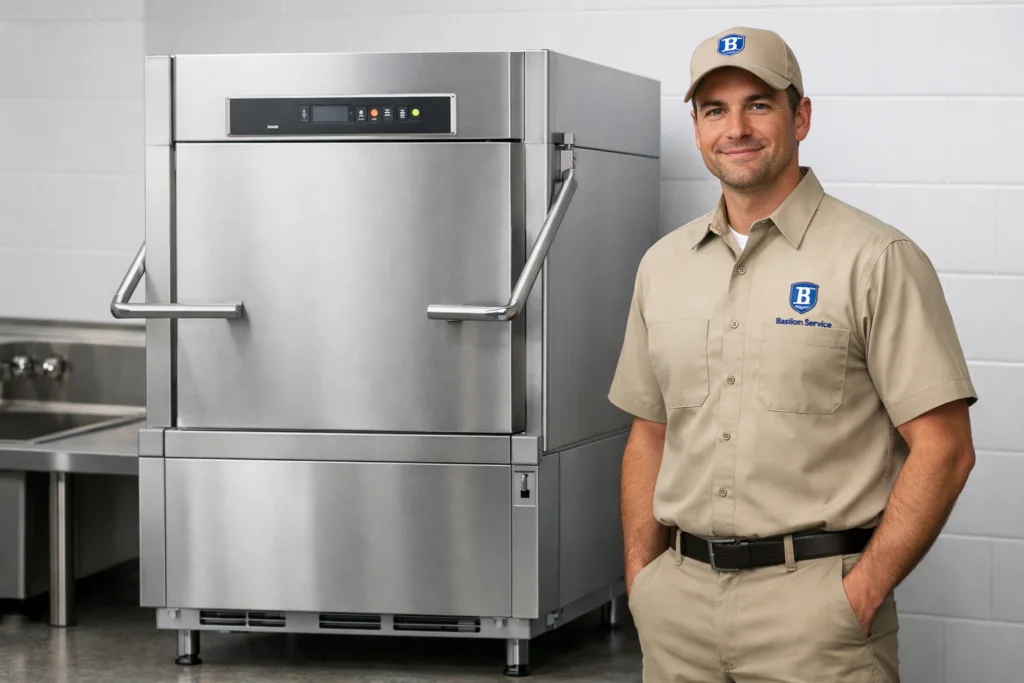




Warewashing equipment problems can disrupt service faster than many operators expect. When a Hobart unit starts missing wash results, leaving water behind, leaking, or failing to complete cycles, the priority is to identify the actual fault before downtime spreads into prep, service flow, and sanitation routines. Bastion Service provides repair support for businesses in Venice that need on-site troubleshooting, repair scheduling, and a realistic path back to stable operation.
For specific equipment paths in Venice, review Hobart Dishwasher Repair in Venice and Commercial Appliance Repair in Venice.
What Hobart warewashing equipment problems usually need repair?
Most service calls start with a symptom that affects daily output rather than a confirmed part failure. Warewashing equipment may still power on and run, but that does not mean it is operating correctly. A machine that is underheating, washing poorly, draining slowly, or shutting down mid-cycle can create inconsistent results long before it stops completely.
Common repair-related symptoms include:
- Poor wash performance or residue left on wares
- Fill problems or low water entering the machine
- Slow draining or standing water after a cycle
- Water leaks around the door, underneath, or near hoses and fittings
- Rinse temperature concerns or weak final rinse performance
- Sanitation complaints tied to cycle quality or heat performance
- Control faults, error conditions, or interrupted cycles
- Unexpected shutdowns, failure to start, or erratic operation
Several different faults can produce similar symptoms, which is why repair decisions are more reliable after the unit is checked under real operating conditions. A wash problem may come from circulation issues, temperature loss, chemical coordination, blocked components, sensor failure, or control trouble. A drain complaint may involve a restriction, a pump issue, or a problem in how the machine is advancing through the cycle.
Wash performance problems that affect output
Items are not coming out clean
If dishes, utensils, or racks are coming out with residue, spotting, or inconsistent cleaning, the issue is often broader than one visible symptom. Spray action, pump performance, water flow, timing, and temperature all affect results. In a busy kitchen, staff may try to compensate by rerunning loads, changing rack handling, or washing items by hand, but those workarounds usually increase labor while the underlying fault gets worse.
Service is worth scheduling when poor results are happening repeatedly, especially if the problem is affecting more than one shift or appears to be getting less predictable. Intermittent cleaning performance often signals a mechanical or control issue that needs inspection before it turns into a complete stoppage.
Cycle results vary from load to load
Inconsistent performance can be harder to manage than an obvious failure. One cycle may appear normal while the next leaves debris, excess moisture, or weak rinse coverage. This pattern can point to control issues, heat instability, circulation problems, or components that are starting to fail under load. For businesses in Venice, that uncertainty can be just as disruptive as a shutdown because staff cannot trust the machine to produce repeatable results.
Fill and drain issues
Machine is not filling correctly
When warewashing equipment does not fill as expected, the cycle may stall, run with poor wash action, or trigger errors. Low fill, delayed fill, or no fill at all can come from valve problems, sensor issues, restrictions, electrical faults, or control-related interruptions. Operators usually notice this when the machine sounds different than normal, seems slow to start, or completes a cycle without the water level needed for proper washing.
This type of symptom should be checked promptly because continued use can lead to poor cleaning, repeated cycle failures, and confusion about whether the machine is safe to keep running through service hours.
Water is not draining out properly
Standing water at the end of a cycle is a common reason to book repair. Slow draining can cause odor issues, repeated restarts, poor wash results, and extra cleanup for staff. It may be related to an obstruction, drain pump trouble, internal buildup, or a control problem that prevents the machine from completing the drain stage correctly.
If employees are manually clearing water or restarting cycles to finish a shift, the machine is already affecting labor and throughput. That is usually the point when repair moves from optional to necessary.
Leaks and water-management problems
Water is leaking onto the floor
A leak should be treated as a priority because it affects both safety and nearby equipment. Door gaskets, pumps, fittings, hoses, internal seals, and water-routing components can all be involved. Some leaks are steady, while others only show up during fill, wash, or drain portions of the cycle. That pattern matters because it helps narrow down where the problem is developing.
Even a small leak can become a bigger repair if the machine stays in use too long. Floor exposure, slipping hazards, and moisture around electrical components are all reasons to have the unit evaluated before normal operation continues.
Water appears where it should not during operation
Not every leak shows up as a puddle under the machine. Operators may notice splashing, door-edge seepage, moisture near panels, or water escaping during specific stages of operation. Those signs often point to worn sealing surfaces, pressure-related problems, spray issues, or misdirected water flow. Because the visible symptom is not always the source of the failure, on-site diagnosis helps determine whether the repair is relatively contained or part of a larger performance problem.
Rinse temperature and sanitation concerns
Final rinse does not seem hot enough
Rinse temperature concerns should not be brushed off as a minor inconvenience. If the machine is not reaching or maintaining expected heat conditions, wash results and sanitation confidence both suffer. Heating elements, thermostats, sensors, controls, boosters, and related electrical components can all affect temperature performance.
Operators often notice this when wares come out cooler than expected, drying changes noticeably, or the machine starts producing inconsistent end-of-cycle results. Because heat-related faults can overlap with other symptoms, diagnosis helps determine whether the issue is isolated to temperature generation, control logic, sensing, or water delivery.
Sanitation complaints keep coming back
If the same machine is generating repeated sanitation concerns, the problem may involve more than one system working poorly at the same time. Weak rinse action, incorrect temperatures, incomplete draining, poor circulation, and interrupted cycles can all reduce confidence in the final result. Repeated complaints are a sign that the equipment should be inspected rather than adjusted casually between shifts.
Control faults and intermittent shutdowns
Machine stops mid-cycle or will not start
Cycle interruption is one of the most disruptive warewashing problems because it creates immediate uncertainty. A machine that powers on but does not start, shuts down partway through a wash, or freezes during a specific stage may have a latch issue, switch failure, sensor problem, control fault, or electrical supply problem within the unit.
Intermittent failures are especially difficult for staff because the machine may restart once and then fail again when demand increases. That pattern usually indicates a problem that needs service rather than observation.
Controls behave erratically
Buttons that do not respond properly, cycles that do not advance correctly, recurring fault indications, and inconsistent startup behavior often point to control-related repair needs. In some cases, the machine appears operational but cannot be trusted to complete a full cycle correctly. When controls become unreliable, downtime planning matters because the equipment may shift from occasional errors to complete non-operation with little warning.
Noise, vibration, and mechanical warning signs
Grinding, humming, rattling, or unusual vibration often signals wear in moving components, pump trouble, motor strain, or an internal obstruction. These sounds may be most noticeable during fill, wash circulation, or drain stages. A machine that has become louder than normal should not be ignored just because it still runs.
Mechanical warning signs are useful because they often show up before a larger failure. Addressing them early may help avoid a more disruptive outage during active service periods.
When to schedule repair instead of waiting
Scheduling service early is usually the better decision when the machine still operates but is showing repeat symptoms. Waiting tends to increase labor workarounds, reduce confidence in wash results, and raise the chance of a complete shutdown at the worst time. Businesses in Venice often book repair when staff have started monitoring the machine constantly, rerunning loads, managing water on the floor, or planning around an unreliable cycle.
More urgent scheduling makes sense when the unit is leaking, failing to drain, underheating, stopping mid-cycle, or showing control faults that prevent dependable operation. In those cases, the question is not just what part failed, but whether the machine should remain in use at all until repairs are completed.
Repair versus replacement decisions
Many Hobart warewashing equipment problems are repairable once the failed component or system is confirmed. Replacement is usually considered when breakdowns are stacking up, reliability has dropped for an extended period, or the cost of keeping the machine in service is no longer justified by the results. The most useful comparison comes after diagnosis, when the likely repair scope, downtime impact, and near-term operating risk are clearer.
For many operators, the real business question is whether a repair restores predictable performance without creating ongoing disruption. That decision is easier when the symptom pattern has been evaluated on site instead of guessed at from one visible problem.
Service planning for Venice businesses
Warewashing problems affect more than one appliance cycle. They can slow kitchen turnover, create extra handling, increase labor pressure, and complicate sanitation routines across the day. A repair visit helps translate symptoms into next steps: identify the fault, determine whether limited operation is reasonable, and schedule the work needed to restore reliable performance.
If your Hobart warewashing equipment in Venice is cleaning poorly, failing to fill or drain, leaking, showing rinse temperature issues, or acting unpredictably at the controls, the next step is to schedule service so the problem can be diagnosed and repaired before downtime expands.


